
Pool Cleaning Supplies & Equipment | Discount Pool Mart
Five tools cover almost all routine pool cleaning. You need an automatic pool cleaner (robotic, suction-side, or pressure-side) or a manual vacuum head with a hose, plus a telescopic pole, a skimmer net or leaf rake, a pool brush that matches your surface, and clean skimmer baskets. Discount Pool Mart keeps 10,000+ cleaning SKUs in stock, with same-day pickup across LA.
Say it's a Saturday morning in Encino after a windy night. The water looks like weak tea, leaves cover the steps, and dust coats the floor. Plenty of owners start looking for a pool cleaning service at this point, and that's a fair choice. This page covers the other route: a do-it-yourself toolkit picked for your pool.
What You Need for Pool Cleaning: The Starter Toolkit
We suggest this minimum kit to every new pool owner who walks into one of our stores:
- Telescopic pole
- Skimmer net or leaf rake
- Pool brush with bristles that suit your surface
- Vacuum head and vacuum hose, or an automatic pool cleaner
- Spare skimmer basket
Each tool has a job in a different part of the pool:
| Pool zone | Tool that handles it |
|---|---|
| Water surface | Skimmer net or leaf rake |
| Waterline and tile | Tile brush |
| Walls and steps | Pool brush |
| Floor | Vacuum head or automatic cleaner |
| Skimmer opening | Skimmer basket |
Daily and Weekly Jobs, Tool by Tool
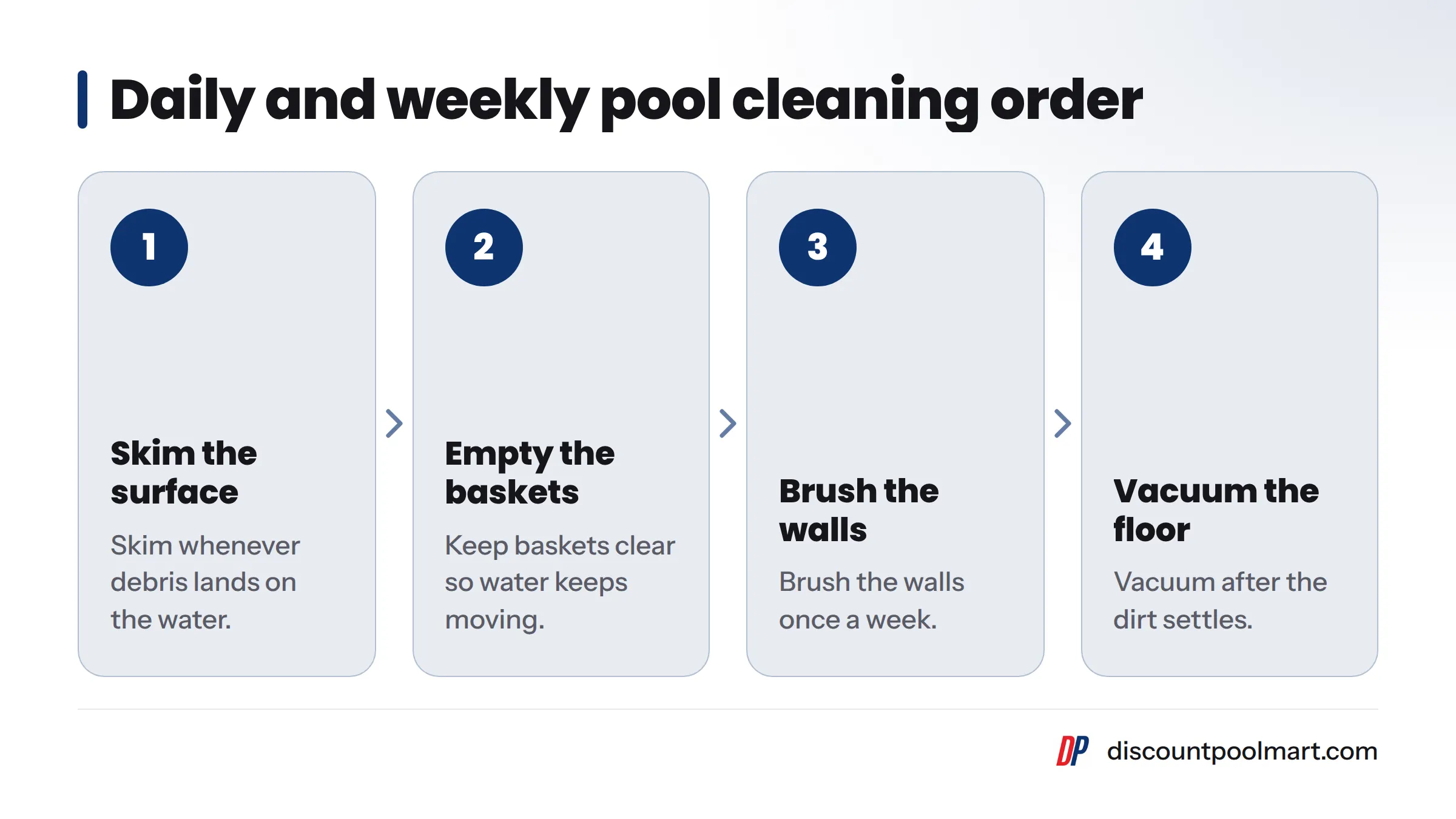
Skim whenever debris lands on the water, and empty the baskets so water keeps moving. Brush the walls once a week. Then vacuum the floor after the dirt settles. Our five-step weekly routine lays out the full order.
Why Pool Cleaning Filters Need Attention Too
Every tool on this list pushes dirt toward your filter. A clogged filter cuts suction, so your pool vacuum and any suction cleaner pick up less. Here's how to clean a pool filter, with steps for sand, cartridge, and DE filters. Keeping your pool cleaning filters clear is the easiest way to get full performance from everything else you own.
Automatic Pool Cleaners: Robotic, Suction, and Pressure
The Wikipedia entry on automated pool cleaners groups these machines into three families: suction-side, pressure-side, and robotic. Let's break them down.
Robotic Pool Cleaners, Corded and Cordless
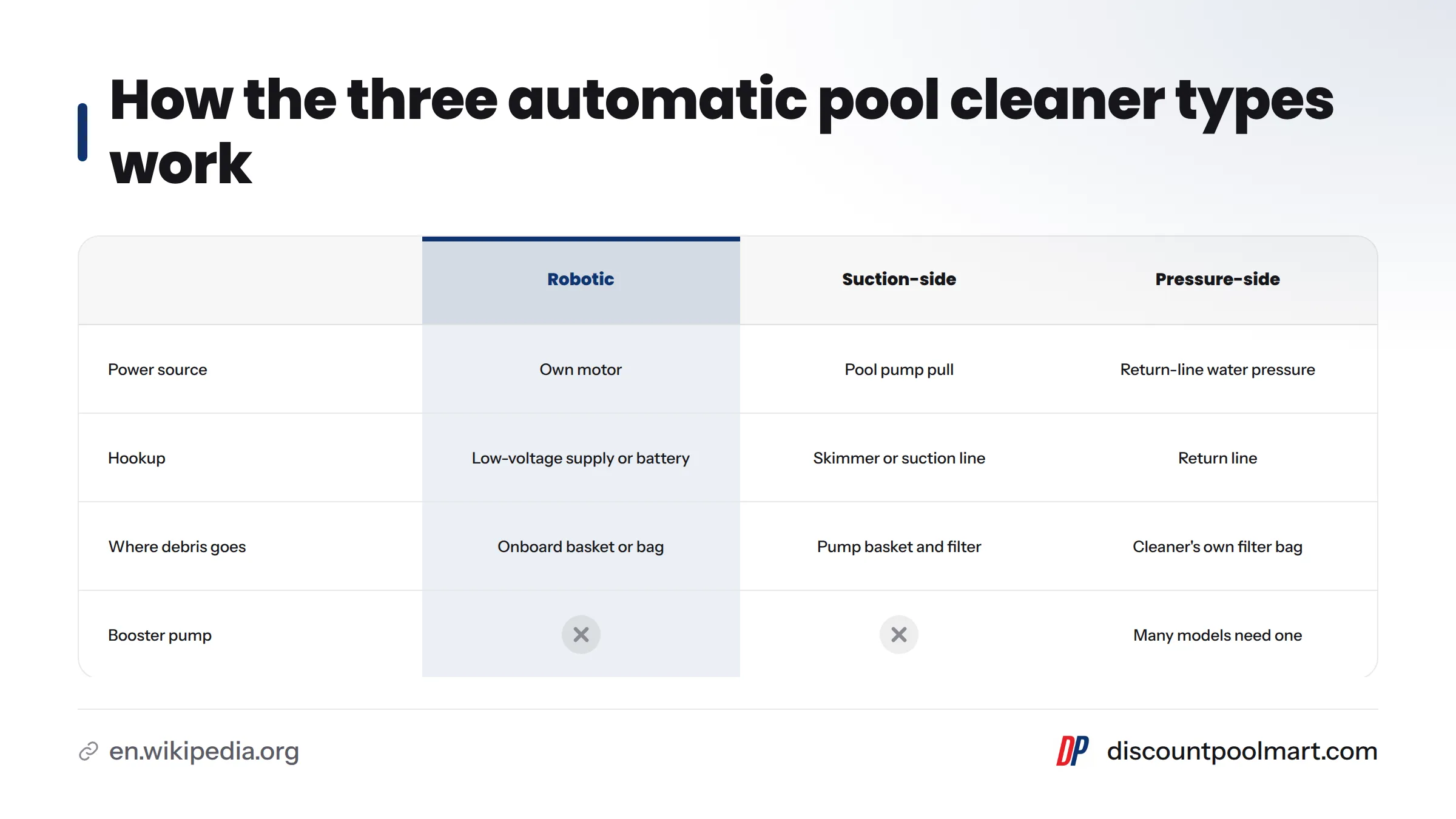
A pool cleaning robot has its own motor and an onboard filter basket or bag, so it runs independently of your pool pump. Corded models draw power from a low-voltage supply that sits on the deck. A cordless pool cleaning robot runs on a battery instead. You get no cable to tangle, but you have to recharge it between runs. If you're weighing a pool cleaning robot, cordless or corded, that tradeoff is the main one to think about. Our upcoming best robotic pool cleaner buying guide will compare specific models.
Suction-Side Pool Cleaners
A suction-side cleaner hooks into your skimmer or a dedicated suction line and moves on the pull of your pool pump. Debris ends up in the pump basket and filter, or in an inline leaf canister if you add one.
Pressure-Side Pool Cleaners
A pressure-side cleaner runs on water pushed through a return line, and many models need a dedicated booster pump. It traps debris in its own filter bag before anything reaches your filter. For background on booster pumps, see our guide to pumps, filters, and heaters.
Robotic vs. Suction vs. Pressure Pool Cleaners at a Glance
| Feature | Robotic | Suction-side | Pressure-side |
|---|---|---|---|
| Power source | Own motor (corded or battery) | Pool pump suction | Return-line pressure |
| Where debris goes | Onboard basket or bag | Pump basket, filter, or leaf canister | Cleaner's own filter bag |
| Uses pool filtration? | No | Yes | Partly (water only) |
| Booster pump needed? | No | No | Often |
| Best for | Fine dust and silt | Light to moderate debris | Leaves and larger debris |
| Setup | Drop in, plug in or charge | Connect hose to skimmer | Connect to return line |
Which cleaner fits my pool?
- Mostly fine dust, and you want less strain on the filter: robotic.
- You already own a booster pump and deal with heavy leaf drop: pressure-side.
- You want an easy hookup to the pump you already have: suction-side, plus a leaf canister.
- Small pool, or you like hands-on control: manual vacuum.
Want more detail? Compare robotic, suction, and pressure cleaners side by side.
Manual Pool Vacuums and Vacuum Heads
I'll be honest: even if you own a robot, keep a manual pool vacuum. It's the tool you grab after a storm, and it reaches the corners that automatic units miss.
Vacuum Head Types
- Weighted flexible heads bend to follow the curves of plaster and pebble floors.
- Brush-bottom or soft-wheeled heads treat vinyl and fiberglass more gently.
- Triangular heads get into corners and along step edges.
Getting the Vacuum Hose Length Right
Measure from the skimmer to the farthest point of the pool and add a little slack. A hose that's too short lifts the head off the floor. One that's far too long just tangles.
Telescopic Pool Cleaning Poles
Pick a telescopic pool cleaning pole that reaches the deep-end floor at a comfortable angle and gets to the middle of the pool from the deck. Our guide on how to vacuum a pool step by step walks through setup and priming.
Pool Skimmer Nets, Leaf Rakes, and Other Surface Tools
Flat Skimmer Nets vs. Deep-Bag Leaf Rakes
A flat pool skimmer net is the right tool for quick daily passes over bugs and floating leaves. A deep-bag leaf rake holds a much bigger load and can also scoop sunken leaves off the floor. Come fall, most Valley owners end up needing both.
When to Replace a Skimmer Basket
Swap out a skimmer basket once it's cracked, warped, or missing its handle. A damaged basket lets debris slip through to the pump basket. Keep a spare on hand so you're never stuck without one.
Valley leaf and ash season tip: After a Santa Ana wind or a nearby fire, skim before you vacuum so heavy debris doesn't clog the line. Read our guide to cleaning up wildfire ash before you start.
Brushes for Walls, Tile, and the Waterline
Nylon vs. Stainless Steel Bristles
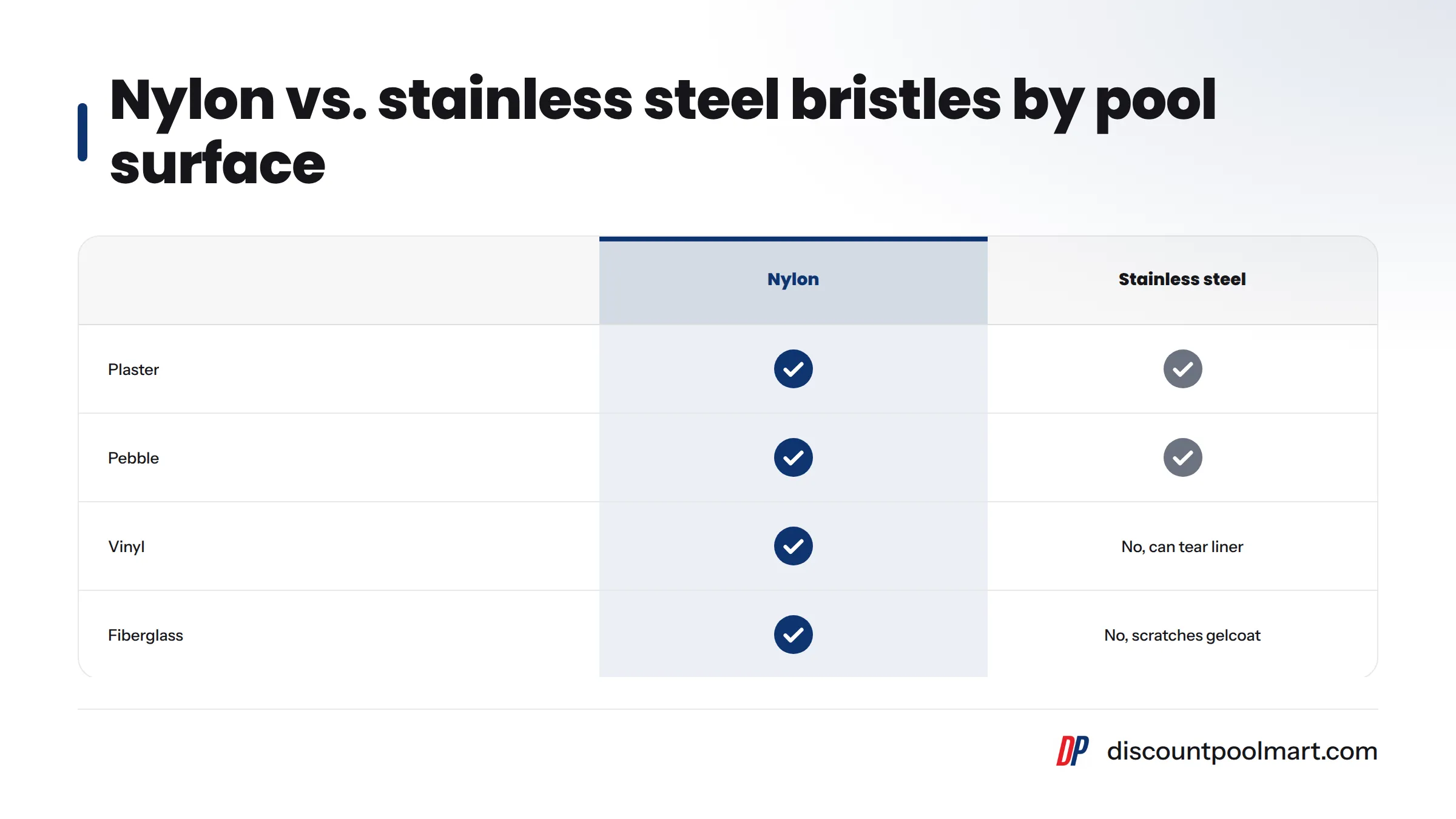
Nylon bristles are safe on every surface. Stainless steel bristles belong on plaster and pebble only. Keep them off vinyl and fiberglass, because they can tear a liner and scratch gelcoat.
Tile and Waterline Brushes
Tile brushes and pumice-style tools scrub scale and grime off the waterline. Use pumice only on surfaces that can take it, such as plaster and suitable tile, and never on vinyl or fiberglass.
When Buildup Is a Stain
A mark that won't budge after firm brushing is probably a stain, not dirt. Our pool stain removal guide shows how to identify each type. Green patches that keep coming back usually point to a water problem, so start with pool algae treatment.
Matching Pool Cleaning Equipment to Your Surface and Size in the San Fernando Valley
| Surface | Brush bristles | Vacuum head | Cleaner considerations |
|---|---|---|---|
| Plaster | Nylon or stainless steel | Weighted flexible | Any type works |
| Pebble | Stainless steel or heavy-duty nylon | Weighted flexible | Choose models rated for rough finishes |
| Vinyl | Nylon only | Brush-bottom | Choose models rated for vinyl |
| Fiberglass | Nylon only | Brush-bottom or soft-wheeled | Choose models rated for fiberglass |
Small Pools and Spools vs. Large Backyard Pools
Spools and small pools get by with a shorter pole and hose, and a compact cleaner usually does the job. Large backyard pools call for a longer pole, a hose that reaches the far end, and a cleaner with a bigger debris bag or canister. Above-ground owners can follow our above ground pool maintenance checklist.
What our Valley store staff recommend: The plaster and pebble pools our staff see most often sit under sycamores, oaks, and fruit trees. For those, we pair a deep-bag leaf rake with a stainless steel brush and a weighted vacuum head. Owners with heavy leaf drop usually do best with a pressure-side or robotic cleaner.
Shop In-Stock Pool Cleaning Supplies with Same-Day LA Pickup
Here is why we stock so deep. I've watched too many owners wait days for a shipped brush while their water turns cloudy. So we keep more than 10,000 cleaning SKUs on the shelves and offer same-day pickup across Los Angeles. Our staff will match each tool to your surface and pool size, so you buy the right pool cleaning supplies the first time.
Would you rather not do it yourself? Ask our team about equipment installation and repair.
Here's a quick look inside one of our stores:
Next steps: Shop pool cleaners, vacuum heads, and skimmers, then find a Discount Pool Mart store near you.
Pool Cleaning Equipment FAQ
What tools do I need to clean my pool myself?
A telescopic pole, a skimmer net or leaf rake, a pool brush, a vacuum head and hose (or an automatic cleaner), and a spare skimmer basket.
Is a robotic, suction, or pressure pool cleaner better for my pool?
Robotic cleaners handle fine dirt best. Pressure-side cleaners do the best job on leaves. Suction-side cleaners are the easiest to hook up.
Do cordless robotic pool cleaners work for in-ground pools?
Yes. Many are built for in-ground pools. Check that the model is rated for your surface and size.
What brush should I use on a vinyl or fiberglass pool?
Nylon bristles only. Stainless steel can damage both surfaces.
How long should my telescopic pole and vacuum hose be?
The pole should reach the deep-end floor and the middle of the pool. The hose should run from the skimmer to the farthest point, with a little slack.
Can I clean my pool myself instead of hiring a pool cleaning service?
Yes. The starter kit above handles routine cleaning. Water balance is a separate job, and our pool water chemistry supplies page covers it.
Sources
Related: pool vacuum heads, pool stain removal