
Best Robotic Pool Cleaners 2026 | Discount Pool Mart
Robotic cleaners for swimming pools are self-powered pool robots. They scrub the floor, walls, and waterline without using your pool pump at all. For most Los Angeles owners, a robot is the right call. If budget comes first, a suction-side pool cleaner is the cheaper route. If your yard drops a lot of leaves and you already own a booster pump, a pressure-side pool cleaner makes more sense. We ranked the models below against a fixed set of criteria, then checked those picks against what customers buy, and what they bring back, at our 8 LA stores.
Quick Answer: Which Pool Cleaner Type Fits Your Pool
Which type fits your pool?
- Robotic cleaner: Best for hands-off cleaning of the floor, walls, and waterline, and it catches fine dust too. The trade-off is a higher upfront cost plus a cord or battery to deal with.
- Suction-side cleaner: Best for tight budgets and pools where the pump runs on a steady schedule. The trade-off is that it loads your pool filter and only works while the pump is on.
- Pressure-side cleaner: Best for leafy yards that already have a booster pump. The trade-off is the extra energy that booster pump uses.
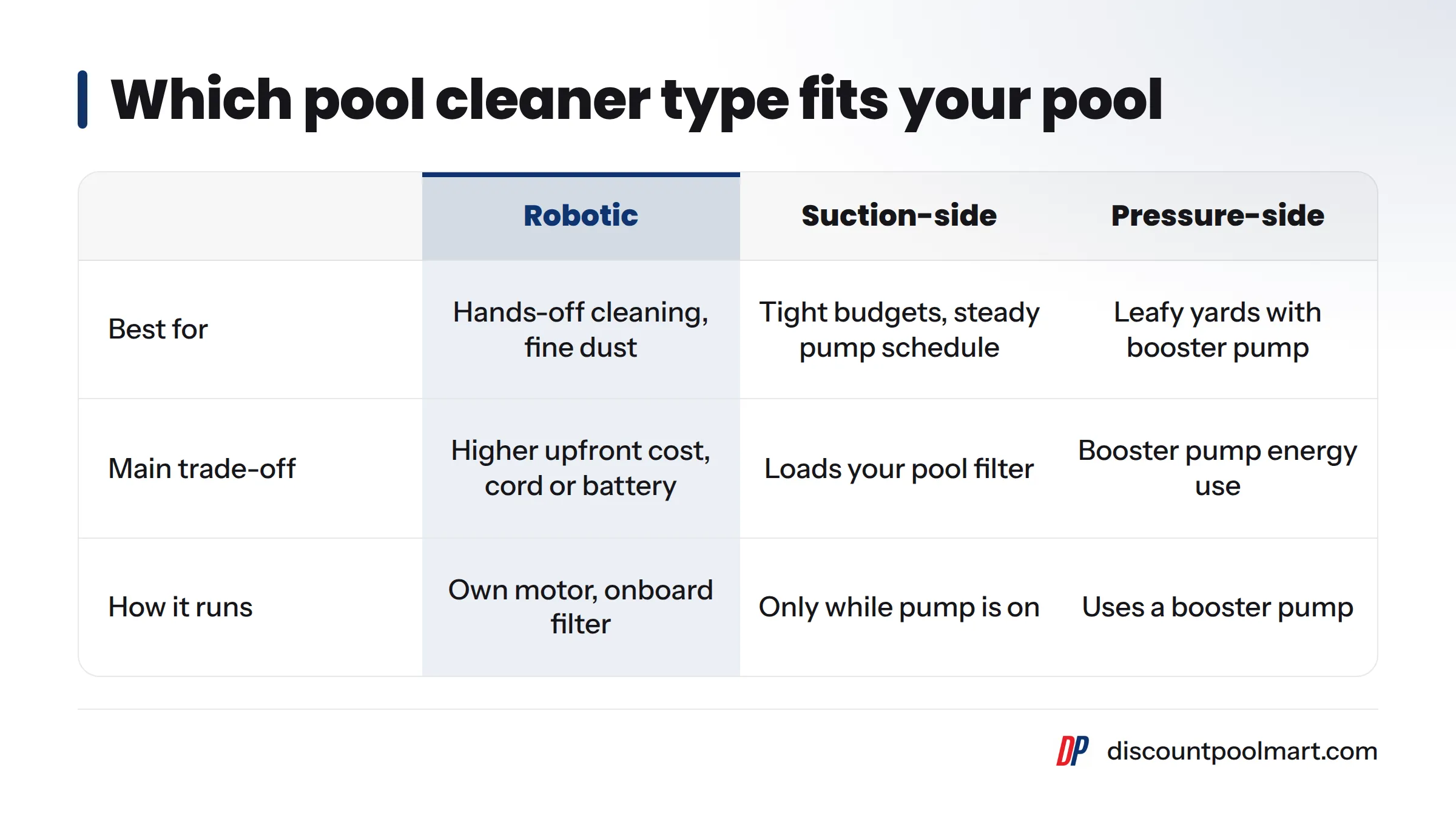
The short definition: robotic pool cleaners are self-contained units with their own motors and onboard filters. They vacuum and scrub without the pool pump running, and they trap debris before it ever reaches your filter.
One note before we start. This guide covers swimming pool cleaners only, so if you came here for floor-mopping robots, you're in the wrong aisle.
How We Ranked These Robotic Cleaners and Pool Cleaners
A cleaner that struggles in a Pasadena pool full of sycamore leaves might do just fine in a Torrance pool that mostly collects dust. That's why we held every pick to the same scorecard.
| Criterion | Why it matters | How we judged it |
|---|---|---|
| Counter demand at our stores | Shows which models LA owners actually choose | Qualitative trends across our 8 LA locations |
| Return and satisfaction feedback | Exposes mismatches before you buy | The most common reasons customers bring units back |
| Wall and waterline climbing | The scum ring at the waterline is the dirt people notice first | Whether the model is built to climb and scrub walls |
| Debris handling | Leaves and fine dust need different kinds of capture | Filter canister vs. debris bag, fine vs. coarse |
| Swivel cable and tangle resistance | Tangled cords cause more robot frustration than anything else | Whether the cord design resists twisting |
| Cycle time and scheduling | Lets the cleaning happen without you thinking about it | Programmable timers and app control |
| In-ground vs. above-ground fit | Not every robot suits every pool shell | Pool types the manufacturer lists |
| Surface compatibility | Plaster, pebble, vinyl, and fiberglass all grip differently | Brush roller type and manufacturer guidance |
| Manufacturer warranty | Covers the motor, which is the expensive part | Terms the maker publishes |
The order below is our own editorial ranking against those criteria, shaped by conversations at the counter in our Los Angeles stores. No brand paid for placement.
Robotic Pool Cleaner vs Suction Cleaner vs Pressure-Side: How Each One Works
Let's break it down. All three are automatic pool cleaners. What separates them is where the power comes from and where the debris ends up.
| Type | Power source | Booster pump needed? | Where debris goes | Climbs walls and waterline? | Best for |
|---|---|---|---|---|---|
| Robotic | Its own motor and power supply (or battery) | No | Onboard filter canister | Yes, on most corded models | Hands-off cleaning, fine dust, pollen |
| Suction-side | Your pool pump's suction, through the skimmer or a dedicated suction line | No | Pool filter and pump basket | Partly, depending on the model | Budget buyers with steady pump run times |
| Pressure-side | Water pressure from a return jet line | Often yes | Attached debris bag | Partly | Heavy leaves and large debris |
Here is why that matters. A robot runs on its own circuit, so you can shorten your main pump's run time. The U.S. Department of Energy's guidance on swimming pool pumps notes that shorter run times and correctly sized pumps lower pool energy costs. Suction and pressure cleaners both depend on that pump, and a pressure cleaner often adds a second one. For a closer look at each flow path, see our comparison of pool cleaner types.
How LA Debris Should Shape Your Pick
Southern California pools collect two very different kinds of debris. One is big leaf litter from sycamores, jacarandas, and palms, which piles up fast after Santa Ana winds. The other is a fine film of dust and pollen that settles nearly every day.
- Heavy leaves: look for a large-opening debris bag or a wide-mouth robot canister.
- Fine dust and pollen: a robot with a fine filtration panel traps particles before they cloud the water.
- Both: run a robot for daily dust and keep a skimmer net handy after windstorms.
Our SoCal pool maintenance calendar shows when leaf and pollen loads peak through the year.
Best Robotic Pool Cleaner Overall: BWT D600
The BWT D600 with app control is our pick for the best robotic pool cleaner of 2026.
| Spec snapshot | Detail |
|---|---|
| Cable length | 60 ft (per product listing) |
| Control | App control |
| Cleaning zones | Floor, walls, waterline |
| Cycle time, filtration rating, warranty | Confirm on the current spec sheet from BWT |
Why it ranked #1: The 60 ft cord reaches the far corner of most LA backyard pools. App control means you can start a cycle from your phone after a windy night, before you've even opened the back door. In my experience, that kind of convenience is what keeps owners using a robot for years instead of letting it collect dust in the garage. As a wall and waterline climbing pool robot, it goes after the scum ring most people notice first.
Best for: Anyone shopping for a robotic cleaner for inground pool setups with plaster or pebble finishes, daily dust, and moderate leaf fall.
Watch out for: Cord twisting when the unit gets stored in a tight coil. Every so often, lay the cable out in the sun and let it relax.
Want to see how this BWT robotic pool cleaner stacks up against the rest? Browse every model in our robotic cleaners collection.
Runner-Up Robotic Pool Cleaners: Models #2 to #4
#2 BWT D500
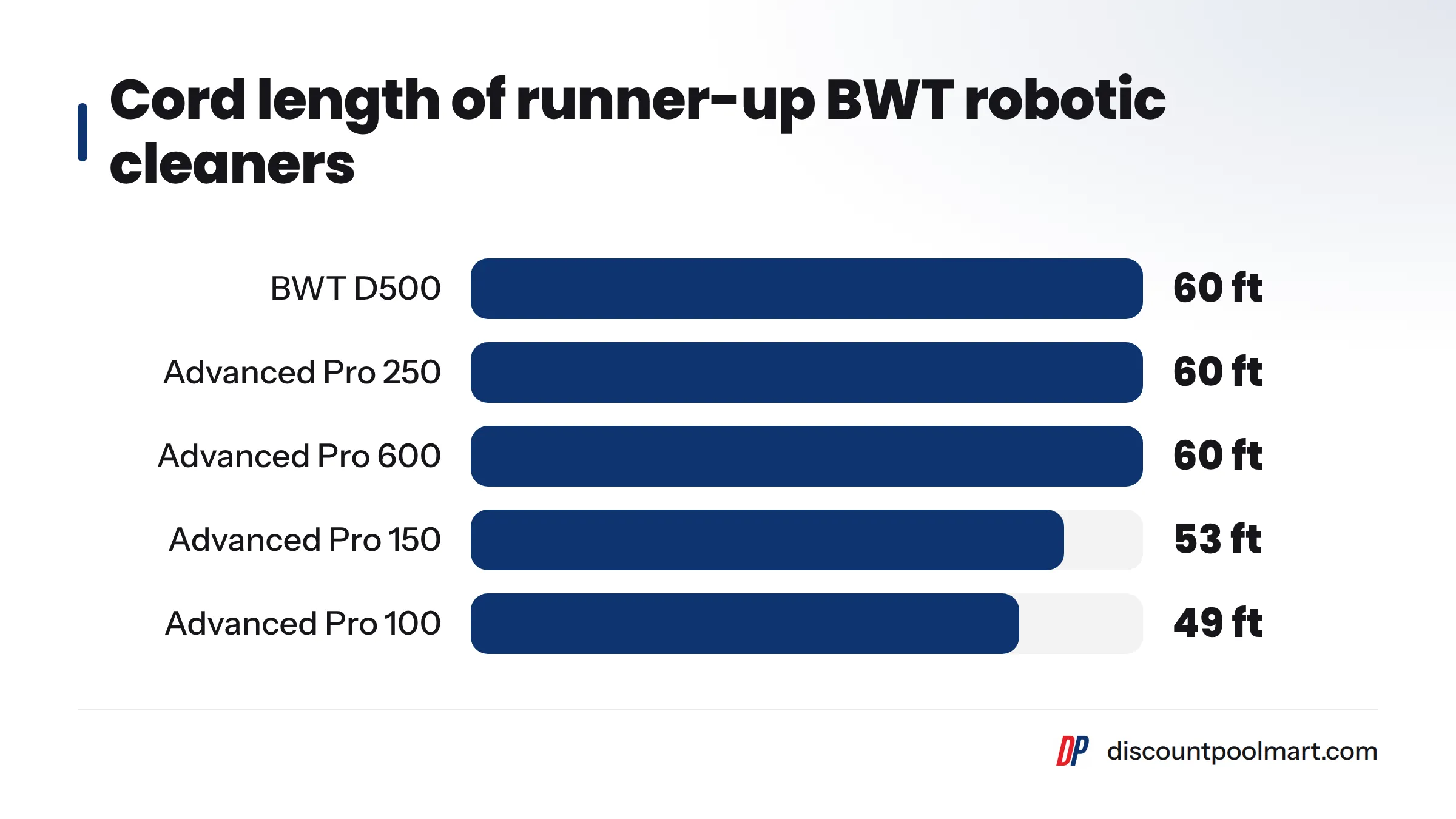
The BWT D500 has the same 60 ft reach as the D600, but its listing doesn't include app control. Best for: Owners who'd rather press a start button and walk away. Watch out for: Fewer scheduling options than the app model. If automated timing matters to you, check the spec sheet first.
#3 BWT Advanced Pro 250
The Advanced Pro 250 also comes with a 60 ft cord. We think it's a strong mid-tier choice for larger residential pools. Best for: Long or freeform in-ground pools. Watch out for: Expecting too much on heavy leaf days. Every robot canister fills up eventually.
#4 BWT Advanced Pro 100
With a 49 ft cable, the Advanced Pro 100 is our value pick for smaller pools. Best for: Compact backyard pools and plunge-style layouts. Watch out for: Cable length. Measure from your outlet to the farthest point of the pool, add the deep-end depth, and confirm the cable covers the total.
Somewhere in between? The Advanced Pro 150 has a 53 ft cord, and the Advanced Pro 600 runs 60 ft.
Prefer no cord at all? Each AIPER robotic pool cleaner in our AIPER robotic cleaners collection runs on a battery, so nothing trails from the pool edge to an outlet. AIPER publishes runtime and pool-size limits for every model. Other cordless brands, such as Beatbot, appear in national roundups too. We only rank what we stock and support at the counter.
Choosing a Robotic Cleaner for Above-Ground Pools
Above-ground pools have vinyl liners and differently shaped walls, so support varies from model to model. Before buying a robotic cleaner for above-ground pool use, confirm compatibility on the manufacturer's spec sheet or ask our staff.
Best Suction-Side Pool Cleaner: Hayward Navigator Pro and Pool Vac Family
Hayward's Navigator Pro and Pool Vac designs have been suction-side workhorses for a long time. We stock parts such as the replacement gear box assembly to keep them going. For complete units, check the cleaners collection for current availability.
How it connects: A hose plugs into your skimmer or a dedicated suction line, and the pump's suction moves the cleaner around the pool.
- Pros: Lower upfront cost, no separate power supply, and parts that are simple to swap.
- Cons: It cleans only while the pump runs, and all the debris lands in your pool filter. Expect to schedule pool filter cleaning more often.
- Warranty: Confirm current terms on Hayward's site.
Best Pressure-Side Pool Cleaner: Who Should Buy One
A pressure-side pool cleaner runs on water pushed through a return line, and it usually needs a booster pump to perform well. That booster is a small dedicated pump that raises line pressure. In exchange, you get a large debris bag that swallows leaves without clogging your pool filter.
So which is the better pool cleaner for leaves, pressure-side or suction-side? Pressure-side wins, because the bag catches big debris before it reaches your plumbing.
This category makes the most sense for leafy hillside yards where a booster pump is already plumbed in. Without one, the added cost of installing it often tips the math toward a robot. Our pool pump sizing guide answers booster pump and run time questions. If you're replacing pumps anyway, take a look at ENERGY STAR certified pool pumps. You can browse current pressure-side models in our pool cleaners collection.
Why LA Customers Return Pool Cleaners
I'll be honest: most returns aren't defects. They're mismatches between the cleaner and the pool. These are the patterns our counter staff see again and again:
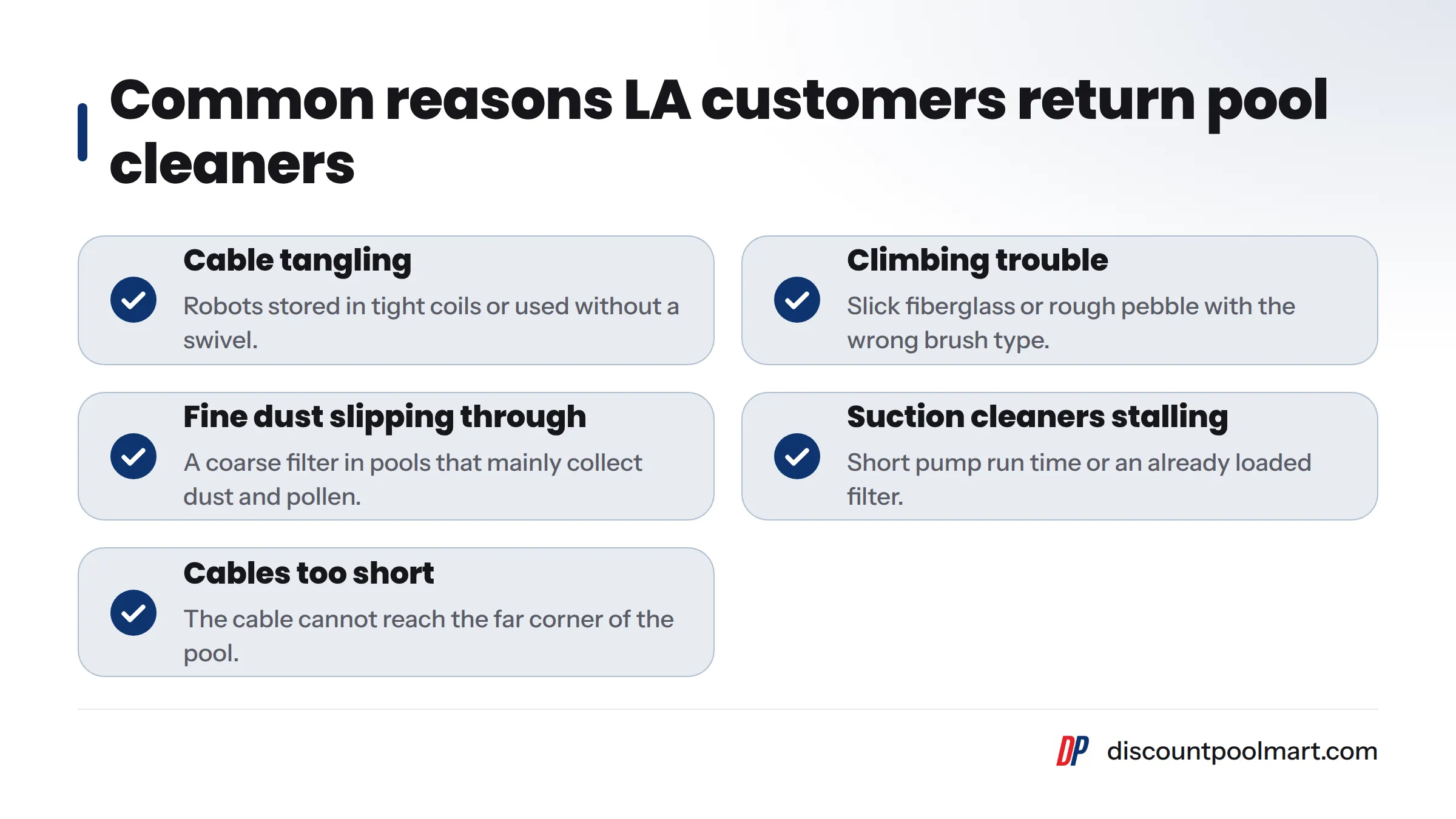
- Cable tangling on robots stored in tight coils or used without a swivel.
- Climbing trouble on certain surfaces, mostly slick fiberglass or rough pebble paired with the wrong brush type.
- Fine dust slipping through a coarse filter in pools that mainly collect dust and pollen.
- Suction cleaners stalling when pump run time is short or the filter is already loaded.
- Cables too short to reach the far corner of the pool.
Free fit check: Bring your pool size, surface type, and a few photos of your debris to any of our 8 LA stores. We'll match you with a cleaner that suits your pool.
Verdict: Picking From the Best Pool Cleaners for Your Yard
We believe robotic cleaners fit most Los Angeles pools best, but your yard gets the final vote. Here's how to decide:
- If you want hands-off cleaning from floor to waterline and solid fine-dust capture, choose a robot, starting with the BWT D600.
- If money is tight and your pump runs on a steady schedule, choose a suction-side cleaner from the Hayward Navigator Pro and Pool Vac family.
- If leaves are your biggest problem and a booster pump is already installed, choose a pressure-side cleaner.
Next steps: shop pool cleaners online, or visit one of our 8 locations to see pool cleaners Los Angeles owners actually use, in person. For setup and routine care, see our pool cleaning resources. For more equipment advice from Discount Pool Mart, check out our pool buying guides.
Pool Cleaner FAQ
Are robotic pool cleaners worth it?
For most owners, yes. A robot cleans the floor, walls, and waterline on its own power, traps debris in its own filter, and lets you cut back on main pump run time. Over the years you own one, those savings and the time you get back usually outweigh the higher price tag.
What kinds of pool cleaning robots and automatic cleaners are there?
You'll find corded robots, cordless battery robots, suction-side cleaners, and pressure-side cleaners. Robotic skimmers only clean the surface, so they work alongside a floor cleaner rather than replacing one. See our robotic skimmers.
Do robotic cleaners need the pool pump running?
No. A robot has its own motor and power supply, so it runs whether the pool pump is on or off.
Do pressure-side cleaners need a booster pump?
Most do. The booster pump raises return-line pressure so the cleaner can move around and fill its debris bag.
Which cleaner type handles leaves best?
A pressure-side cleaner with a large debris bag handles heavy leaves best. A robot with a wide canister comes in a close second, and it catches fine dust as well. For background on how filtration and circulation keep water clean, read about swimming pool sanitation. The Pool & Hot Water Tub Alliance, the industry's trade association, has broader resources for owners and professionals.