Pool Water Chemistry Supplies | Discount Pool Mart
Safe, clear pool water takes five kinds of supplies: a test kit, a sanitizer (chlorine, pool shock, or a salt chlorine generator), pH and alkalinity balancers, a calcium hardness adjuster, and cyanuric acid stabilizer for outdoor pools. Keep clarifier or algaecide on the shelf too, for the days when problems show up.
At Discount Pool Mart, we've worked with Los Angeles pool owners for more than 40 years. Our advice hasn't changed in all that time: test before you buy anything. Ready to shop? Browse pool shock and sanitizers or our Jandy salt chlorine generators.
What Chemicals Does Your Pool Need? The Short Answer
Good pool water chemistry comes down to five readings. Each reading does its own job, and each one has a product category that corrects it. Treat the table below as a swimming pool chemicals list sorted by the problem each product solves.
| Parameter | What it does | Product category | Commonly cited range |
|---|---|---|---|
| Free chlorine | Kills germs and algae | Chlorine, shock, salt system | 1-4 ppm (CDC minimum: 1 ppm) |
| pH | Sets how acidic the water is | pH decreaser or increaser | 7.2-7.8 |
| Total alkalinity | Buffers pH against swings | Sodium bicarbonate, muriatic acid | 60-180 ppm (80-120 typical target) |
| Calcium hardness | Protects plaster from etching | Calcium increaser or partial refill | 150-1,000 ppm (200-400 typical target) |
| Cyanuric acid | Shields chlorine from UV | Stabilizer | 30-50 ppm typical target |
The pH and chlorine minimums come from CDC Healthy Swimming. The remaining ranges follow the ANSI/APSP/ICC-11 residential water quality standard, which the Pool & Hot Tub Alliance publishes.
Why do sources disagree on ranges? Surface type matters. Plaster needs more calcium than vinyl or fiberglass does. Some writers also quote the full allowable range, while others quote the ideal target inside it. For a closer look, read our guide to the six water chemistry parameters.
Starter checklist of pool chemicals for beginners:
- Test kit (strips or drops)
- Sanitizer: liquid chlorine, tablets, or a salt system
- Pool shock
- pH decreaser (muriatic acid) and pH increaser (soda ash)
- Alkalinity increaser (sodium bicarbonate)
- Stabilizer, if you use unstabilized chlorine outdoors
- Clarifier and algaecide, stored until you need them
Start With a Test: Pool Water Testing Kits and What to Measure
Every product decision depends on a reading, so the test kit comes before anything else on the list. Let's break down your options.
Test strips vs drop-based test kits
| Feature | Test strips | Drop (titration) kits |
|---|---|---|
| Speed | About 30 seconds | 5-10 minutes |
| Accuracy | Approximate color match | More precise, counts drops |
| Measures | FC, pH, TA, CH, CYA (varies) | Full panel, including combined chlorine |
| Best for | Quick checks between full tests | Troubleshooting and salt pools |
My take: strips are handy, but every pool owner should still own a drop kit. The Taylor complete salt water test kit from Taylor Technologies checks chlorine, pH, alkalinity, hardness, CYA, and salt in one box.
What to measure
A full panel covers free chlorine, combined chlorine, pH, total alkalinity, calcium hardness, and CYA. Salt pools add salt level to that list.
How often to test
Most owners check chlorine and pH a few times a week and run the full panel once a month. Heat waves and heavy swim days call for more frequent checks. Our guide on how to test pool water walks through each method step by step.
Pool Shock and Sanitizers: Chlorine Forms and Salt Chlorine Generators
Free chlorine vs combined chlorine
Free chlorine is the active chlorine still available to kill germs. Combined chlorine (chloramines) has already bonded with sweat, urine, and other waste. Total chlorine is the two added together. The CDC links chloramines to the sharp "pool smell" and to red, irritated eyes. So a strong chlorine odor usually means the pool has too little free chlorine, not too much.
Chlorine forms
- Liquid (sodium hypochlorite): unstabilized and fast-acting. Our HASA liquid chlorine guide covers the HASA line.
- Tablets (trichlor): slow-dissolving and stabilized, which means they add CYA every week.
- Granular (dichlor or cal-hypo): dichlor adds CYA, while cal-hypo adds calcium.
Pool shock (calcium hypochlorite)
Shock is a large dose of chlorine that burns off chloramines and organic waste. Here is the catch for LA owners: cal-hypo adds calcium, and our tap water already carries plenty. Shocking procedures deserve their own guide, so this page sticks to the chemistry.
Salt chlorine generators
A salt chlorine generator uses electrolysis to turn dissolved salt into chlorine. I think Jandy systems do the job well, but hard water leaves calcium scale on the cell plates no matter which brand you pick. Weigh both approaches in our comparison of salt water vs chlorine pools.
Pool Water Balance: pH, Total Alkalinity, and Calcium Hardness
What chemical goes in a pool first? The order of operations
- Test the water.
- Adjust total alkalinity.
- Adjust pH.
- Adjust calcium hardness.
- Sanitize or shock.
- Add stabilizer if CYA is low.
Here is why alkalinity comes first: it buffers pH. Correct pH before alkalinity and the pH just wanders back to where it started. The full steps live in how to balance pool water.
Lowering pH and alkalinity
Muriatic acid or a dry pH decreaser (sodium bisulfate) brings both readings down.
Raising alkalinity
Sodium bicarbonate, sold as alkalinity increaser, lifts alkalinity while barely moving pH.
Calcium hardness
Low calcium etches plaster. High calcium leaves scale. LA pools rarely run low, since the tap water arrives hard.
Always follow the product label for dosing. Pool volume and product strength vary, and so does the right amount.
Stabilizer and Specialty Treatments: Cyanuric Acid, Clarifiers, and Algaecides
Cyanuric acid (stabilizer)
Cyanuric acid bonds loosely with chlorine and slows its breakdown in sunlight. Too much of it makes chlorine sluggish, and draining is the only way it leaves the pool. Read more about what cyanuric acid does.
Clarifier vs algaecide
| Product | What it does | When to use it |
|---|---|---|
| Clarifier | Clumps tiny particles so the filter catches them | Hazy water with balanced readings |
| Algaecide | Stops algae from getting a foothold | Prevention, or backup during treatment |
Fighting haze? Read how to fix cloudy pool water. For algae, Natural Chemistry Green Aid Algaecide pairs well with our tips to prevent pool algae in Southern California.
Phosphate removers and enzymes
Consider these optional extras. Natural Chemistry makes PHOSfree Max phosphate remover. Orenda makes the CV-600 enzyme cleaner, which breaks down oils and lotions.
Test-Result Decision Tree: Which Product to Reach For
Work from the top of the table down. If alkalinity is off, fix it before you touch pH.
| Test result | Reach for | Read next |
|---|---|---|
| Alkalinity low | Sodium bicarbonate | Balance guide |
| Alkalinity high | Muriatic acid, then aeration | Balance guide |
| pH high | Muriatic acid or pH decreaser | Balance guide |
| pH low | Soda ash (pH increaser) | Balance guide |
| Free chlorine low | Sanitizer or shock | Sanitizer section above |
| Combined chlorine high | Shock | Sanitizer section above |
| Calcium low | Calcium hardness increaser | Label directions |
| Calcium high or scale | Partial drain and refill, scale sequestrant, and stop using cal-hypo | SoCal section below |
| CYA high | Partial drain, then switch to liquid chlorine | CYA guide |
| CYA low | Stabilizer | CYA guide |
| Cloudy, readings balanced | Clarifier | Cloudy water guide |
| Green or visible algae | Shock plus algaecide | Pool algae treatment |
Running a Hard Water Pool in Southern California
The USGS classifies water above 180 mg/L as very hard. Much of Southern California relies on imported supplies, and you can look up your local hardness in the annual water quality reports from the Metropolitan Water District or LADWP.
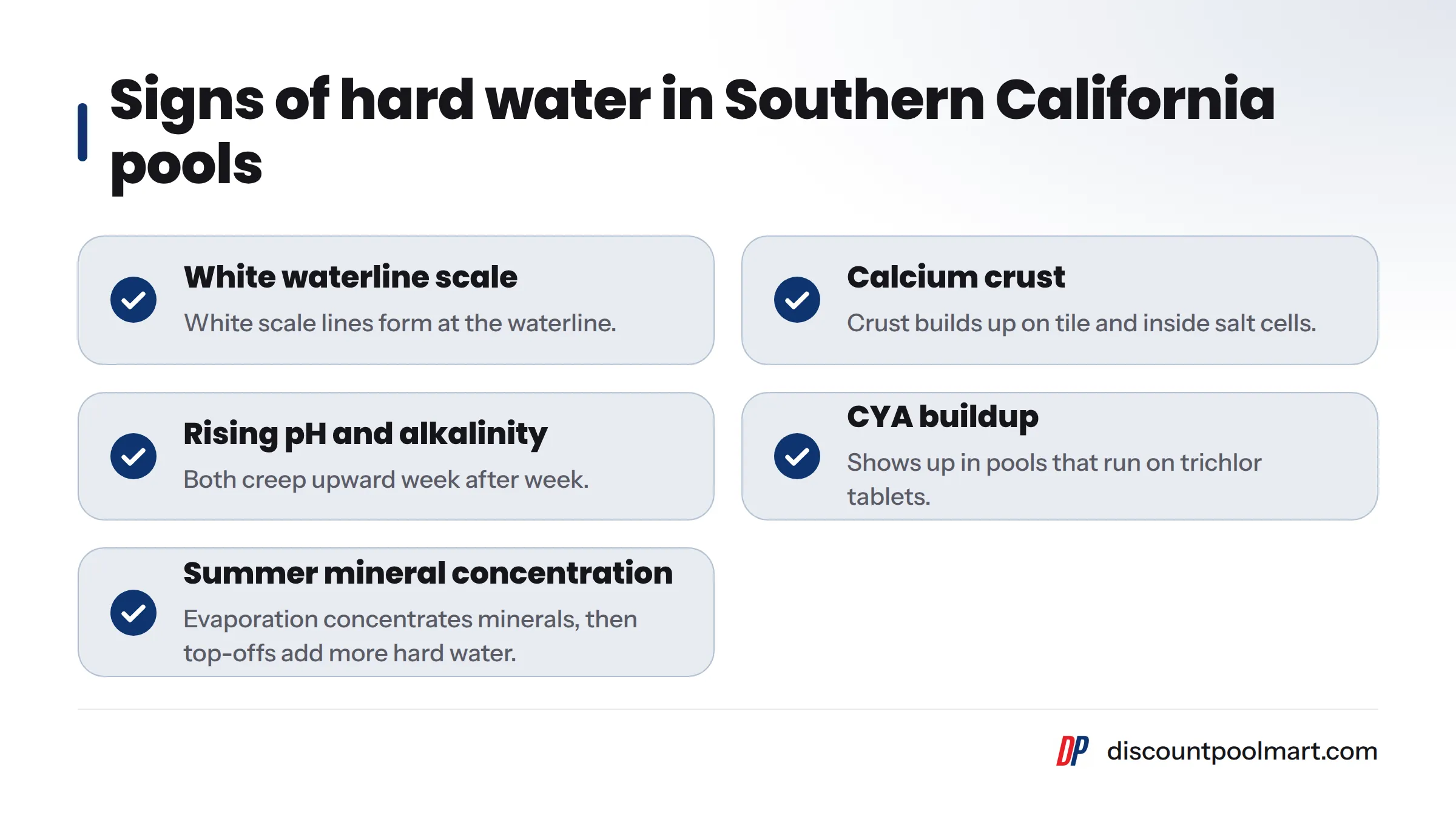
Year after year, our service records show the same patterns:
- White scale lines at the waterline
- Calcium crust on tile and inside salt cells
- pH and alkalinity creeping upward week after week
- CYA buildup in pools that run on trichlor tablets
- Summer evaporation concentrating minerals, followed by top-offs with more hard water
I've watched owners fight scale with more and more acid when the real fix was lowering calcium. It's frustrating to see, and it costs them money.
What the Langelier Saturation Index tells you
The Langelier Saturation Index (LSI) rolls pH, alkalinity, calcium, temperature, and dissolved solids into one score. A positive number points to scaling water, and a negative number points to corrosive water. Start with high calcium and you have less room for high pH before scale forms. That's why LA pool chemistry depends so heavily on keeping pH steady.
Have confusing results? Find a Discount Pool Mart store and talk them over with our staff.
Chemical Safety and Storage Rules
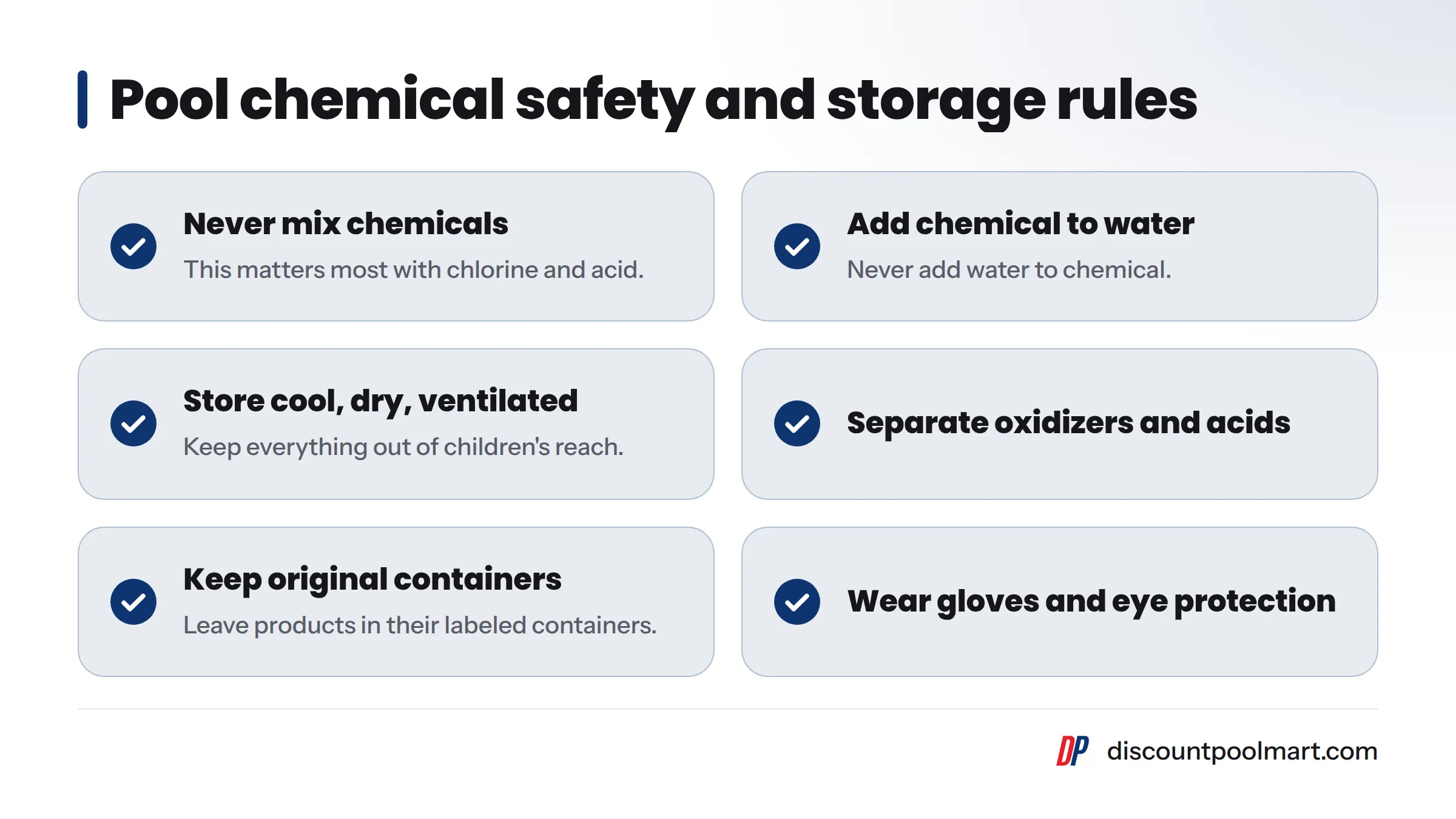
- Never mix chemicals, especially chlorine and acid.
- Always add chemical to water, never water to chemical.
- Store everything in a cool, dry, ventilated spot out of children's reach.
- Keep oxidizers and acids apart.
- Leave products in their original labeled containers.
- Wear gloves and eye protection.
- Follow every label.
If chemicals get mixed or someone is exposed, call Poison Control at 1-800-222-1222 or visit poison.org, and contact a doctor.
Shop Pool Chemistry Supplies and Read the How-To Guides
- Shop: chlorine, shock, and balancers, Jandy salt systems, and the Taylor test kit mentioned above.
- Learn: testing, balancing, cloudy water, algae, CYA, and liquid chlorine, all linked throughout this page.
- Own a hot tub? Spa water behaves differently, so start with our spa water chemistry guide.
No product can guarantee clear water. A reliable test kit and the right product category on the shelf will get you most of the way there. Next steps: shop chemicals online or visit an LA store for help in person.
Pool Water Chemistry FAQ
What chemical goes in a pool first?
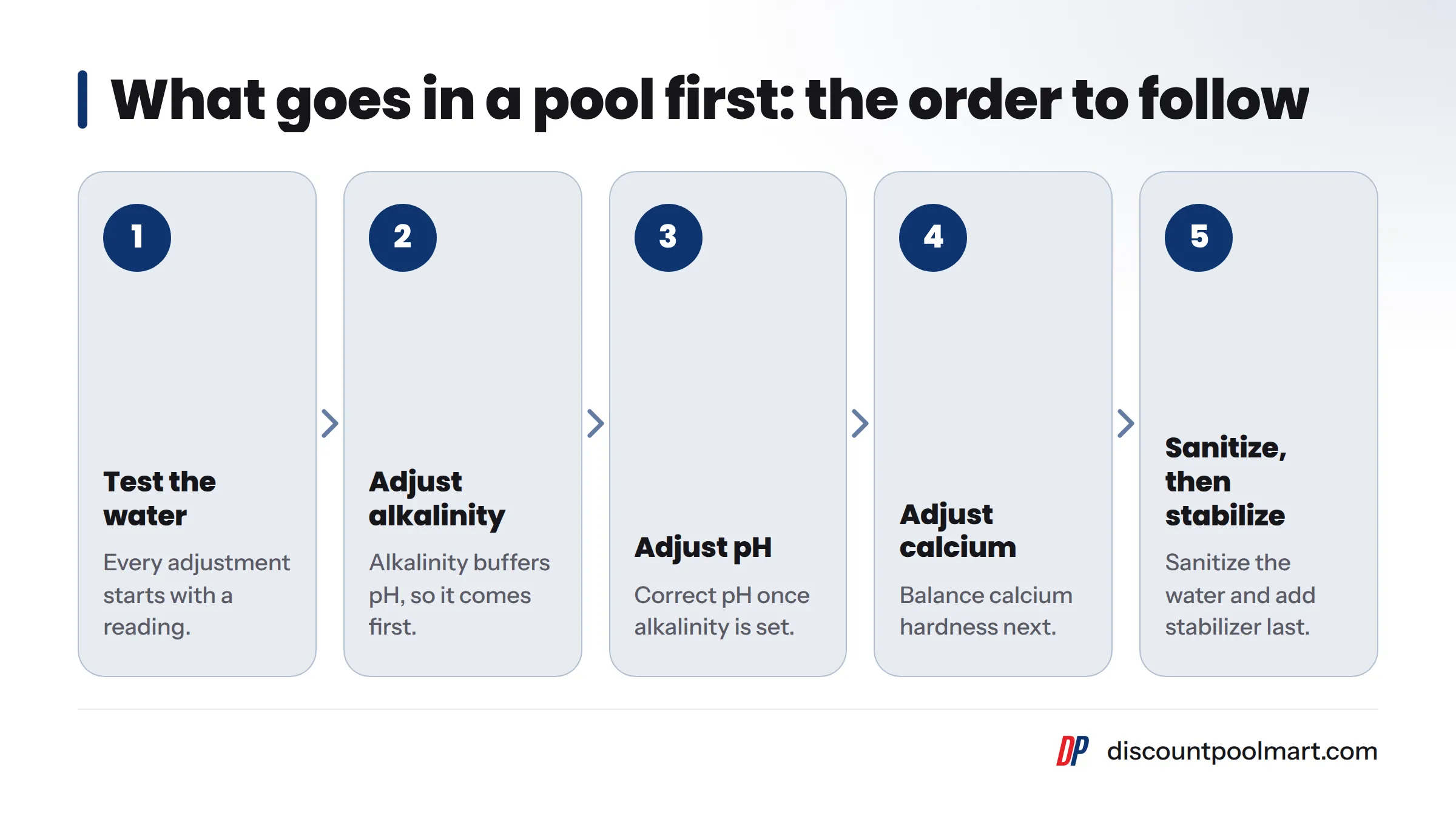
Test first. Then adjust alkalinity, then pH, then calcium, then sanitize. Stabilizer goes in last.
How do I test pool water for chemicals?
Use test strips for quick checks and a drop kit when accuracy matters. Our pool water testing walkthrough covers both.
What does rain do to pool chemistry?
Rain dilutes chlorine and stabilizer, washes in debris, and can shift pH. Read our tips on pool care after heavy rain.
What is pool chlorine made of chemically?
Pool chlorine comes as several compounds: sodium hypochlorite, calcium hypochlorite, trichlor, and dichlor. In water, all of them form hypochlorous acid, which does the actual sanitizing.
Do salt water pools still need chemicals?
Yes. A salt pool still needs pH, alkalinity, calcium, and stabilizer adjustments, along with regular testing.
Sources
- Healthy Swimming, Centers for Disease Control and Prevention
- Pool & Hot Tub Alliance (ANSI/APSP/ICC-11 standard publisher)
- Hardness of Water, U.S. Geological Survey Water Science School
- Metropolitan Water District of Southern California
- Los Angeles Department of Water and Power
- Poison Control, National Capital Poison Center
- Cyanuric acid, Wikipedia