

Here's how to vacuum a pool manually. Clip the vacuum head to a telescopic pole, attach the hose, and prime the hose to push out the air. Then connect it to the skimmer, a vacuum plate, or a dedicated vacuum port. Sweep in slow, overlapping strokes on the filter setting, or switch to waste for heavy debris. Once daily debris starts piling up faster than you can clear it, it's time to look at automatic cleaning.
We hear a version of the same story at our counters every week. A homeowner spends an hour vacuuming, the pump starts gurgling, and a cloud of dirt blows right back out of the return jets. Nearly every time, one small step happened out of order. Our Los Angeles store staff at Discount Pool Mart talk customers through this fix all the time, and this guide puts that advice in writing.
| Quick facts | |
|---|---|
| Time needed | Roughly 30 to 60 minutes for most backyard pools, in our experience |
| Difficulty | Easy once the hose is primed |
| Tools | Manual vacuum head, telescopic pole, vacuum hose, brush, leaf rake |
| Best setting | Filter for light dirt, waste for heavy debris, never backwash |
Before You Vacuum the Pool: Gather Tools, Skim, and Brush
What You Need
- Manual vacuum head, weighted or wheeled to match your pool surface
- Telescopic pole long enough to reach the deep end
- Vacuum hose that reaches the far wall from your skimmer (a 1.5-inch pool vacuum hose fits most residential setups)
- Vacuum plate (skim vac), if you plan to vacuum through the skimmer basket
- Pool brush and leaf rake
Prep the Pool: Skim, Brush, and Check the Water Level
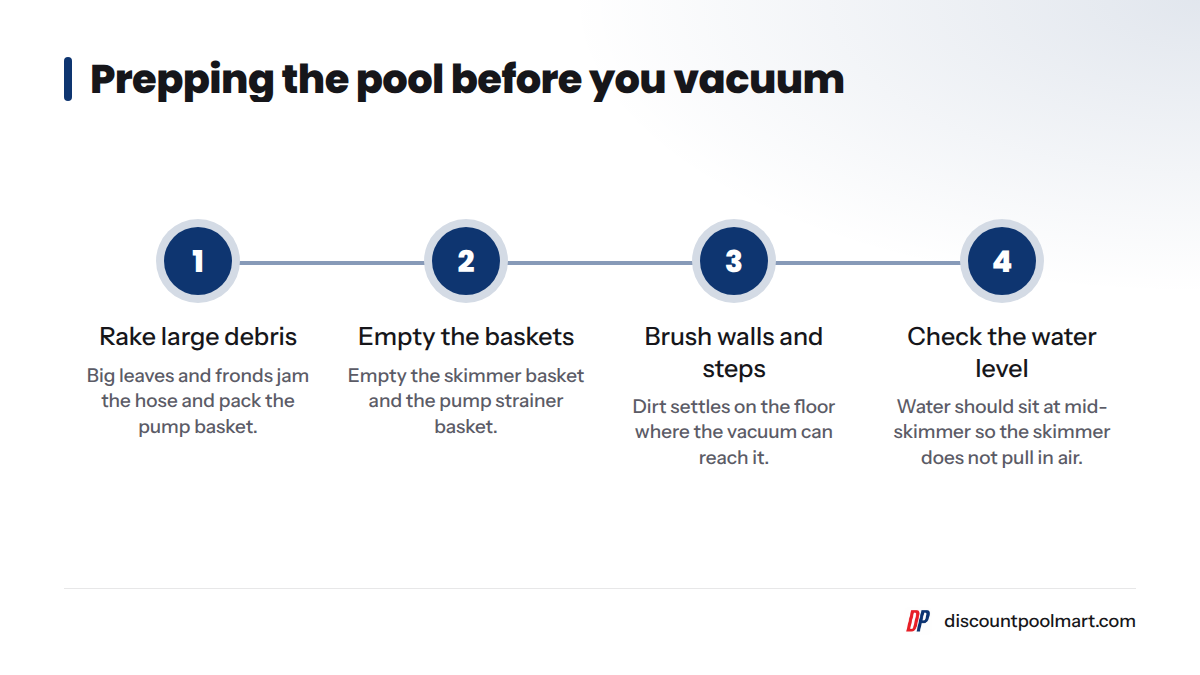
Start by emptying the skimmer basket and the pump strainer basket. Brush the walls and steps so the dirt settles on the floor where the vacuum can reach it. For tight spots, a corner vacuum brush helps. Last, check that the water sits at mid-skimmer. When the level runs low, the skimmer pulls in air.
Rake first. Large leaves and palm fronds jam the hose and pack the pump basket within minutes. Pull them out with a leaf rake before you vacuum.
Step 1: Attach the Vacuum Head and Hose to the Telescopic Pole
Clip the vacuum head onto the pole. Then push the swivel cuff end of the hose onto the head. The swivel stops the hose from kinking as you sweep. Worn connections leak air, and in that case a vacuum head adapter hose saves you a headache. Not sure your head suits plaster, pebble, or vinyl? Our guide to choosing the right pool vacuum head covers it.
Step 2: How to Prime a Pool Vacuum Hose
Priming fills the hose with water so the pump draws water instead of air. Air in the line is the most common reason a pump loses prime, meaning it stops moving water and starts sucking air. If I could get every customer to remember one step, it would be this one.
Method A: Feed the Hose Down Hand Over Hand
- With the pump running, lower the vacuum head to the pool floor.
- Feed the hose straight down beside the head, one section at a time.
- Watch for bubbles rising from the head. Once they stop, the hose is full.
Method B: Hold the Hose End Over a Return Jet
- Sink the head and hose in the pool.
- Hold the open hose end against a return jet.
- Let the jet push water through the hose until bubbles stop coming out of the head.
Primed means no bubbles. If bubbles still rise from the vacuum head, keep going.
Step 3: Connect the Vacuum Hose to the Skimmer or Vacuum Port
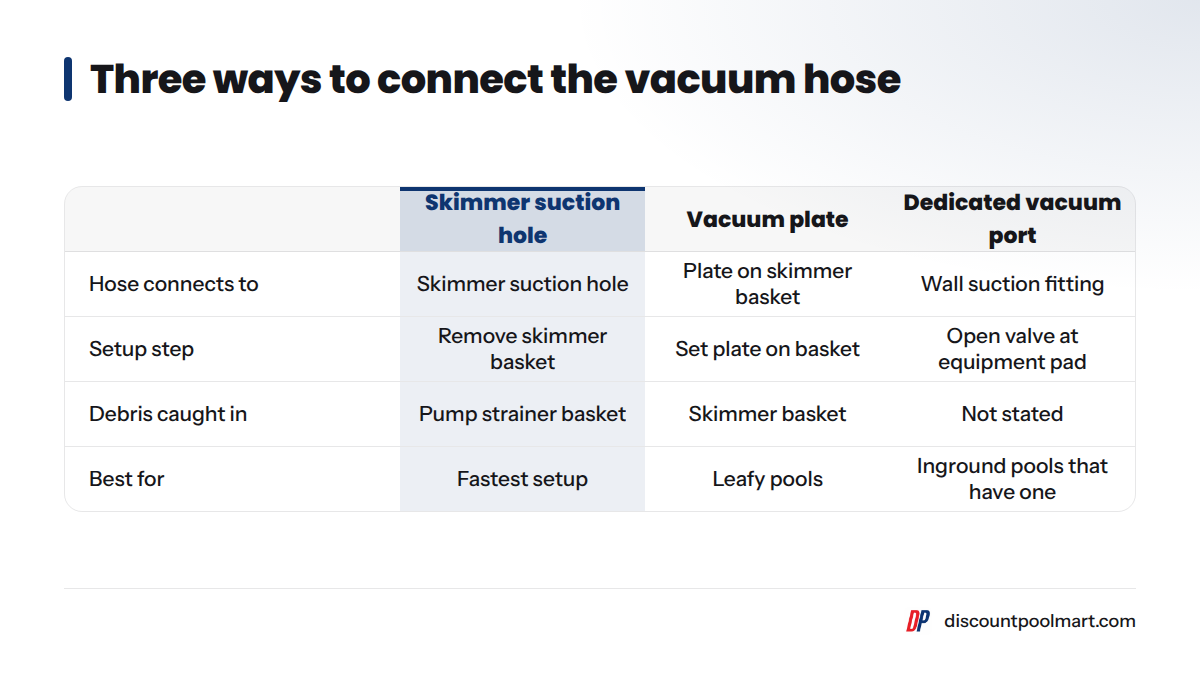
Your pump supplies the suction and the hose carries the dirt, so this step decides where the debris ends up. You have three ways to make the connection.
Option 1: Straight Into the Skimmer Suction Hole
Take out the skimmer basket and press the hose end into the suction hole. It's the fastest setup. Debris bypasses the skimmer and lands in the pump strainer basket, so check that basket often.
Option 2: The Vacuum Plate (Skim Vac) Over the Skimmer Basket
A vacuum plate is a disc that sits on top of the skimmer basket and accepts the hose. With the plate in place, the skimmer basket catches debris before it reaches the pump. For leafy pools, we recommend this method.
Option 3: A Dedicated Vacuum Port
If you're working out how to vacuum an inground pool, check the wall for a separate suction fitting. Some inground pools have one, called a dedicated vacuum port. Open its valve at the equipment pad and plug in the hose.
Suction tip: Turn the diverter valve or close the main drain valve to send more suction to the skimmer. If the head grabs the floor, open the main drain slightly to ease off.
Step 4: Vacuum the Pool Floor in Slow, Overlapping Strokes
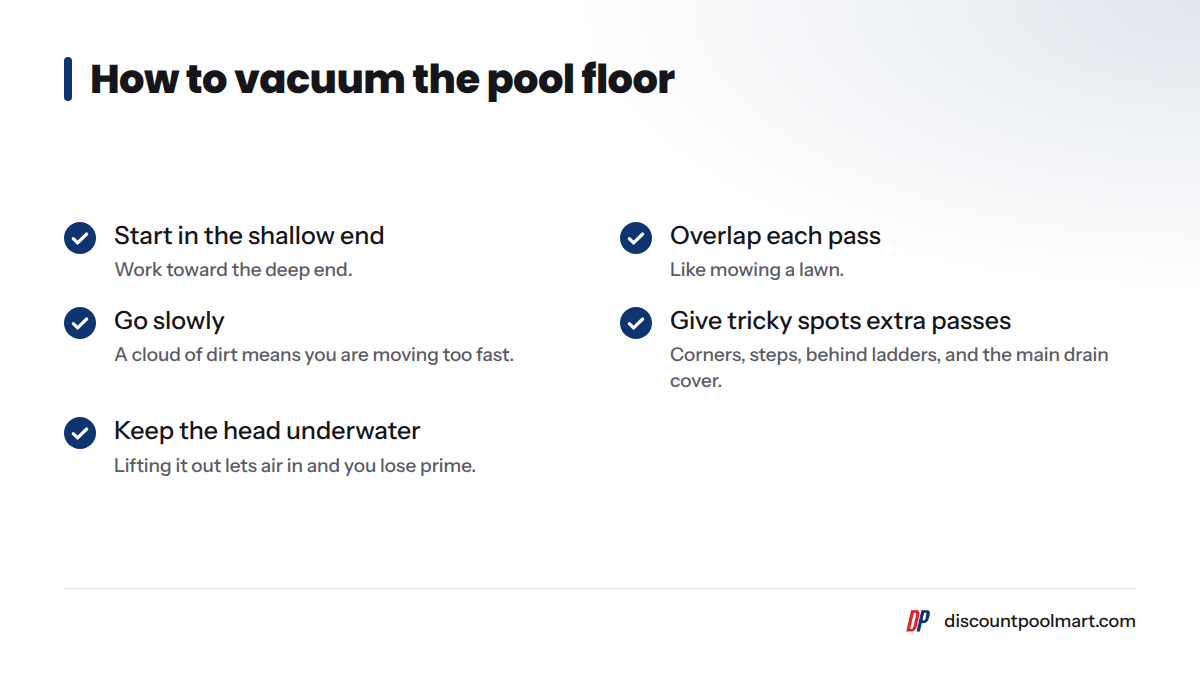
Start in the shallow end and work toward the deep end, overlapping each pass a little, the way you'd mow a lawn. Go slowly. A cloud of dirt rising in front of the head tells you you're moving too fast. Corners, steps, the area behind ladders, and the main drain cover all deserve extra passes. And keep the head underwater the whole time. Lifting it out lets air into the hose, and you'll lose your prime.
Step 5: Vacuum the Pool on the Waste Setting for Heavy Debris, Then Clean Up
Most people we talk to don't know which setting to use. Here is why it matters. Dirt travels from the vacuum head through the hose and skimmer, into the pump strainer basket, and then on to the multiport valve. That valve sends it either into the filter or out the waste line.
Filter vs. Waste vs. Backwash: Which Setting to Use
| Setting | When to use | Where dirt goes | Water lost? |
|---|---|---|---|
| Filter | Light, everyday dirt | Trapped in the filter | No |
| Waste | Heavy dirt, dead algae, fine ash | Out the waste line | Yes, so refill while you vacuum |
| Backwash | Never for vacuuming | Reverses flow through the filter | Yes |
Backwash runs water backward through a sand or diatomaceous earth filter to clean the filter itself. Vacuum on backwash and you push the dirt straight back out instead of capturing it. Cartridge filters usually have no waste setting, so vacuum on filter and hose off the cartridge afterward. Before you run a waste hose toward the street, check your city's rules on discharging pool water.
Cleanup Checklist
- Turn the pump off before you move the multiport handle.
- Empty the skimmer and pump strainer baskets.
- Check the filter pressure gauge. If pressure has climbed, backwash or clean the filter.
- Refill the water to mid-skimmer.
- Return the valves to their normal positions and reset your pool pump run times.
- Rinse the hose and store it in the shade.
If you want to see how to vacuum a pool with a sand filter, Swim University's video walks through the whole waste-setting process.
Vacuuming LA Yard Debris: Palm, Eucalyptus, and Wildfire Ash
Southern California yards throw some messes into pools that a standard guide won't cover. Let's break it down by debris type.
Palm Debris
Fronds, seed pods, and flower stalks come out with the rake. After that, vacuum up the small bits and check the pump basket every few minutes. If the pool is full of pods, a leaf vacuum that bags debris spares your pump.
Eucalyptus Leaves
Get these out fast. The tannins in eucalyptus leaves can stain plaster if the leaves sit for long. Vacuum the fragments, then brush any brown marks. If the marks won't brush away, our guide to removing pool stains can help.
Wildfire Ash
Let the ash settle first. Then vacuum slowly on waste, since ash is too fine for many filters to hold. The CDC's wildfire guidance recommends gloves, long sleeves, and an N95 respirator for ash cleanup. When you're done, test your pool water, and if haze lingers, fix the cloudy pool water.
| Debris type | First tool | Setting | Follow-up |
|---|---|---|---|
| Palm debris | Leaf rake | Filter | Empty pump basket often |
| Eucalyptus leaves | Leaf rake | Filter | Brush stains |
| Wildfire ash | Vacuum | Waste | Test water, watch pressure |
| Dead algae | Vacuum | Waste | Retest sanitizer |
The Pool Vacuuming Mistakes We See Most in Our Stores
Every item here comes from real conversations at our counters, and each one has a simple fix.
- Skipping the prime. Purge every bubble before you connect.
- Ignoring the baskets. A full pump basket chokes suction.
- Rushing. Slow strokes keep dirt from clouding the water.
- Using backwash instead of waste. Check the settings table above.
- Running waste without topping up. The water drops below the skimmer, and the pump can run dry.
- Lifting the head out of the water. That breaks the prime instantly.
- Vacuuming ash on filter. Watch the pressure gauge, or switch to waste.
- Forgetting to reset the valves. The pool then circulates poorly for days.
| Symptom | Likely cause | Fix |
|---|---|---|
| No suction | Air in hose or full basket | Re-prime, empty baskets |
| Bubbles in pump lid | Air leak or low water | Top up, check lid O-ring |
| Dirt blowing back in | Torn filter part or backwash setting | Check setting and filter internals |
| Head stuck to floor | Too much suction | Open main drain slightly |
| Pressure spike | Filter loaded with fines | Clean filter or use waste |
If air gets trapped in the filter tank, bleed it out through the manual air relief valve. Still losing prime after all that? A seal may be failing, and you can book pool pump repair in Los Angeles with our team.
When a Manual Pool Vacuum Isn't Enough: Automatic and Robotic Cleaners
Automatic cleaners come in three main types. Suction-side cleaners run on your pump's suction, pressure-side cleaners run on return-line pressure, and robotic pool cleaners carry their own motor and filter. One of them makes sense if:
- You vacuum more than a couple of times a week
- Trees drop debris daily
- Hauling a pole around is hard on your body
That said, I still keep a manual setup for spot cleaning, ash events, and pulling out dead algae after you treat pool algae. In my experience, automatic cleaners handle none of those jobs well.
Pool Vacuuming FAQ
What setting do you put your pool filter on when vacuuming?
If you're wondering what setting to vacuum pool debris on, start with filter for routine dirt. Switch the multiport valve to waste for heavy debris, dead algae, or ash, so the dirt leaves the pool without loading the filter.
Vacuum pool: backwash or waste?
Waste, never backwash. Backwash reverses flow through the filter to clean it. It doesn't collect debris from the pool.
Where does the dirt go when vacuuming a pool?
It travels through the hose into the skimmer and the pump strainer basket. From there, the filter traps it on the filter setting, or it exits through the waste line on waste.
How do I vacuum a pool without losing water?
Stay on the filter setting. If a job calls for waste, keep a garden hose running into the pool while you vacuum.
Can you vacuum a pool with a sand filter or cartridge filter?
Yes. Sand filters handle both filter and waste. Cartridge filters usually lack a waste option, so rinse the cartridge after heavy jobs. For cleaning without the pump, a cordless pool vacuum works too.
Why does my pool vacuum keep losing suction?
Air in the line causes most suction loss. Check for low water, a full basket, a cracked hose, or a loose cuff.
Clear Water Is a Safety Issue, Not Just a Looks Issue
The CDC's Model Aquatic Health Code treats water clarity as a safety measure for public pools. In our view, the same logic applies to your backyard. If you can't see the bottom clearly, you can't spot trouble in the water either.
Next steps: stop by a Discount Pool Mart store in the LA area for hoses, heads, and help with suction problems. Bring a photo of your equipment pad and we'll sort it out with you.