

Learning how to remove pool stains starts before you buy anything. First, figure out whether the stain is organic, metal, or mineral. Each type has its own fix. Organic stains respond to chlorine or an enzyme (tannin) treatment. Metal stains need an ascorbic-acid stain remover followed by a metal sequestrant. Calcium scale needs a stain and scale remover and gentle scrubbing. The order matters, and here is why.
Discount Pool Mart has served Los Angeles pool owners for 40 years. The mistake we see most often is someone buying the wrong bottle for a stain they never identified. That costs money, and the stain stays put. You can skip all of it. This guide gives you two cheap spot tests, three stain types, and a chart of tools that won't damage your surface. Identify the stain first, and you only have to treat it once.
Quick Answer: Identify the Pool Stain Type, Then Match the Treatment
| Stain Type | Typical Color | Where It Shows Up | Spot Test That Lifts It | Treatment Category | Safe Tool |
|---|---|---|---|---|---|
| Organic | Brown, green-brown, reddish | Leaf or berry shapes on the floor and steps under trees | Chlorine test | Chlorine spot treatment or enzyme/tannin stain treatment | Nylon brush |
| Metal | Rust-brown or orange (iron), blue-green or teal (copper), purple-brown or black (manganese) | Streaks or blotches near returns, fill points, or under metal objects | Vitamin C (ascorbic acid) test | Ascorbic-based stain remover plus metal sequestrant | Ascorbic sock, stain eraser |
| Mineral (calcium scale) | White or gray-white, crusty, rough | Waterline tile, spillways, water features | Neither test | Stain and scale remover | Pumice stone (plaster and tile only) or stain eraser |
Not sure? Run both spot tests before you buy anything.
Step 1: Identify Your Stain Type (Organic, Metal, or Mineral)
Color gives you a strong hint. Location usually confirms it.
Organic Pool Stains: Leaves, Berries, Pollen, and Debris
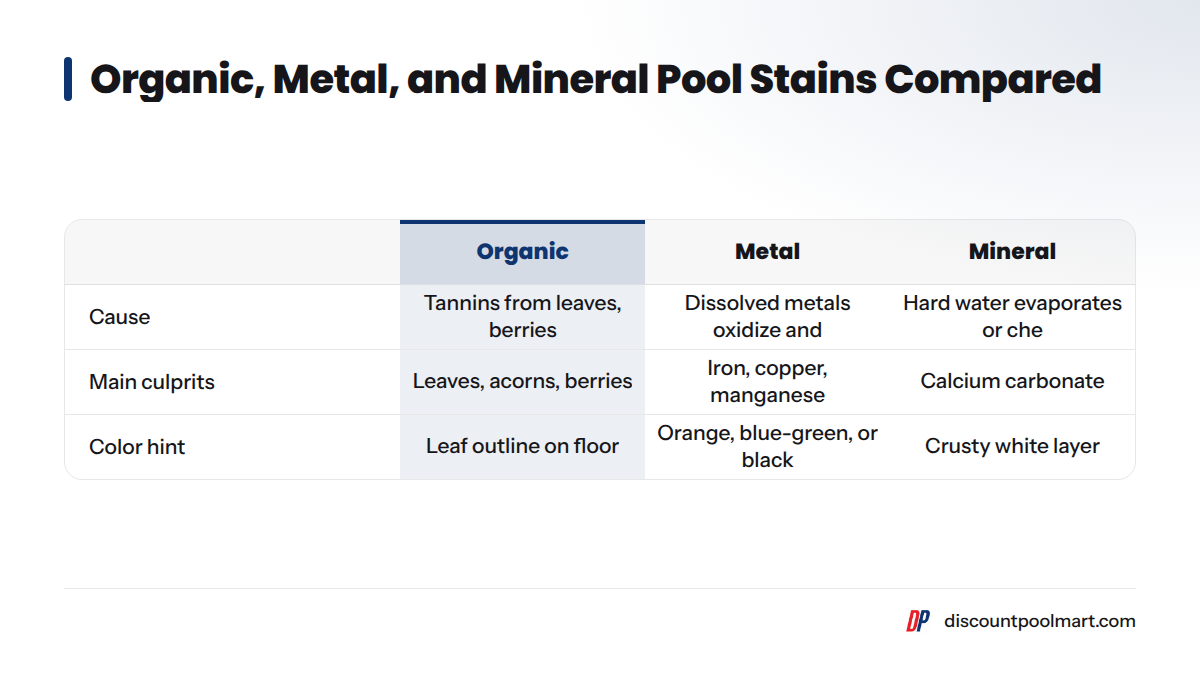
Organic pool stains form when leaves, acorns, berries, or algae sit on the surface and leach tannins, the same plant compounds that color tea. A pool under an oak or a ficus often shows a perfect leaf outline on the floor.
Metal Stains: Iron, Copper, and Manganese
Metal stains appear when dissolved metals oxidize, drop out of solution, and settle on the surface. The U.S. EPA's guidance on nuisance chemicals ties iron to reddish or orange staining, copper to blue-green staining, and manganese to black or brown-black staining. Pool surfaces follow the same color pattern.
Mineral Stains: Calcium Scale and Hard Water Deposits
Calcium scale is a crusty white layer of calcium carbonate. It builds up when hard water evaporates or the water chemistry drifts out of balance. According to the USGS Water Science School, hard water leaves mineral scale on the surfaces it touches, and much of the Southwest has some of the hardest water in the country.
Check Your Surface First: Plaster, Vinyl, or Fiberglass
Know your finish before you scrub. Plaster and pebble finishes can handle firmer tools. Vinyl liners and fiberglass scratch easily, and in our experience a scratch holds stains forever.
Step 2: Run the Spot Tests (Chlorine Test vs. Vitamin C Pool Stain Test)
These two tests cost almost nothing, and together they usually tell you what you're dealing with.
The Chlorine Spot Test for Organic Stains
- Put on gloves and read the chlorine product label.
- Place a small amount of granular chlorine or one chlorine tablet in an old sock or a length of PVC pipe.
- Hold it against the stain underwater for a few minutes.
- If the stain lightens, it is organic.
The Vitamin C Pool Stain Test for Metal Stains
- Crush a few vitamin C tablets and put the powder in a clean sock.
- Hold the sock on the stain for several minutes. Use a pole if you can't reach it.
- If the spot lightens or vanishes, you have a metal stain.
The test works because ascorbic acid is a reducing agent. It turns the oxidized metal on the surface back into a dissolved form. Chlorine works the opposite way: it oxidizes organic material.
If Neither Test Works
Let's break it down:
- Chlorine lightens it? Organic.
- Vitamin C lightens it? Metal.
- Neither, but it is white, crusty, or rough? Calcium scale.
- None of the above? It may not be a surface stain. Jump to the last section.
Safety callout: Never test chlorine and ascorbic acid on the same spot at the same time. Rinse the area, let the water circulate, and wait before you switch tests. Never mix chemicals.
Step 3: Remove Organic Pool Stains from Leaves, Berries, and Debris
Organic stains tend to be the easiest to clear.
- Skim and vacuum all debris so nothing keeps leaching tannins.
- Brush the stained area with a nylon brush.
- Spot-treat with chlorine, or apply an enzyme or tannin stain treatment as the label directs.
- Brush again after treatment.
- If the stain fades but doesn't clear, repeat.
If organic staining covers much of the pool, it often makes sense to shock the whole thing. Follow the shock label, and check our guide on how to balance pool water before and after.
Is it algae? If the "stain" is green, slimy, fuzzy, or spreading, it's probably algae. Use our guide on how to treat pool algae instead.
Step 4: Remove Metal Stains (Iron, Copper, Manganese) Common in LA Municipal Water
Where the Metals Come From
Metals get into a pool through fill water, corroding metal parts, some copper-based products, and dropped objects like bobby pins or coins. LA's municipal supply draws from several sources, and LADWP publishes an annual drinking water quality report where you can look up the mineral content for your area. If a heater or other equipment is corroding, bring in a professional instead of guessing.
Spot-Treating Small Metal Stains
The vitamin C sock is the cheapest pool rust stain remover there is, and it often works as the treatment, not just the test. If you're figuring out how to remove iron stains from pool floor plaster, such as a rust spot under the ladder or the outline of a dropped hairpin, hold the sock on the spot longer and repeat as needed. On vinyl and fiberglass, a stain eraser does the job without scratching.
Treating Widespread Metal Staining
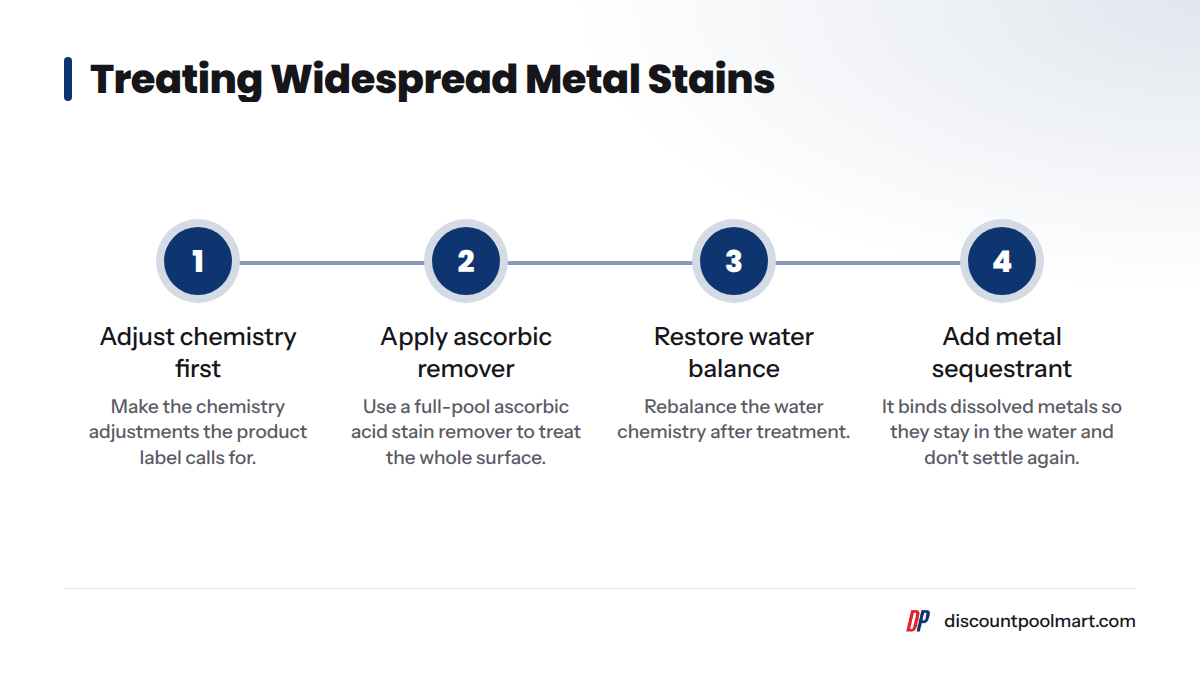
When streaks cover large areas, use a full-pool ascorbic acid pool stain remover. It works as an underwater pool stain remover across the whole surface, so you don't have to hold dozens of socks in place. Follow the manufacturer's label exactly, since most products call for chemistry adjustments before treatment. Afterward, restore balance with our guide to balancing your water chemistry. If the water turns hazy after a big treatment, see how to fix cloudy pool water.
Lock Metals in Solution with a Metal Sequestrant
A metal sequestrant is a chelating chemical. It binds dissolved metals so they stay in the water instead of settling back onto your surface. Here is the catch: removing a stain puts those metals back into the water, so if you skip the sequestrant, the stain usually comes back. We think it's the most skipped step in the whole process, and it's the one we'd never skip.
What we see in LA: In 40 years behind our counters, metal staining has been one of the stain questions we hear most. Many cases trace back to top-off water and older metal fixtures. The pools that stay clean are the ones that get sequestrant routinely, not just once.
Products we stock for this step: United Chemical Pool Stain Treat is a full-pool treatment for metal staining. Hasa Super Stain Out is made to both remove and prevent stains. The best pool stain remover for you depends on your surface and how far the staining has spread, and our staff can help you choose between the two. For the rest of the shelf, see our pool chemical guide for LA homeowners.
This walkthrough shows a full-pool treatment done without draining:
Step 5: Pool Calcium Scale Removal for Southern California Hard Water
Clearing Pool Waterline Scale from Tile
- Apply a stain and scale remover as the label directs.
- Wet the pumice stone and the tile.
- Rub gently in small circles, on ceramic or porcelain tile only.
- Keep both surfaces wet the whole time, and rinse often.
Scale on Plaster, Vinyl, and Fiberglass Surfaces
On plaster, a wet pumice stone handles small rough patches. On vinyl and fiberglass, use a stain eraser or soft brush with a stain and scale remover. Never use pumice on those finishes.
| Tool or Product | Plaster | Vinyl | Fiberglass | Waterline Tile |
|---|---|---|---|---|
| Pumice stone | Safe (wet) | Avoid | Avoid | Safe on ceramic or porcelain; avoid glass tile |
| Stain eraser / pool stain brush | Safe | Safe | Safe | Safe |
| Stainless steel brush | Use with care | Avoid | Avoid | Avoid |
| Nylon brush | Safe | Safe | Safe | Safe |
| Ascorbic sock | Safe | Safe | Safe | Safe |
| Stain and scale remover | Safe per label | Safe per label | Safe per label | Safe per label |
Check your surface manufacturer's guidance too.
What we see in SoCal: Scale nearly always appears first at the waterline, where evaporation leaves minerals behind, and around spillways and water features. A thin white line in spring turns into a rough crust by fall if nobody wipes it.
Step 6: Keep Pool Stains from Coming Back After Treatment
Prevention costs less than treatment. Next steps:
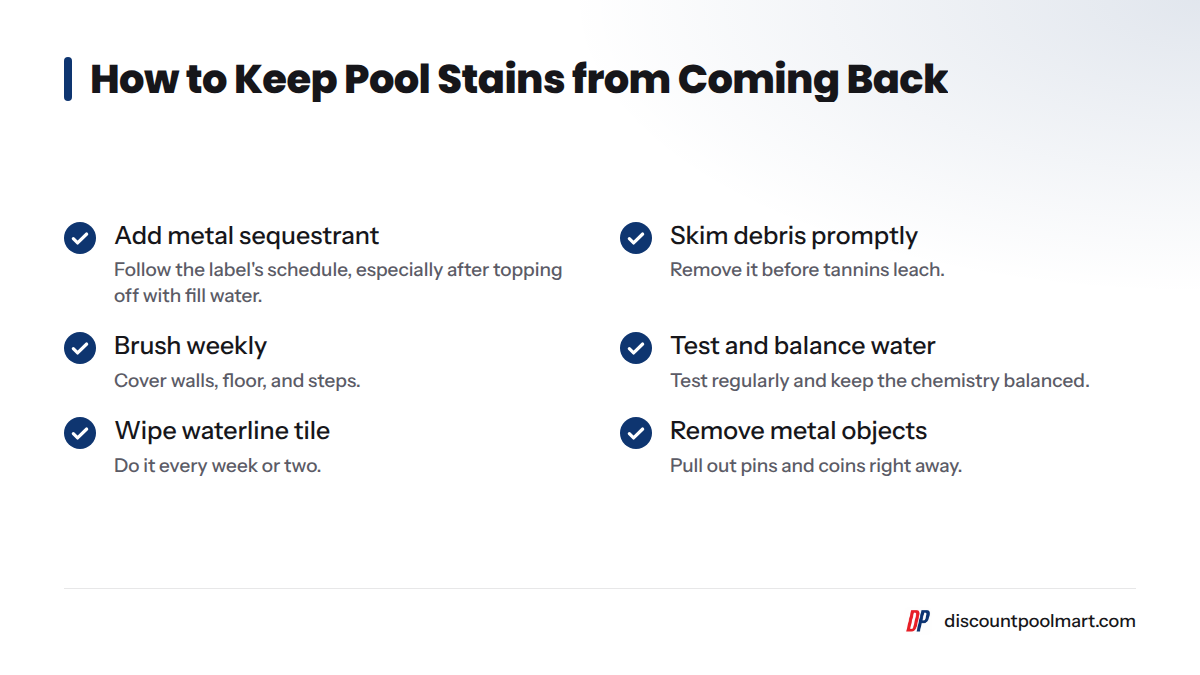
- Add a metal sequestrant on the label's schedule, especially after topping off with fill water.
- Skim debris promptly, before tannins leach.
- Brush walls, floor, and steps weekly.
- Test water regularly. Our guide on how to test pool water covers strips, drops, and digital kits.
- Keep water balanced with help from how to balance pool water.
- Wipe the waterline tile every week or two.
- Pull out pins, coins, and other metal objects right away.
For a full weekly routine, use our LA pool maintenance checklist alongside our tips on preventing pool algae in Southern California.
When a Stain Won't Lift: Signs It's Not a Surface Stain
Sometimes no product will fix it, and we'd rather tell you that than sell you another bottle. Watch for these signs:
- Neither spot test changes the color.
- The surface feels rough, pitted, or etched.
- The discoloration sits inside the plaster, not on top of it.
- The color appears as even mottling across the whole pool.
- The "stain" is really a shadow from a crack or surface defect.
- The stain returns within days of treatment.
If you see these, stop buying chemicals. Acid washing and resurfacing are jobs for professionals, so talk to a pool pro or our staff.
Bring it to us: Take a photo of the stain and bring it, along with a water sample, to your nearest Discount Pool Mart. We'll test the water, help identify the stain, and point you to the right product.
Frequently Asked Questions
Can I use vitamin C to remove pool stains?
Yes, for metal stains. Put crushed vitamin C tablets in a sock and hold it on the stain for several minutes. That often lifts small iron or copper spots. Large areas need a full-pool ascorbic-based treatment.
What is a good pool metal stain remover?
Look for an ascorbic-acid-based stain remover, then follow it with a metal sequestrant. At Discount Pool Mart, United Chemical Pool Stain Treat and Hasa Super Stain Out both cover this category.
How do you remove a stain that has already dried?
Refill or rewet the area, identify the stain with the spot tests, and treat it by type. Dried stains may take several rounds.
How do I remove pool stains without draining?
You can do every method in this guide with the pool full. Manufacturers make spot tests, sock treatments, full-pool stain removers, and sequestrants for filled pools.
What pool rust stain remover works under a ladder?
Use the vitamin C sock method on the rust spot, then add sequestrant. If the ladder itself is corroding, have someone inspect it or replace it.
How do I remove metal stains from a fiberglass pool?
Use an ascorbic treatment with a stain eraser or soft brush. Keep pumice and steel brushes away from fiberglass.
Why do pool stains come back after treatment?
The metals or minerals are still in the water. Without a sequestrant, regular brushing, and balanced water, they settle back onto the surface.
Is a pumice stone safe on my pool?
Only on plaster and ceramic or porcelain tile, and only when wet. Never use one on vinyl, fiberglass, or glass tile.
Sources
- Guidance for Nuisance Chemicals - U.S. Environmental Protection Agency
- Hardness of Water - U.S. Geological Survey Water Science School
- Los Angeles Department of Water and Power - LADWP
- Ascorbic acid - Wikipedia
Related: pool cleaning guide