

To treat pool algae, brush every surface, clean the filter, shock the water to the free chlorine (FC) level your product label gives for that algae type, brush again several times, run the pump nonstop, and retest. Below you'll find exact steps for green, yellow, and black algae, plus a dose table for 10,000, 15,000, and 20,000 gallon pools.
I work with Los Angeles pool owners at Discount Pool Mart, and I keep hearing the same story. The pool looked fine on Friday. By Monday it's a swamp, or dark spots have appeared on the plaster and nothing you tried touches them. Let's break it down so you can fix it in the right order.
Quick answer
- Identify the color (green, yellow, or black).
- Brush walls, floor, steps, and benches.
- Clean or backwash the filter.
- Shock to the label's target free chlorine.
- Brush every few hours and keep the pump running.
- Clean the filter again, retest FC, and confirm the water is clear.
Identify Your Algae Type Before You Treat It
Each type needs a slightly different attack. Treat black algae like green algae and you'll barely dent it. Spend two minutes on identification first.
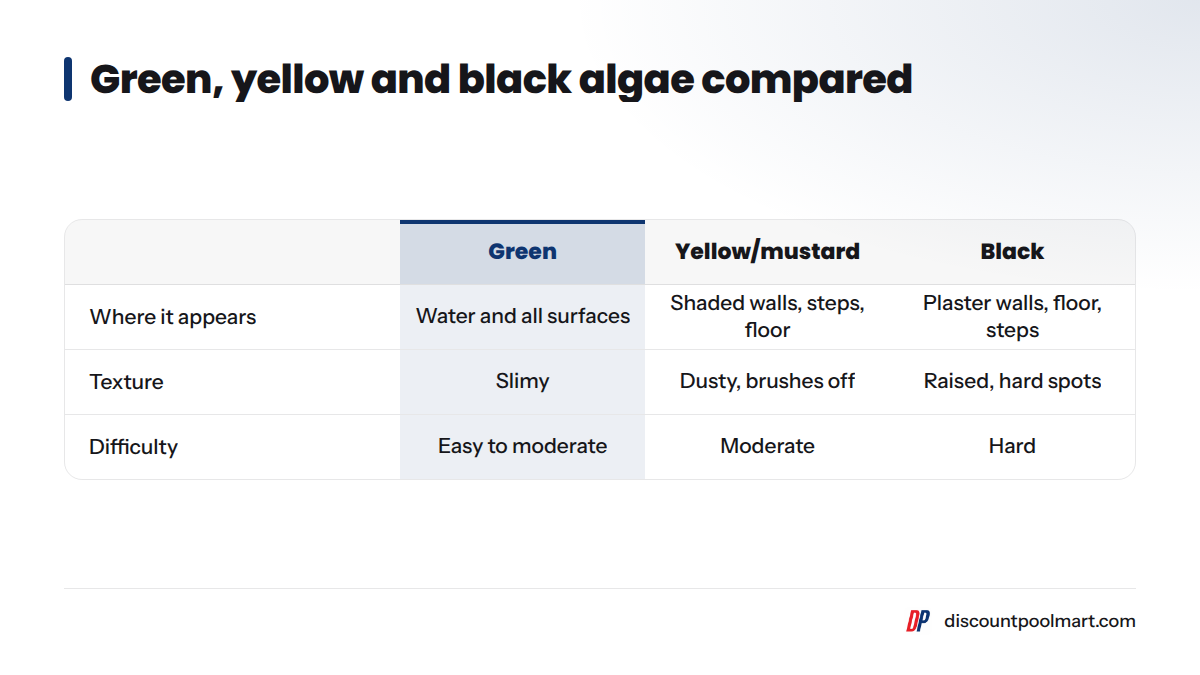
Green algae
This is the common one. The water runs from hazy green to dark, opaque green, and the walls feel slimy. It spreads fast in warm weather and usually responds well to shock and brushing.
Yellow (mustard) algae
Mustard algae looks like yellow-brown dust or sand on the walls, often in shaded spots. It brushes off easily, then returns a day later. It also clings to swimsuits, toys, and ladders, so it can restart in a pool you just cleaned.
Black algae
Black algae (often blue-black) shows up as dark spots with raised heads, mostly on plaster and other rough surfaces. It resists brushing because it grows a protective outer layer and roots into the surface. Of the three, it's the hardest to remove.
| Type | Where it appears | Texture | Difficulty | Protocol |
|---|---|---|---|---|
| Green | Water and all surfaces | Slimy | Easy to moderate | Green steps |
| Yellow/mustard | Shaded walls, steps, floor | Dusty, brushes off | Moderate | Mustard steps |
| Black/blue-black | Plaster walls, floor, steps | Raised, hard spots | Hard | Black algae steps |
Quick decision tree: Is the water itself green or cloudy? Follow the green protocol. Is the water clear, with dusty yellow patches that wipe away? Follow the mustard protocol. Are there dark spots that won't wipe away? Follow the black algae protocol.
What You Need Before You Start
Tools
- Stiff nylon brush: safe on every surface type, including vinyl and fiberglass.
- Stainless steel brush: for plaster or concrete only, because it can scratch vinyl and fiberglass. The Pooline Stainless Steel Brush is built for this job.
- Black algae scraper: the Pool Tool Company Black Algae Scraper helps break up stubborn spots on plastered pools.
- Pool vacuum and hose: for removing dead algae. Vacuum to waste if your system allows it.
- Test kit: you need an accurate free chlorine reading. Our guide on how to test pool water compares strips, drops, and digital readers.
Products
- Pool shock (calcium hypochlorite): a granular chlorine compound sold as shock.
- Liquid chlorine (sodium hypochlorite): pours easily and leaves no residue. Our HASA liquid chlorine guide covers dosing and safe use.
- Algaecide: a helper, not a replacement for chlorine. We stock Silver Algaedyn, Swimtrine Plus, and Natural Chemistry Green Aid. You can pick up chlorine, algaecide, and brushes in a single trip at our everyday low prices.
Know your pool volume
For a rectangular pool, length x width x average depth x 7.5 gives a rough gallon count. Dose by volume, not by guess.
Safety first
Read the product label before every step. The CDC and manufacturers agree on the basics: never mix chemicals, never combine chlorine products with each other, add chemical to water (never water to chemical), and wear gloves and eye protection. Store products dry, sealed, and apart from each other.
| Shock option | Form | Notes |
|---|---|---|
| Calcium hypochlorite | Granular | Strong and shelf-stable; pre-dissolve per label to avoid bleaching surfaces |
| Sodium hypochlorite | Liquid | Pours directly; loses strength as it ages, so buy fresh |
| Algaecide | Liquid or granular | Supports chlorine; follow the label for algae type |
Green Pool Algae Treatment: Shock and Brush Step by Step
This is how to clear a green pool, and it's the same shock and brush pool algae routine that anchors the other two protocols.
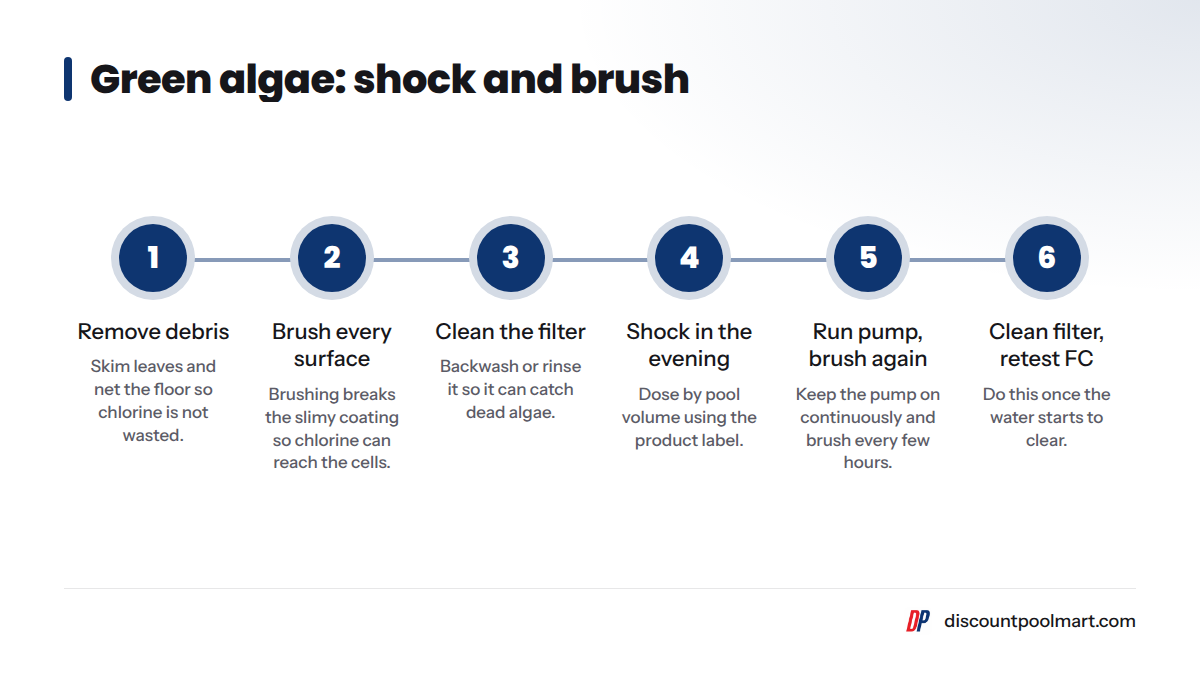
- Remove debris. Skim leaves and net the floor so chlorine doesn't waste itself on organic matter.
- Brush every surface. Use the nylon brush on walls, floor, steps, and behind ladders. Brushing breaks the slimy coating so chlorine can reach the cells.
- Test the water. Record your starting free chlorine.
- Clean the filter. Backwash a sand or DE filter, or rinse a cartridge, so it can catch dead algae.
- Shock. Dose by pool volume using the shock product's label for algae. Apply in the evening so sunlight doesn't burn off the chlorine.
- Add algaecide if your label calls for it, at the label rate.
- Run the pump continuously and brush again every few hours.
- Clean the filter again once the water starts to clear, then retest FC.
Dose table. Shock products vary in strength, so the label on your container controls. Use this layout as a planning tool and fill in your product's label dose:
| Pool volume | Dose per label (green algae) | Notes |
|---|---|---|
| 10,000 gallons | Label dose x 1 | Multiply the per-10,000-gallon label rate |
| 15,000 gallons | Label dose x 1.5 | Typical LA residential size |
| 20,000 gallons | Label dose x 2 | Split large doses into two applications if the label allows |
Always verify against the product in your hand. A label is the only dose source I trust.
Algaecide vs chlorine: which one do you need?
Chlorine does the killing. Algaecide supports it. So for any active bloom, shock first, and bring in algaecide as a booster or for slow-growing patches. Algaecide alone rarely clears a bloom.
If you learn better by watching, this video walks through the process:
Yellow Mustard Algae Treatment
Mustard algae is stubborn because it survives on things that leave the water, so treat the gear too.
- Clean the filter before you start.
- Brush walls, steps, and shaded areas with a stiff nylon brush, then vacuum.
- Shock at the higher FC target your product label lists for mustard algae.
- Add an algaecide labeled for mustard algae, such as Swimtrine Plus or Silver Algaedyn.
- Treat accessories. Soak or rinse ladders, toys, brushes, and swimwear in the shocked pool water or in chlorinated water so spores don't restart the bloom.
- Brush again several times and keep the pump running.
- Clean the filter again, retest FC, and repeat brushing in shaded corners.
Black Algae Treatment for a Plaster Pool
Black algae needs force as well as chemistry. This order works best for plaster.
- Scrape and brush. On plaster or concrete, scrub each dark spot with a stainless steel brush or scraper to break the protective layer.
- Clean the filter.
- Apply targeted treatment. Use chlorine or an algaecide labeled for black algae, such as Black Algaetrine or Hasa Algi-Ban, following the label for spot or whole-pool use.
- Shock the pool to the label's target FC.
- Repeat brushing over several sessions. One pass is rarely enough.
- Clean the filter, retest FC, and re-inspect each spot.
Never use a steel brush on vinyl or fiberglass. Stick with nylon there and check the label for surface limits.
Why Black Algae Treatment Fails on LA Plaster Pools
Our service and retail conversations in Los Angeles turn up the same patterns again and again. This is our own qualitative observation, not a measured study.
- Incomplete brushing. Rough plaster hides roots in tiny pits, and a quick pass skips them.
- Spot treatment without repeat cycles. One treatment knocks the top off the spot while the roots survive.
- Treating too lightly. Under-dosing leaves survivors that regrow.
- Surface condition. Heavily worn or pitted plaster can keep harboring algae, and sometimes resurfacing is the real fix.
Troubleshooting checklist:
- Did you scrape each spot until the dark layer broke?
- Did you repeat the cycle over several sessions?
- Did you hold the label's FC target?
- Is the filter clean?
- Is the plaster pitted or deteriorating?
If water chemistry might be fighting your chlorine, read what cyanuric acid is and balance your water before the next attempt.
Pool Turned Green After Rain: What We See in LA
When a big storm rolls through Southern California, green pools tend to follow. Rain carries leaves, dust, and organic matter into the water and dilutes the sanitizer. A few days later, owners call us about water that looks like pea soup.
The response is the green protocol: pull out debris first, brush, clean the filter, shock per the label, and run the pump continuously. If the water is also cloudy, our guide to fixing cloudy pool water helps. To keep it from happening again, read how to prevent pool algae in Southern California. This page covers treatment only.
How to Confirm the Algae Is Gone and When to Call a Pro
Confirmation checklist
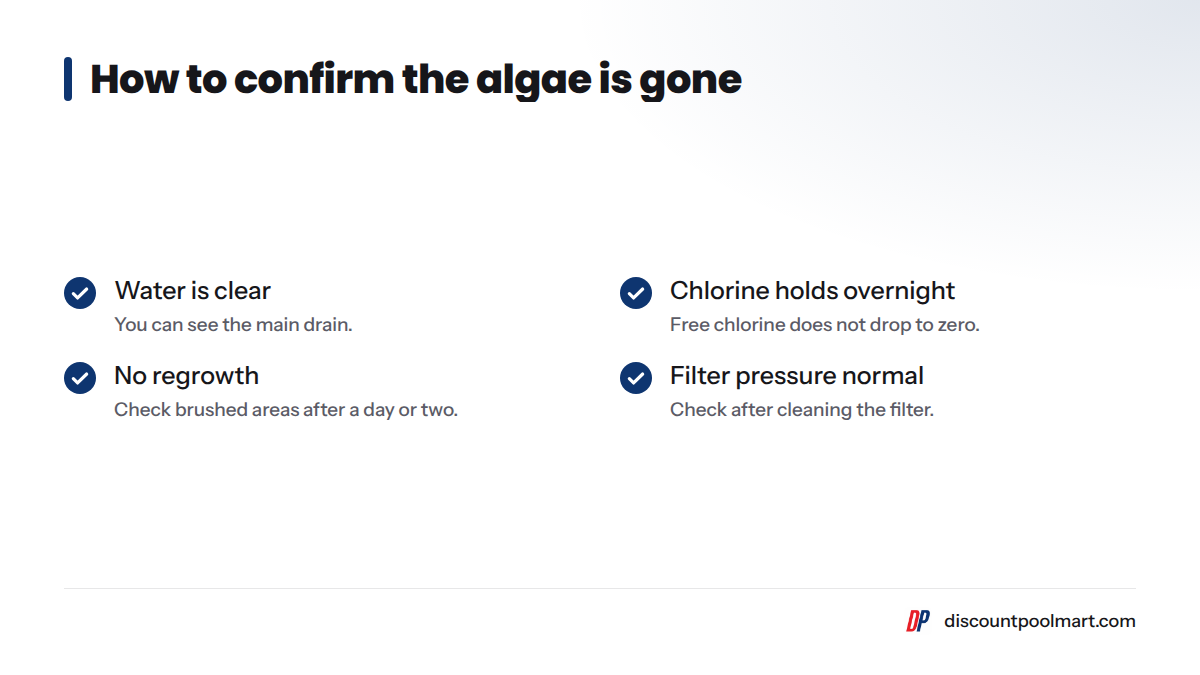
- The water is clear and you can see the main drain.
- Free chlorine holds steady overnight instead of dropping to zero.
- Brushed areas show no regrowth after a day or two.
- Filter pressure is back to normal after cleaning.
Is it safe to swim?
Wait until the water is clear and chlorine is back in the range your test kit and product label list for swimming. The CDC's healthy swimming pages cover general pool safety, and I'm not giving medical advice. If you're unsure, wait another day.
When to call a pro
- Black algae returns after repeated full cycles.
- Blooms keep coming back.
- The plaster is rough, pitted, or damaged.
- Pump or filter problems keep circulation weak. Our team also handles pool pump repair in Los Angeles.
Next steps
Read our pool cleaning guide for routines, and learn to balance your pool water so chlorine works at full strength.
FAQ
Does Dawn dish soap kill algae?
No. Dish soap isn't a pool sanitizer and can foam in your water. Use chlorine and brushing.
Is it okay to swim in a pool with algae?
Skip it. Algae signals low sanitizer, and slippery surfaces add a fall risk. Treat first, then swim once the water is clear and chlorine is in range.
Does shocking a pool kill algae?
Yes. Shocking raises chlorine enough to kill most algae, but you have to brush and filter for it to work fully.
What kills algae better, chlorine or algaecide?
Chlorine is the main killer. Algaecide helps prevent regrowth and supports stubborn types. Use both when the label says to.
How long does it take to clear?
That depends on how bad the bloom is. Plan on several days, and don't expect a guarantee.
Can I treat algae without running the pump?
No. Circulation spreads chlorine and moves dead algae to the filter.
Why is my pool still green after shocking?
Common causes are a dirty filter, too little chlorine, not enough brushing, or water chemistry working against you. Clean the filter, retest, and repeat the cycle.
Does algaecide alone work?
Rarely. It works best alongside chlorine and brushing.