

Cloudy water has a fixed order of repair. Confirm the cause, test and balance the water, shock only if the cause calls for it, run and clean the filter, add clarifier or flocculant to match the problem, then re-test and repeat only what still applies. Not sure what caused it? Start with why your pool water is cloudy, then come back here.
I've watched plenty of Los Angeles pool owners pour in a second bottle of clarifier when the real culprit was a clogged filter. Let's break down the sequence so you spend money once.
The Fastest Order of Operations for Cloudy Water
How do you fix cloudy pool water? Test and balance the water. Shock if free chlorine is low or combined chlorine is high. Run the pump and clean the filter, add clarifier for fine particles or flocculant for heavy suspension, then re-test. Repeat only the step that still applies.
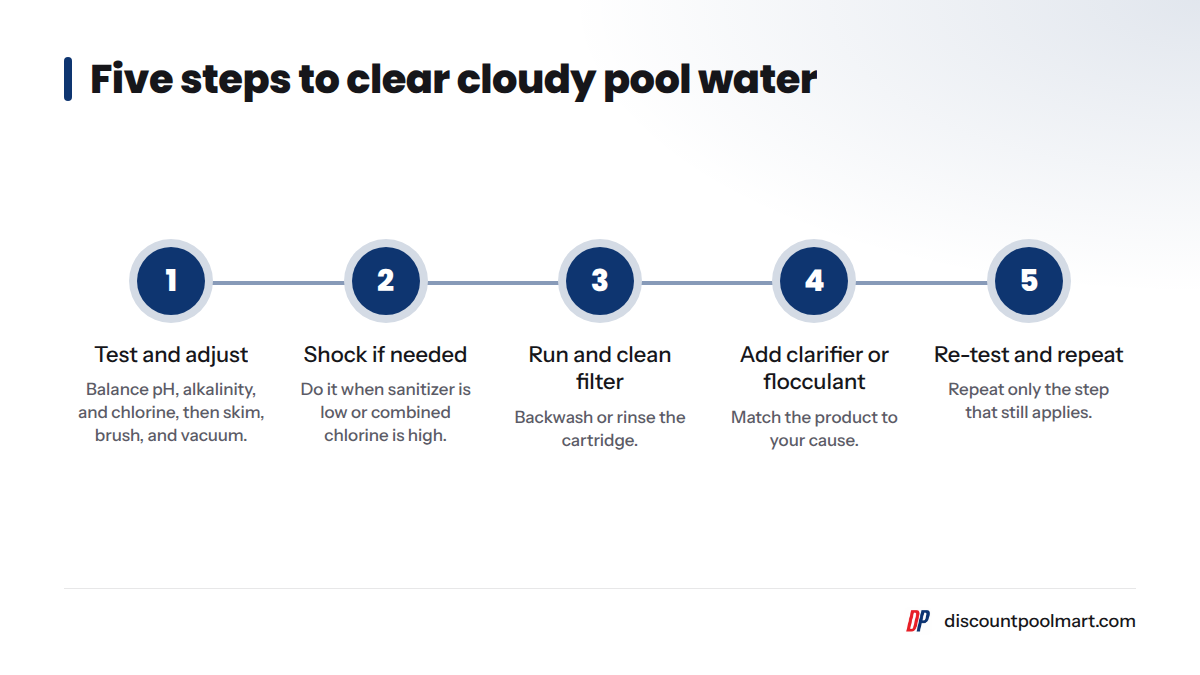
- Test and adjust pH, alkalinity, and chlorine. Skim, brush, and vacuum.
- Shock when sanitizer is low or combined chlorine is high.
- Run and clean the filter (backwash or rinse the cartridge).
- Add clarifier or flocculant to match your cause.
- Re-test, wait, and repeat only what is needed.
Here is how the branches work:
| If your diagnosed cause is... | Go to |
|---|---|
| Chemistry out of range | Step 1 |
| Low sanitizer or high combined chlorine | Step 2 |
| Dirty or undersized filtration | Step 3 |
| Fine suspended particles | Step 4, clarifier |
| Heavy suspension | Step 4, flocculant |
Our pool cleaning guide covers the wider maintenance routine around these steps.
What You Need Before You Start
Supplies checklist
- Test kit or reliable strips (see how to test pool water)
- Pool brush and vacuum
- Shock (calcium hypochlorite or liquid chlorine)
- Clarifier or flocculant
- Filter tools: multiport valve access, backwash hose, or a cartridge hose
- Gloves, splash-proof eyewear, and a clean bucket
Safety first
Read every product label before you open it. The CDC's Healthy Swimming guidance stresses following manufacturer directions for pool chemicals, storing them dry and separate, and never mixing different products together. Add chemicals to water, never water to chemicals, and keep the pump running while you dose.
If you have not identified your cause
I won't re-diagnose here. Our guide on why your pool is cloudy walks through the causes. If a green tint or slime points to algae, you need a separate algae-treatment routine. For prevention, see how to prevent pool algae in Southern California.
Step 1: Test and Adjust the Basics That Block Clearing
Clarifier and shock work poorly in unbalanced water, so test first.
Target ranges
| Parameter | Typical target | Source |
|---|---|---|
| Free chlorine | At least 1 ppm (pools) | CDC Healthy Swimming |
| pH | 7.2 to 7.8 | CDC Healthy Swimming |
| Total alkalinity | 60 to 180 ppm (many pros aim 80 to 120) | PHTA standards and manufacturer guidance |
| Calcium hardness | 150 to 400 ppm | PHTA standards and manufacturer guidance |
| Cyanuric acid (CYA) | Follow your sanitizer label | Product label |
Your product labels and equipment manufacturer may set tighter numbers, so treat the table as a starting point.
Adjust in the right order
Fix alkalinity first, then pH, then sanitizer. Our step-by-step pool water balancing guide gives the full order, and the pool chemistry guide explains each parameter.
Why CYA and calcium hardness matter
High CYA can blunt chlorine, so shock seems to do nothing. Hard water can leave scale and fine particles that stay suspended. Read the CYA explainer before you add more chlorine.
Finish by skimming, brushing walls and steps, and vacuuming what you can reach. Less debris means less work for every step that follows.
Step 2: Shock the Pool Only When It Fits the Cause
When to shock and when to skip it
Shock when free chlorine is low or combined chlorine (chloramines) is high. Skip it when free chlorine is already healthy and the haze is fine dust or dead particles. More chlorine will not filter those out. A clean filter and clarifier will.
Calcium hypochlorite vs. liquid chlorine
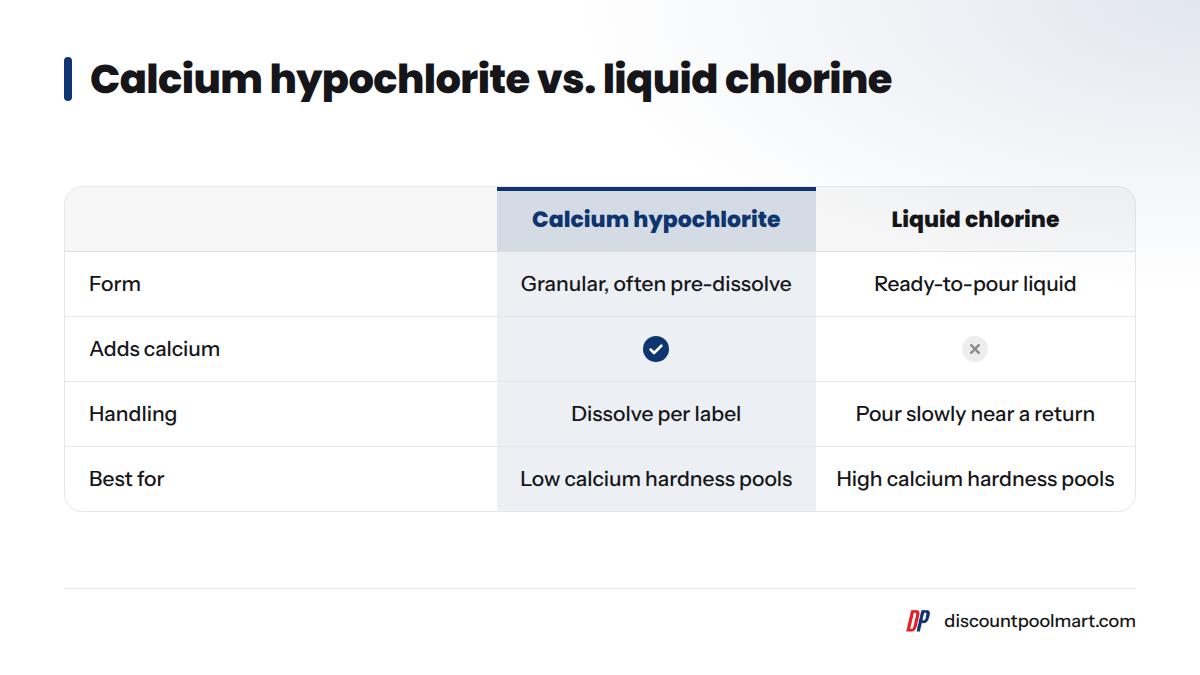
| Calcium hypochlorite | Liquid chlorine | |
|---|---|---|
| Form | Granular, often pre-dissolved | Ready-to-pour liquid |
| Adds calcium | Yes | No |
| Handling | Dissolve per label | Pour slowly near a return |
| Best for | Pools with low calcium hardness; watch calcium levels | Pools with high calcium hardness |
In hard-water Los Angeles, I lean toward liquid chlorine because it adds no calcium. Our HASA liquid chlorine guide covers dosing and safe use.
Dosing and timing
Follow the label for your pool volume. Dose in the evening so sunlight does not burn off the chlorine, and run the pump overnight.
How to clear cloudy pool water after shocking
If the water is still cloudy the next day, the shock did its oxidizing job and left dead particles behind. Do not shock again by reflex. Re-test free chlorine, run the filter continuously, clean it, and move to Step 4.
Step 3: Run the Filter Longer, Then Clean or Backwash It
Cloudy pool water filter run time
Cloudy water needs circulation. Running the pump continuously until the water clears is common practice. Check your equipment manual and PHTA guidance on turnover, and use our pump scheduling guide to set run times without wasting energy.
Cleaning by filter type
| Filter | What to do |
|---|---|
| Sand | Backwash until the sight glass runs clear, then rinse |
| DE | Backwash, rinse, then recharge with DE per manufacturer directions |
| Cartridge | Remove, hose between the pleats, soak if the manual says so, reinstall |
Clean the filter before you add clarifier so pressure starts low. Clean it again after the clumps load it.
When the filter is the problem
Rising pressure, short cycles, or water that never improves can mean worn media or a damaged element. See common pool filter problems.
Step 4: Add Pool Clarifier or Flocculant Based on Your Cause
What is pool clarifier? A product that clumps microscopic particles into pieces large enough for your filter to catch.
What is pool flocculant? A product that binds particles into heavier clumps that sink to the floor, where you vacuum them out.
Clarifier vs. flocculant
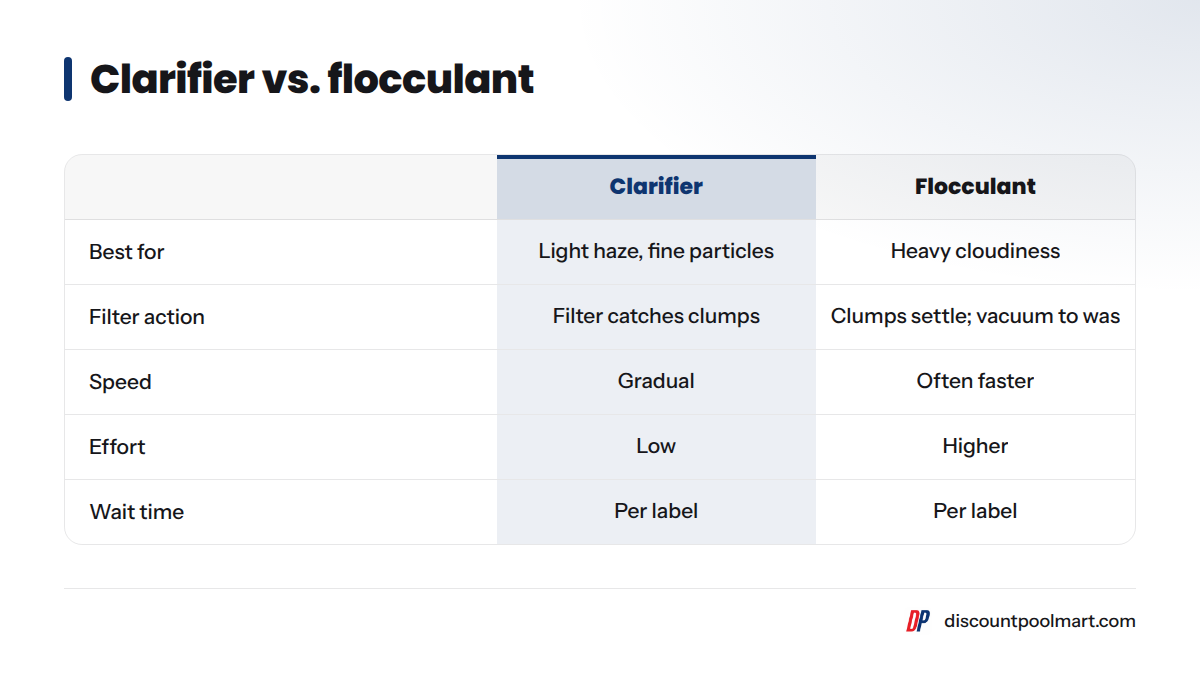
| Clarifier | Flocculant | |
|---|---|---|
| Best for | Light haze, fine particles | Heavy cloudiness |
| Filter action | Filter catches the clumps | Clumps settle; vacuum to waste |
| Speed | Gradual | Often faster, more hands-on |
| Effort | Low | Higher |
| Wait time | Per label | Per label |
Always follow the label for wait times and dose.
How to add clarifier to your pool
- Clean the filter and confirm the water is balanced.
- Run the pump.
- Measure the label dose for your pool volume.
- Pour it slowly around the return jets or into the skimmer.
- Keep circulating for the time the label specifies.
- Clean or backwash the filter afterward.
How to use flocculant
- Set the filter valve to recirculate and dose per the label.
- Run briefly, then turn the pump off so the clumps settle.
- Vacuum the settled material to waste.
- Top up the water level.
Product options
I recommend starting with Poolife Gold Medal Clarifier or Poolife TurboBlu Clarifier. Both are in stock at Discount Pool Mart.
Step 5: Re-Test, Wait, and Repeat Only What Is Needed
Run this checkpoint after each treatment cycle:
- Are free chlorine, pH, and alkalinity back in range?
- Is filter pressure normal after cleaning?
- Is the water visibly clearer at the deep end drain?
- Still hazy? Repeat only the step that still applies.
Test at least once a day while the water is cloudy. I won't promise a clearing time, because it depends on pool size, filter, and cause. Stop rule: if the water is still cloudy after one full cycle of all five steps, go to the next section.
What Clears LA Pools Fastest
Discount Pool Mart works with Los Angeles and Southern California pool owners, and our service records show a consistent pattern. Pools that clear most smoothly get balanced first, then run through a clean filter, with clarifier as a finishing step rather than a first reaction. We have not published specific resolution times or product-combination percentages, so I won't invent numbers. Visit a store if you want to talk through what we see on current service tickets.
How hard water and strong sun change the sequence
Hard water pushes calcium and scale up, so I favor liquid chlorine and keep an eye on calcium hardness. Strong sun burns off chlorine quickly, so evening dosing helps. Scale and metals can also keep water dull. A product such as Orenda SC-1000 scale and metal control addresses that when testing points to it.
When to Call a Pro
Get help when:
- The water has not improved after a full five-step cycle.
- Filter pressure climbs again right after cleaning.
- The pump is noisy, losing prime, or not moving water. See pump troubleshooting or our pool pump repair in Los Angeles.
- You suspect algae. That needs its own treatment plan, not more clarifier.
Bring a water sample to Discount Pool Mart for a test, and we'll tell you which step to repeat.
Frequently Asked Questions
What can I put in my pool if it is cloudy?
It depends on the cause. Use balancing chemicals for off-range water, shock for low sanitizer, clarifier for fine particles, and flocculant for heavy suspension. Test first.
Should I shock or add clarifier first?
Balance first. Shock only if chlorine is low or combined chlorine is high. Clean the filter, then add clarifier.
Why is my pool still cloudy after shocking?
Shock oxidizes contaminants but leaves the particles behind. Run the filter, clean it, and use clarifier or flocculant.
Why is my pool cloudy when my chemicals are fine?
Fine particles or a tired filter are the likely suspects. Clean the filter, run the pump, and try clarifier.
How often should I test while it is cloudy?
At least daily, and after each treatment.
Do I backwash after adding clarifier?
Yes. Clean or backwash after the label wait so trapped particles leave the system.
Can algae cause cloudy water?
Yes, but algae needs its own treatment. See our algae prevention post, and ask us for an algae-treatment plan.
Can I use baking soda or borax?
Baking soda raises alkalinity and borax shifts pH. Neither clears cloudiness on its own, so use them only if testing shows a need.
How do I fix cloudiness after draining and refilling?
Fresh fill water can carry minerals and arrive out of balance. Test, balance, run the filter, then clarify if needed.