

HASA liquid chlorine pool treatment comes down to one simple routine: dose by pool volume, base the amount on a free chlorine test reading, and follow the HASA label. The product is liquid sodium hypochlorite. Because it is unstabilized, it does not add cyanuric acid (CYA) the way trichlor tablets do. This guide covers dosing, safe addition, storage, and how liquid compares with tablets.
I write this from the counter of an authorized HASA dealer. At Discount Pool Mart, the same three questions come up every week: "How much do I pour?" "Where do I pour it?" "Why does my chlorine vanish by Sunday?" Let's break it down.
What HASA Liquid Chlorine Is and Why It Doesn't Raise CYA
HASA liquid chlorine is liquid sodium hypochlorite, an unstabilized chlorine sanitizer that raises free chlorine without adding cyanuric acid. HASA lists its Hasachlor product as HASA 12.5% liquid chlorine on its Hasachlor product page, HASA. Confirm the strength printed on your own jug's label before you dose.
Liquid sodium hypochlorite in plain terms
Free chlorine (FC) is the chlorine in your water that is available to sanitize. "Stabilized" chlorine carries cyanuric acid with it. "Unstabilized" chlorine, like HASA sodium hypochlorite, does not. You add chlorine and nothing else that lingers.
Does liquid chlorine raise CYA? No, and trichlor does
Trichlor tablets contain cyanuric acid as part of the molecule. Each time a tablet dissolves, it leaves CYA behind, and CYA does not leave the pool on its own. HASA makes the same argument on its Make the Switch to Sani-Clor Liquid Chlorine, HASA page. Liquid chlorine leaves no such residue. For stabilizer targets and ways to lower a high reading, read what is cyanuric acid in pool water.
Product names: HASA sells this chemistry under names including HASA Chlor (Hasachlor) and HASA Sani-Clor. Check the label on your container for the exact product and strength.
What You Need Before You Dose
Gather these first:
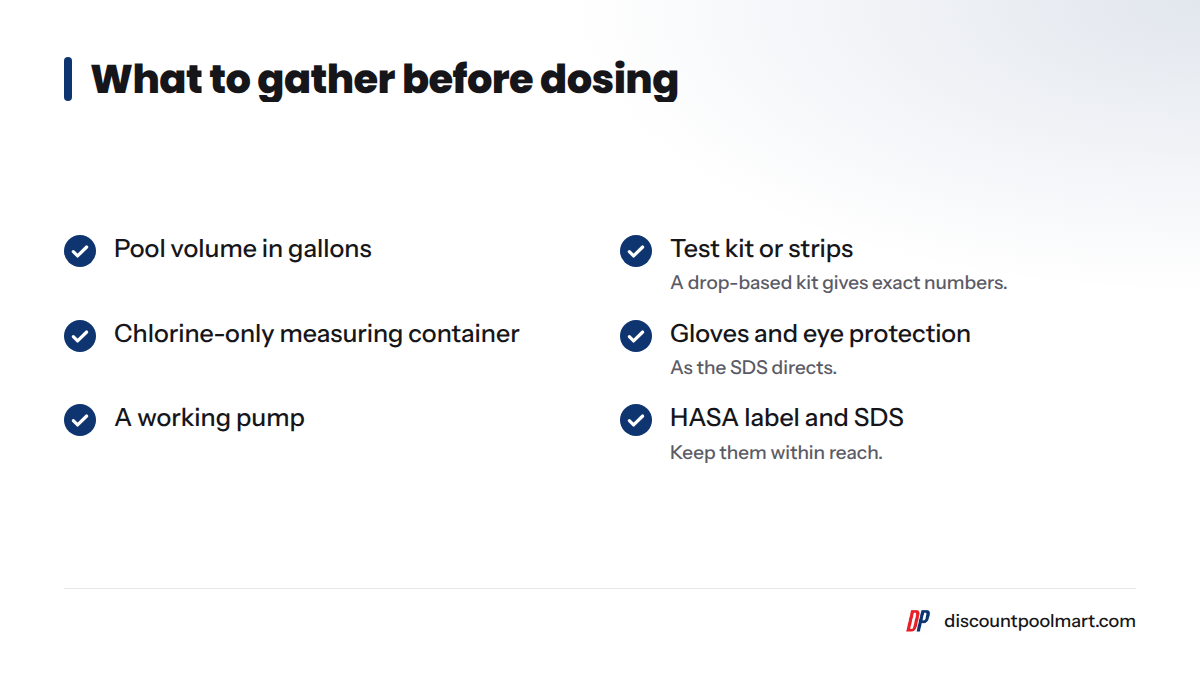
- Your pool volume in gallons
- A test kit or test strips (see how to test pool water for kit types)
- A measuring container used only for chlorine
- Gloves and eye protection, as the Safety Data Sheet (SDS) directs
- A working pump
- The HASA label and SDS within reach
My opinion: a drop-based kit beats strips for dosing decisions, because you read exact numbers. The Taylor Complete FAS-DPD kit tests chlorine, pH, alkalinity, hardness, and CYA in one box.
Know your target
Your FC target depends on your CYA level, so test both. The CDC's Healthy Swimming, Centers for Disease Control and Prevention guidance sets minimum free chlorine levels for public pools, while home pool targets shift with stabilizer. Your CYA reading and your pool pro can help you settle on a number for your pool.
How Much Liquid Chlorine to Add to Pool Water: HASA Liquid Chlorine Dosing Step by Step
HASA's Hasachlor page gives a dosing example of 10 fluid ounces to raise free chlorine by 1 ppm in 10,000 gallons. Treat that as a starting point and check it against the label and SDS on your jug.
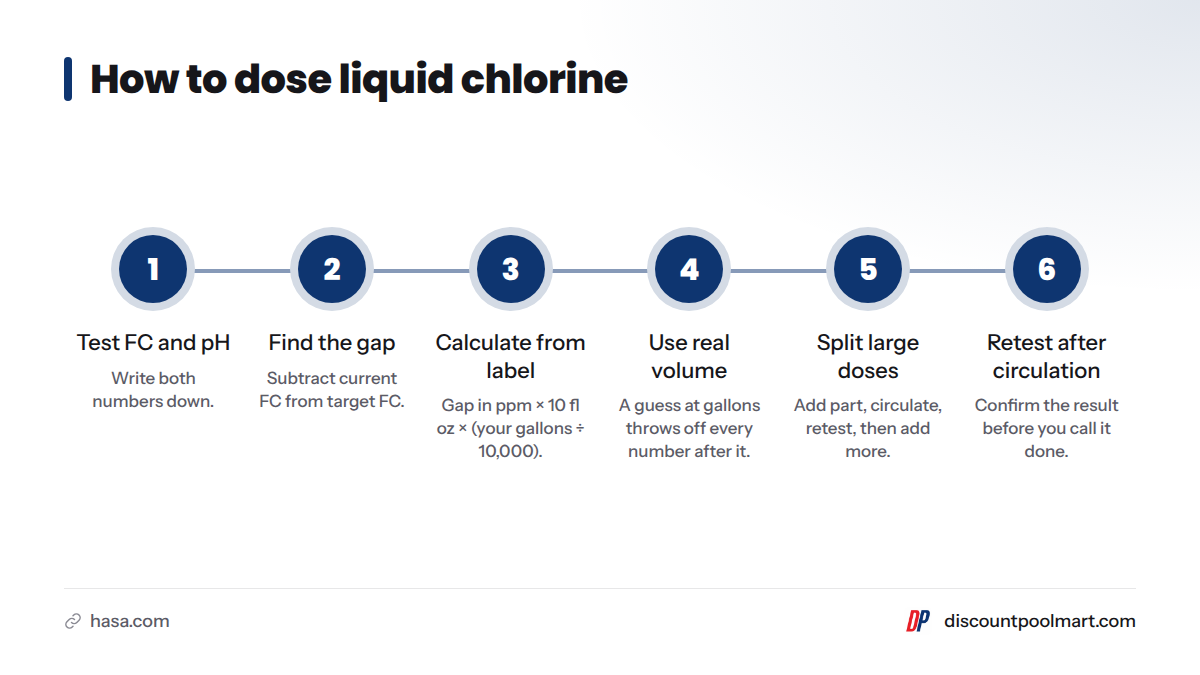
- Test FC and pH. Write both numbers down.
- Find the gap. Subtract your current FC from your target FC.
- Calculate from the label figure. Gap in ppm × 10 fl oz × (your gallons ÷ 10,000).
- Use your real volume. A guess at gallons throws off every number after it.
- Split large doses. Add part, circulate, retest, then add more.
- Retest after circulation. Confirm the result before you call it done.
Worked examples (label-based)
These figures come from the HASA example above. They are arithmetic, not a substitute for your label.
| Pool volume | Raise FC by 1 ppm | Raise FC by 2 ppm | Raise FC by 3 ppm |
|---|---|---|---|
| 10,000 gal | 10 fl oz | 20 fl oz | 30 fl oz |
| 15,000 gal | 15 fl oz | 30 fl oz | 45 fl oz |
| 20,000 gal | 20 fl oz | 40 fl oz | 60 fl oz |
| 30,000 gal | 30 fl oz | 60 fl oz | 90 fl oz |
Shocking or clearing algae? Higher doses apply. Follow the label directions for your situation, and see how to prevent pool algae in Southern California.
Once FC sits where you want it, the rest of your water needs attention too. Our pool water chemistry guide and how to balance pool chemicals safely cover the full sequence.
How to Add It Safely and Let It Circulate
Safety first. Follow the SDS for handling specifics. These are the habits I see matter most:
- Run the pump before you pour.
- Pour low and slow near a return jet so the chemical disperses fast.
- Keep the jug close to the water's surface to avoid splashing.
- Never pour it into the skimmer.
- Never mix it with acid or any other chemical.
- Keep children and pets away while you work.
- Cap the jug and put it away before you do anything else.
Circulation and pump runtime after dosing
Moving water spreads the chlorine evenly. Keep the pump running so the dose passes through the whole pool and filter loop. Run time depends on your system, so see pool pump scheduling for how to set it.
Timing and sunlight
Sunlight breaks down unstabilized chlorine quickly. That is the honest trade-off against tablets, and it explains the vanishing Sunday chlorine. Dosing at dusk gives the chlorine a night to work before the sun starts burning it off.
Quick troubleshooting
| Symptom | Likely cause | Next step |
|---|---|---|
| FC drops fast after dosing | Sun loss or high chlorine demand | Dose at dusk, retest the next day |
| Cloudy water after shocking | Filter still catching particles | Run the pump, see why pool water gets cloudy |
| Strong chlorine smell | Combined chlorine, not too much FC | Test FC, then follow label shock directions |
| Reading did not change | Too little dose or old product | Retest, check your math and jug label |
How to Store Liquid Chlorine
Liquid chlorine loses strength over time, and heat speeds that up. Check the SDS and label for shelf life and storage limits. I won't guess at a number for you.
| Do | Don't |
|---|---|
| Keep it in the closed original container | Pour it into an unmarked bottle |
| Store it cool and shaded | Leave it in a hot garage or in direct sun |
| Keep it upright | Stack heavy items on it |
| Store it away from acids and other chemicals | Shelve it next to muriatic acid |
| Keep it out of reach of children | Leave an open jug unattended |
HASA Liquid Chlorine vs Tablets: Which Fits Your Pool
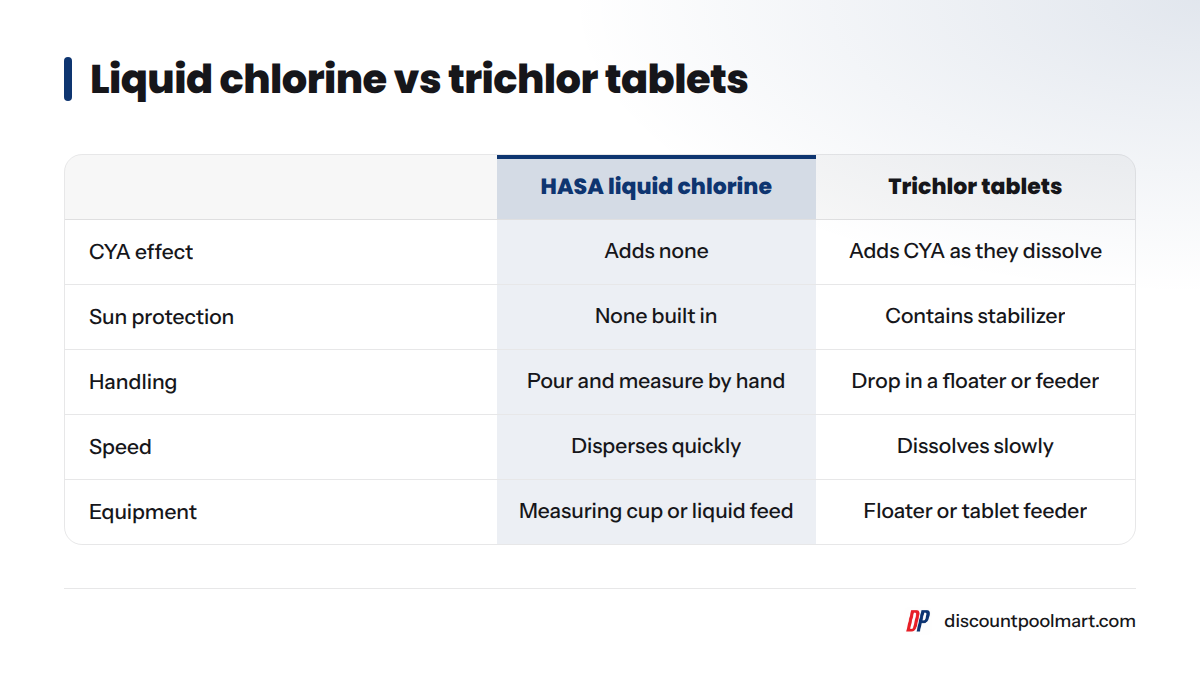
Both work. They suit different pools and different people. Here is how liquid chlorine vs trichlor tablets stacks up:
| Factor | HASA liquid chlorine | Trichlor tablets |
|---|---|---|
| CYA effect | Adds none | Adds CYA as they dissolve |
| Sun protection | None built in | Contains stabilizer |
| Handling | Pour and measure by hand | Drop in a floater or feeder |
| Dosing frequency | More hands-on, or automatic with a liquid feeder | Slow release over days |
| Speed | Disperses quickly | Dissolves slowly |
| Equipment | Measuring cup or liquid feeder | Floater or tablet feeder |
Decision box:
- Choose liquid if you want to control CYA, run a salt system and want a backup, or like testing and adjusting.
- Choose tablets if you want low-effort, steady dosing and your CYA stays in range.
- Go hybrid if you want tablets for convenience and liquid for quick fixes.
- Want it automatic? The HASA Liquid Feeder meters liquid chlorine into your system. If you are on tablets now, a floating tablet feeder is the simple option.
Running a saltwater pool? Liquid chlorine makes a handy backup when the cell falls behind. See our saltwater chlorinator guide.
Where to Find HASA Liquid Chlorine Near Me
Discount Pool Mart is an authorized HASA dealer with a direct manufacturer relationship. HASA manufactures and distributes from Southern California, so we talk about the product from firsthand experience. If you search for HASA liquid chlorine near me, call or stop by the store to confirm what is on the shelf today. I won't promise stock I can't see. Our pool chemical guide for LA homeowners is a good read on the way in.
FAQ
Is HASA chlorine good?
HASA is a long-established pool chemical manufacturer, and its liquid chlorine is standard sodium hypochlorite sold in the strength printed on the label. It works when you dose by volume and test results. Whether it is right for you depends on your pool and routine.
Is it okay to put liquid chlorine in a pool?
Yes. Liquid sodium hypochlorite is a common pool sanitizer. Follow the label, run the pump, pour near a return jet, and test before and after every dose.
What is HASA chlorine?
It is HASA's line of liquid sodium hypochlorite for pools, sold under names including HASA Chlor (Hasachlor) and Sani-Clor. It sanitizes water and shocks pools without adding CYA.
What's the best liquid chlorine for pools?
Look for a labeled pool-grade sodium hypochlorite with a clear strength on the container and a fresh supply. Strength fades with age and heat, so a recent batch matters more than a brand claim.
Does liquid chlorine raise CYA?
No. Liquid sodium hypochlorite is unstabilized and carries no cyanuric acid. Trichlor and dichlor products do add CYA as they dissolve.
Can I pour it directly into the pool?
Yes, if you pour it low and slow near a return jet with the pump running. Never pour it into the skimmer or mix it with other chemicals.
Is it safe for salt pools?
HASA states that its liquid chlorine works with salt systems. Confirm with your equipment maker, follow the label, and test your water after dosing.
How should I store it?
Keep it in the closed original container, upright, cool, shaded, and away from acids and children. Check the SDS for shelf life.
How long should I wait before swimming?
Follow the product label and wait for a test reading in your target range. This guide does not replace the label.
Next steps
Test your water, do the math with your pool's gallons, and dose in steps. Retest, then adjust. If you want help picking a kit, a feeder, or the right jug size, Discount Pool Mart is ready at the counter.
Always follow the product label, and test before and after every dose.