

Here is the short answer on how to prevent pool algae: test your water weekly, hold free chlorine in the right ratio to cyanuric acid, keep pH and alkalinity in range, brush every surface, control phosphates, and run your pump long enough to circulate all the water. This guide covers pool algae prevention only. If algae has already shown up, read our guide on how to treat pool algae first, then come back here to stop a repeat.
I have watched good pool owners lose a green-free summer in a single hot weekend. They "did maintenance." The water still turned. The cause is almost always one lever out of order, and the fix is a routine you can repeat.
The pool algae prevention routine at a glance
- Test and log your water once a week (twice in summer).
- Keep free chlorine matched to your cyanuric acid (CYA) level.
- Keep pH and total alkalinity in range so chlorine works.
- Brush walls, steps, and corners every week.
- Check phosphates and reduce them if they run high.
- Run the pump long enough, and keep the filter clean.
- Adjust for heat, storms, heavy use, and wildfire ash.
Why Southern California Pools Face Year-Round Algae Pressure
Algae needs three things: spores, nutrients, and light. Spores arrive on wind, rain, leaves, and swimmers, and you cannot keep them out. You can only deny them a place to grow. That is the whole logic behind pool algae prevention in Southern California.
Warm Water and Strong Sun Work Against Your Chlorine
Los Angeles-area pools stay warm for most of the year, and warm water speeds up algae growth. Strong sunlight also burns off unprotected chlorine fast, which is why a stabilizer matters here. The CDC's Healthy Swimming guidance on pool chemistry notes that sunlight degrades chlorine and that stabilizer slows that loss.
What We See From Local Service Work
At Discount Pool Mart, we have served LA-area pool owners for 40 years. Our own service experience points to a pattern. Pools rarely go green because owners skip chlorine. They go green because chlorine, CYA, and circulation drift out of balance during a hot stretch, and nobody notices for a week. I will not quote figures we cannot back up. The pattern is consistent enough that this routine is built around catching drift early. For product guidance specific to our region, see our pool chemical guide for LA homeowners.
Step 1: Test Your Water Weekly and Log the Results
You cannot prevent what you do not measure. Weekly pool maintenance to prevent algae starts here. Test at least once a week, and twice a week in summer or after heavy use.
Strips, Drop Kits, and Digital Testers Compared
| Method | Speed | Precision | Best for |
|---|---|---|---|
| Test strips | Fastest | Lowest, color matching is subjective | Quick weekly checks |
| Drop (reagent) kit | Moderate | High when you read it carefully | Owners who want accurate CYA and chlorine readings |
| Digital tester | Fast | High, removes color guessing | Owners who test often |
Strips are fine for a quick look. If a reading surprises you, confirm it with a drop kit. Our guide on how to test pool water walks through all three.
What to Write Down
Keep a simple log with the date, free chlorine, CYA, pH, total alkalinity, and anything unusual (storm, party, heat). Trends tell you more than a single reading. A slow chlorine drop across three entries warns you days before the water changes color.
Step 2: Match Free Chlorine to Cyanuric Acid
This is the step most "maintained" pools get wrong. The free chlorine and cyanuric acid ratio decides whether your sanitizer actually works.
What Free Chlorine Does
Free chlorine is the sanitizer that stops algae spores from taking hold. Liquid chlorine is a common way to add it, and many owners dose a little every few days rather than a lot at once.
How CYA Protects Chlorine, and How Too Much Locks It Up
Cyanuric acid shields chlorine from UV, which is useful in Southern California. But CYA also binds chlorine, so the higher your CYA, the more free chlorine you need to keep the same sanitizing power. A pool with high CYA can show a "fine" chlorine reading and still grow algae, because much of that chlorine is bound up and slow to act. Our CYA explainer covers how to measure and lower it.
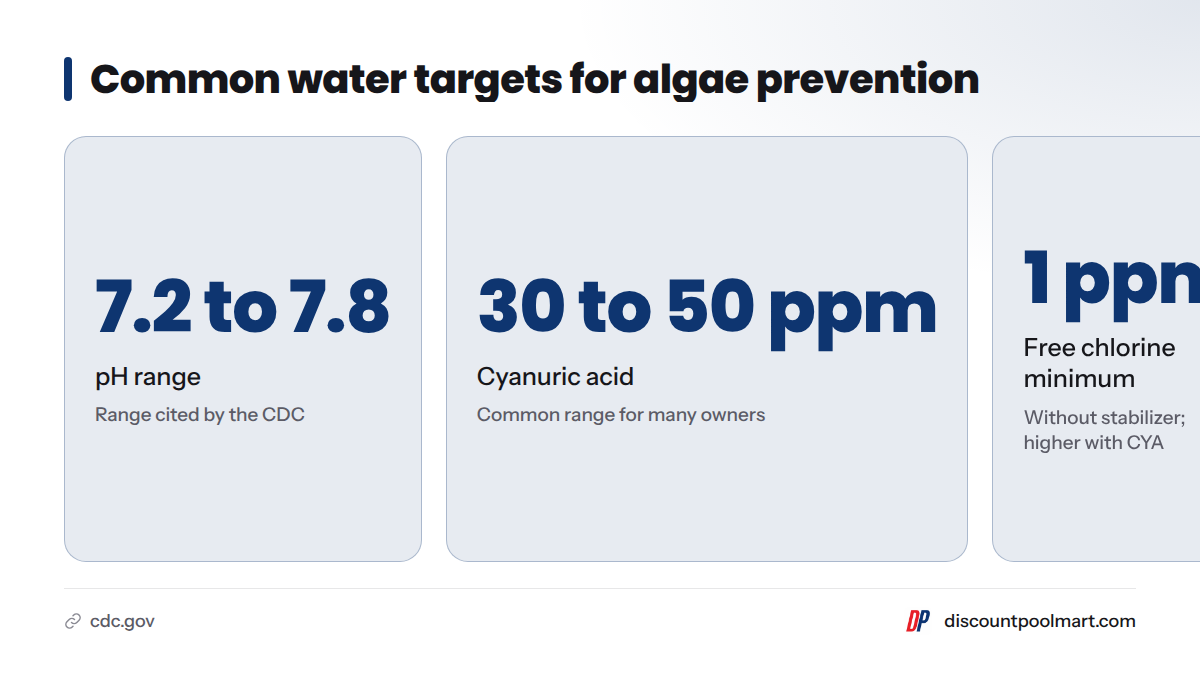
| Parameter | Common target | Source |
|---|---|---|
| Free chlorine | At least 1 ppm in pools without stabilizer, higher with CYA | CDC Healthy Swimming |
| Cyanuric acid | 30 to 50 ppm is a common range for many owners | Manufacturer and industry guidance; check your chlorine product label |
| pH | 7.2 to 7.8 | CDC Healthy Swimming |
Free chlorine minimums rise as CYA rises. Check your product label and ask your pool professional for the exact pairing for your pool.
Step 3: Keep pH and Alkalinity in Range
Chlorine weakens as pH climbs. When pH runs high, the chlorine reads present but works slowly. Total alkalinity acts as a buffer, so it keeps pH from swinging. Hold pH in the 7.2 to 7.8 range cited by the CDC, and adjust alkalinity first if pH keeps bouncing. Our guide on how to balance pool water gives the order of adjustments, and our pool water chemistry guide explains all six parameters.
Step 4: Brush Walls, Steps, and Corners Every Week
Brushing breaks up the thin film where algae first anchors, and it pushes spores back into the water where chlorine can reach them. Do it weekly, and again after heavy use or rain. It is one of the simplest ways to keep algae out of a pool.
Where Algae Hides
Start in the dead spots, where water barely moves:
- Steps and benches
- Corners and the floor-to-wall seam
- Behind ladders and handrails
- Around return fittings and light niches
Match the Brush to Your Surface
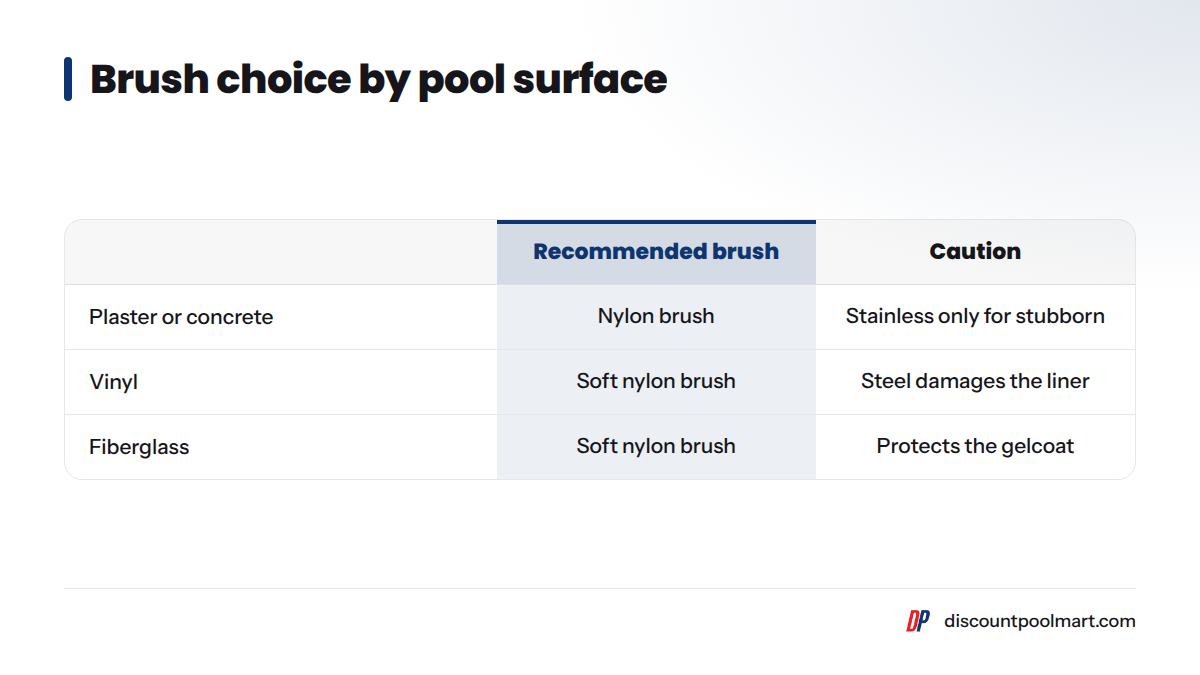
- Plaster or concrete: a nylon brush is the safe default. Stiffer stainless brushes are for stubborn spots on hard plaster only.
- Vinyl: use a soft nylon brush. Steel will damage the liner.
- Fiberglass: use a soft nylon brush to protect the gelcoat.
A sturdy pole makes a weekly brushing habit easier. See our best pool poles guide.
Step 5: Control Phosphates Before They Feed Algae
Where Phosphates Come From
Phosphates are a nutrient algae can use to grow. They enter pools through fertilizer runoff, leaves, dust, and some source water. Phosphates and pool algae are linked, but phosphates alone do not create algae. High levels simply give it more to work with when chlorine slips.
When a Phosphate Remover Makes Sense
Test for phosphates a few times a season. If your reading is high and algae keeps returning, a phosphate remover can help. Follow the dosing on the manufacturer's label exactly, and retest after filtering. Skip it if your phosphates are low and your chlorine is steady. Chemistry and circulation come first.
Step 6: Run the Pump Long Enough and Keep the Filter Clean
Algae settles where water sits still. Your pump has to move the full volume of water through the filter and past the chlorine often enough to keep it mixed.
Pump Run Time
A common rule is to turn over the full pool volume at least once a day, and many owners run longer in hot weather, often 8 to 12 hours. Your pool size and pump set the real number. Our pump scheduling guide shows how to set run times, and an automation setup can keep them consistent. If your pump is failing, see our Los Angeles pump repair page.
Filter Cleaning and Backwash
A clogged filter cuts flow and leaves dead spots. Clean cartridges, backwash sand or DE filters, and follow the pressure reading on your gauge. Our filter cleaning guide covers each filter type.
Step 7: Adjust Your Routine for Heat, Storms, Heavy Use, and Wildfire Ash
Your baseline routine covers a normal week. These situations put extra demand on your sanitizer.
| Situation | What to change |
|---|---|
| Heat wave | Test twice a week, run the pump longer, and check chlorine mid-week |
| Storm or heavy rain | Brush, empty the skimmer baskets, clean the filter, and retest chlorine and pH |
| Heavy use | Brush and retest within a day, since swimmers add organic load |
| Wildfire ash | Skim and filter out debris, clean the filter more often, and retest chemistry |
Ash and debris add organic material that consumes chlorine, so retest afterward rather than assume your numbers held. For local conditions during fire events, check guidance from the US EPA before cleanup.
Why Does Algae Keep Coming Back Even Though I Maintain My Pool?
Here is why repeat blooms happen, matched to the fix.
| Symptom | Likely cause | Fix |
|---|---|---|
| Chlorine reads fine, algae still grows | CYA too high | Test CYA, then lower it by partial draining |
| Algae returns on steps and corners | Skipped brushing or dead spots | Brush weekly, check return direction |
| Algae returns after heat or storms | Chlorine demand spiked | Test mid-week, adjust the routine |
| Persistent growth, steady chemistry | High phosphates or short pump runs | Test phosphates, extend run time |
| Water also looks hazy | Filtration problem | See cloudy water causes |
Weekly Algae Prevention Checklist
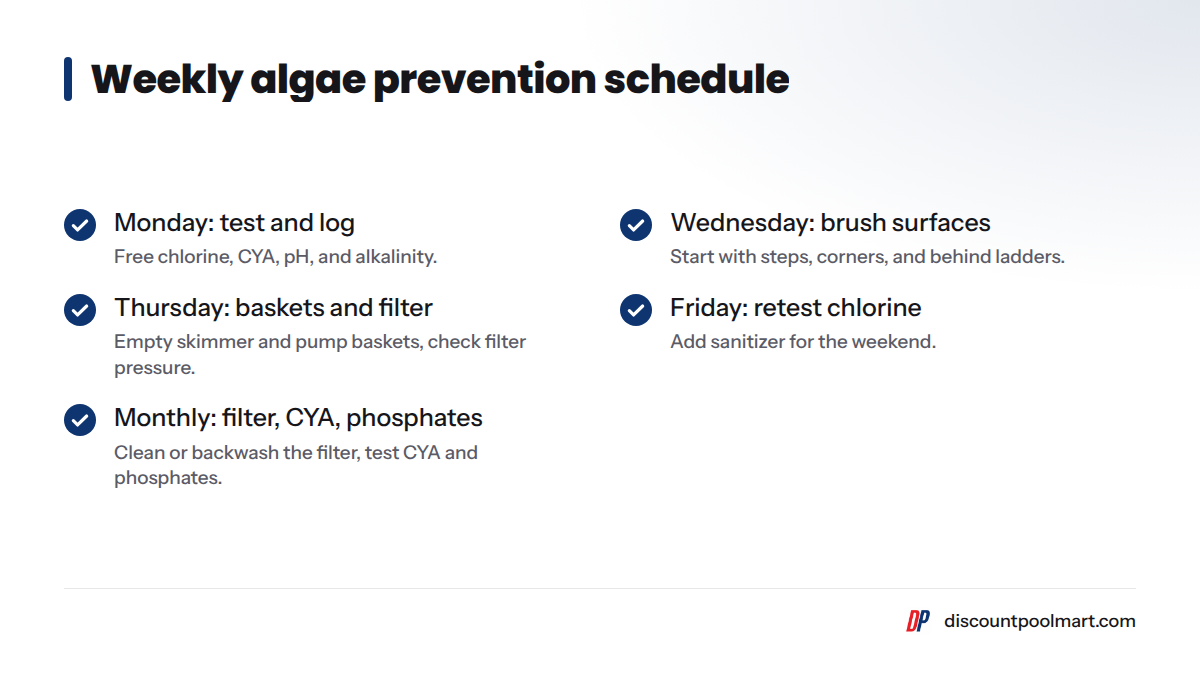
- Monday: Test water and log free chlorine, CYA, pH, and alkalinity.
- Tuesday: Adjust pH and alkalinity if needed. Check the pump schedule.
- Wednesday: Brush all surfaces, starting with steps, corners, and behind ladders.
- Thursday: Empty skimmer and pump baskets. Check filter pressure.
- Friday: Retest chlorine and add sanitizer for the weekend.
- Weekend, after heavy use: Brush again and retest.
- Monthly: Clean or backwash the filter. Test CYA and phosphates.
Frequently Asked Questions
How do I stop algae from growing in my pool?
Keep free chlorine matched to your CYA, hold pH in range, brush weekly, circulate the water long enough, and watch phosphates. No single step does it alone.
What can I put in my pool to stop algae?
Start with balanced chemistry and steady sanitizer. A phosphate remover can help when phosphates are high. Follow label directions on any product.
How often should I brush my pool?
Weekly, plus after heavy use or rain.
How many hours should the pump run?
Long enough to turn over the full pool volume at least once a day. Many owners run 8 to 12 hours in hot weather.
Does high CYA cause algae?
It can. High CYA binds chlorine, so a normal-looking reading may not sanitize well.
Do phosphates cause algae?
They feed it. They do not start it without spores and weak sanitizer.
Can I ever fully prevent algae?
No honest guide can promise that. A steady routine makes algae far less likely and easier to catch early, and it is the best way to keep pool water from turning green.
Where do I go if algae has already appeared?
Use our guide on how to treat pool algae. Prevention steps will not clear an active bloom.
Next Steps
Print the checklist, test your water this week, and start your log. If your numbers look off, our pool water chemistry guide is the next stop, and the team at Discount Pool Mart can help you read your results. Consult a pool professional if readings stay out of range after you adjust.