

Why is my pool water cloudy? In most pools, one of five things is behind it: low or ineffective chlorine, high pH, poor filtration or circulation, an early algae bloom, or calcium scaling. Each has a quick test that confirms it. Run the right test first and you stop guessing, stop dumping in chemicals you don't need, and get clear water back sooner.
I know the feeling. You walk out on a sunny Saturday, the pool looked fine on Thursday, and now it looks like someone stirred in a glass of milk. Let's break it down so you can find your cause in about five minutes.
The Five Most Common Cloudy Pool Water Causes
Cloudy water is a turbidity problem. Tiny suspended particles scatter light, and your eye reads that as haze or a milky look. Those particles can be dead algae, scale crystals, oils, or fine debris that slips past the filter.
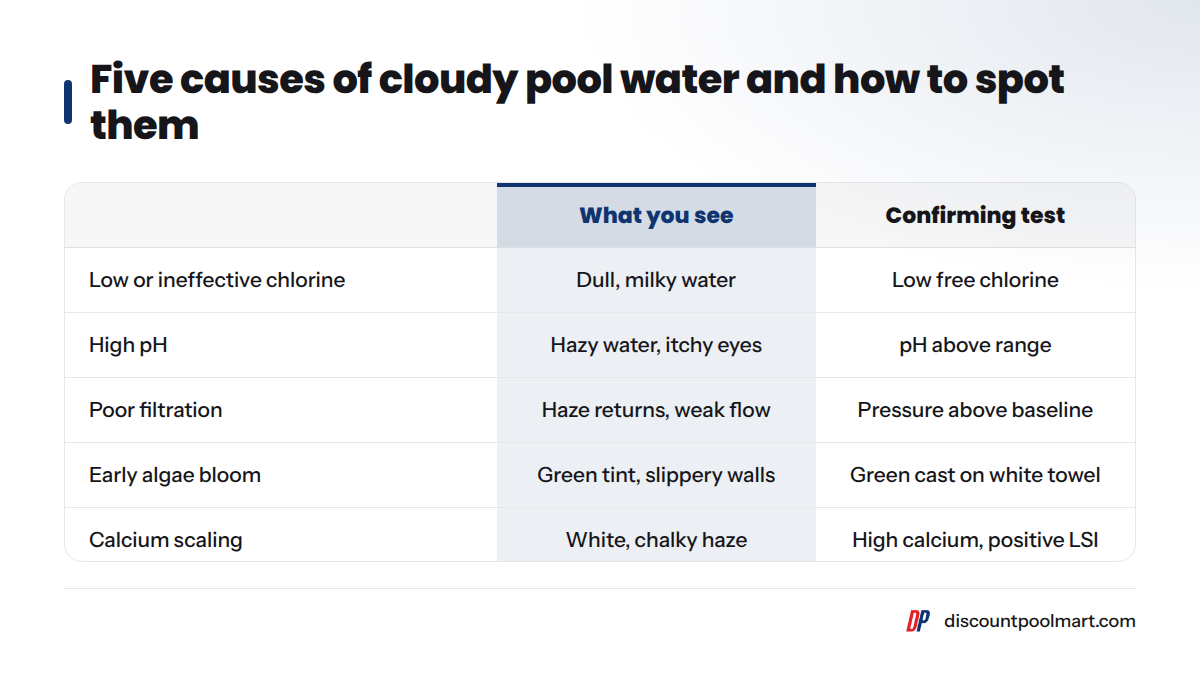
Here are the five causes, listed in the order we see them most often on Los Angeles-area pool service calls at Discount Pool Mart:
- Low or ineffective chlorine. Test free chlorine and compare it to total chlorine.
- High pH. Test pH with a reliable kit.
- Poor filtration or circulation. Read the filter pressure gauge against your clean baseline.
- Early algae bloom. Look for a dull or green tint and slippery walls.
- Calcium scaling. Look for white crust on tile and test calcium hardness.
| Cause | What you see | One-line confirming test |
|---|---|---|
| Low or ineffective chlorine | Dull, milky water; sometimes a strong chlorine smell | Free chlorine is low, or total chlorine is well above free chlorine |
| High pH | Hazy water, itchy eyes, chlorine that seems to "do nothing" | pH reads above the recommended range |
| Poor filtration or circulation | Haze that returns after cleaning, weak return flow | Filter pressure sits well above clean baseline, or the pump runs too few hours |
| Early algae bloom | Green tint, slippery walls, haze that worsens in sun | Green cast on a white towel or wall; low free chlorine |
| Calcium scaling | White, chalky haze; rough crust on tile or heater | High calcium hardness, high pH and alkalinity, positive LSI |
One caution: cloudy water often has more than one cause at once. High pH weakens chlorine, weak chlorine invites algae, and a tired filter lets the haze linger. Test before you treat.
What Our LA-Area Service Calls Show
Where this ranking comes from
The order above reflects the experience of the Discount Pool Mart team on cloudy-water service calls across the Los Angeles area. We have not published a call-by-call dataset for this article, so we're not quoting percentages. Treat the ranking as field experience, not a statistical study. If we publish figures later, we'll state the date range and sample size beside them.
Most to least common
In our records, low chlorine comes first, then high pH, poor filtration, algae bloom, and calcium scaling. The first two often travel together, which is why one test session usually finds the answer.
Why Southern California heat, sun, and hard water matter
Three local factors push pools toward cloudiness:
- Heat and sun burn through chlorine quickly, and warm water speeds up algae growth.
- Long swim seasons mean more sunscreen, sweat, and oils reaching the water.
- Hard water raises calcium hardness, which sets the stage for scale. Southern California pool hard water varies by area, so check your local utility's water quality report, such as those from the Metropolitan Water District of Southern California.
Cloudy Pool Low Chlorine: How to Confirm It
Free chlorine versus combined chlorine
Free chlorine is the chlorine still available to sanitize. Combined chlorine (chloramines) is chlorine that has already reacted with sweat, oils, and other waste, and it no longer cleans well. The CDC's Model Aquatic Health Code lists recommended chemistry ranges for pools, and many pool owners use its free chlorine guidance as a reference point.
The one-line test
Measure free chlorine and total chlorine. Combined chlorine is total minus free. If free chlorine is low, or combined chlorine is noticeable, the sanitizer is losing to the load in the water. A strip can look "fine" and still hide a high combined number, so a drop-based or digital test gives a clearer picture. Our guide on how to test your pool water walks through strips, drops, and digital readers.
When the pool water is cloudy but chlorine is fine
Cyanuric acid (CYA) shields chlorine from sunlight. Too much of it slows chlorine down, so you can read a "normal" free chlorine number and still see haze. That is the usual answer when someone says the pool water is cloudy but chlorine is fine.
Cloudy Pool High pH: How to Confirm It
How high pH clouds water and weakens chlorine
When pH climbs, chlorine sanitizes less effectively, and dissolved minerals drop out of solution more easily. Both effects lead to hazy pool water. High total alkalinity makes pH drift upward and stay there.
The one-line test
Take a pH reading. The Pool & Hot Tub Alliance (PHTA) publishes industry standards with recommended water balance ranges, and most guidance puts ideal pH in the low-to-mid 7s. A reading above that range makes high pH a prime suspect. Then check total alkalinity, since it explains why pH keeps rising. Our pool water chemistry guide covers all six parameters in plain language.
Cloudy Pool Filter Problem: How to Confirm It
Read the gauge against your clean baseline
Right after you clean a sand, cartridge, or DE filter, note the pressure on the gauge. That is your clean baseline. When pressure climbs well above it, the filter is loaded and passing less water. A reading far below baseline can point to a blocked line or an air problem upstream. Either way, fine particles stay in the pool.
Pump run time and circulation
Water only gets filtered while the pump runs. Hot, heavily used pools often need longer run times than owners expect. Our guide to pump run time shows how to set a schedule. If the pump itself is struggling, see our pool pump repair service in Los Angeles.
The one-line test
Compare today's filter pressure to your clean baseline, then count your daily pump hours. Weak return flow, a rising gauge, or a short run schedule points to a filtration problem.
Bather load matters too. After a pool party, sunscreen and oils can overwhelm a filter that copes fine on quiet days. That is the usual story when pool water turns cloudy after swimming.
Early Algae Bloom: How to Confirm It
Signs of early algae
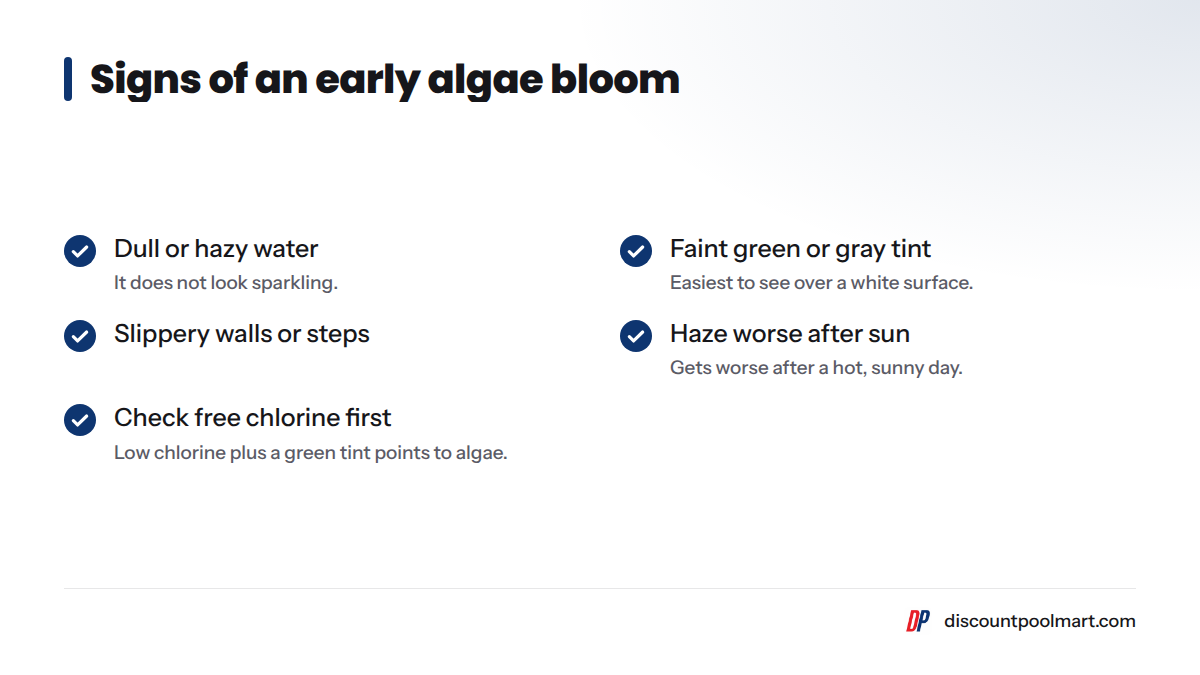
Early algae doesn't always look green. Watch for:
- Water that looks dull or hazy rather than sparkling
- A faint green or gray tint, easiest to see over a white surface
- Slippery walls or steps
- Haze that gets worse after a hot, sunny day
The one-line test
Check free chlorine first. Low chlorine plus a green tint or slippery walls points to an early algae bloom. Hold a white towel or bucket in the water to judge the color. We leave treatment steps out of this page on purpose, because the right plan depends on how far the bloom has gone. When you're ready, use our algae treatment guide for next steps.
Calcium Scaling in Hard Water: How to Confirm It
How hardness, pH, alkalinity, and heat combine into scale
Calcium scaling happens when dissolved calcium comes out of the water as tiny white crystals. High calcium hardness, high pH, high alkalinity, and warm water all push in that direction. Southern California's hard tap water and hot summers make scale a regular visitor in local pools, and it is a common reason for calcium scaling pool cloudy complaints.
LSI explained simply
The Langelier Saturation Index (LSI) combines pH, alkalinity, calcium hardness, temperature, and dissolved solids into one number. A balanced result sits near zero. A strongly positive result means the water tends to deposit scale, and a strongly negative one means it tends to corrode surfaces. Many pool test kits and apps calculate it for you.
The one-line test
Look for white, chalky crust on waterline tile, heater parts, or fittings. Then test calcium hardness and check your LSI. If calcium is high, pH is high, and LSI is positive, scale is a likely cause. Scale and metal control products, such as the Orenda SC-1000 scale and metal control, exist for this problem. Follow the label and your test results, not a guess.
A Quick Diagnostic Order
Test in this order, because the earlier steps explain the later ones:
- Test free chlorine, total chlorine, and pH. This catches the top two causes in one sitting.
- Read the filter pressure and compare it to your clean baseline.
- Check your pump run time against how hot and busy the pool has been.
- Look for a green tint or slippery surfaces.
- Check calcium hardness, alkalinity, and LSI, and inspect tile for white crust.
A reliable test kit makes this easy. The Taylor Complete Pool Salt Water Test Kit is a drop-based kit many pool owners trust for accurate readings. Bring a water sample to Discount Pool Mart if you want a second opinion.
If two or three results look off, that's normal. Fix the chemistry first, since balanced water makes the filter's job easier.
Next Steps: Match Your Diagnosis to a Fix
You have a diagnosis. Now pick the plan that fits it:
- Balance problems (pH, alkalinity, calcium): follow how to balance pool water for the right order of adjustments.
- Chemistry basics: review the pool water chemistry guide.
- Clearing steps and algae treatment: use our sibling guides on fixing cloudy pool water and treating algae.
We keep this page focused on diagnosis so you spend money on the right fix the first time.
FAQ
What is the most common cause of cloudy pool water?
Low or ineffective chlorine is the most common cause on our Los Angeles-area service calls, followed by high pH. They often appear together.
Why is my pool cloudy even though the chlorine looks fine?
Check combined chlorine and cyanuric acid. A normal-looking free chlorine reading can hide high combined chlorine, or chlorine slowed by too much CYA. High pH can also weaken chlorine.
What is the difference between free and combined chlorine?
Free chlorine is active and ready to sanitize. Combined chlorine has already reacted with contaminants and cleans poorly. Total chlorine minus free chlorine equals combined chlorine.
How do I know if my filter is the problem?
Compare the pressure gauge to your clean baseline. A reading well above it suggests a loaded filter. Also confirm the pump runs enough hours for your pool's heat and use.
How can I tell early algae from other causes?
Look for a green tint, slippery walls, and low free chlorine. Hold a white towel in the water to see the color clearly.
Does Southern California hard water cause cloudy pools?
It can. Hard water raises calcium hardness, and combined with high pH and heat, that can lead to scale. Check your utility's water quality report for local hardness.
Why does my pool turn cloudy after swimming?
Sunscreen, sweat, and oils raise the chlorine demand and load the filter. Test chlorine and check filter pressure after heavy-use days.
Can more than one cause be at work at once?
Yes, and it's common. High pH weakens chlorine, weak chlorine invites algae, and a loaded filter keeps the haze in the water.
How long does a cloudy pool take to clear, and will shock fix it?
It depends on the cause, and shock only helps when low sanitizer is the problem. Diagnose first, then follow the steps in our cloudy-pool fix guide.
When should I call a professional?
Call one if your tests look normal but the water stays cloudy, if the pump or filter seems to be failing, or if you can't tell which cause applies. A water sample test at a pool store can narrow it down fast.
Sources
- Turbidity, Wikipedia
- Langelier saturation index, Wikipedia
- Model Aquatic Health Code, Centers for Disease Control and Prevention
- Pool & Hot Tub Alliance (PHTA)
- Metropolitan Water District of Southern California
Related: how to fix cloudy pool water