

You tested your water, spotted a line that read "CYA," and wondered what is cyanuric acid in a pool and whether your number is a problem. Here is the short answer, plus the mistake I see most often in Los Angeles backyards: too much of a good thing.
What Is Cyanuric Acid in a Pool? The Short Answer
Cyanuric acid (CYA), also sold as pool stabilizer, pool conditioner, or chlorine stabilizer, shields free chlorine from the sun's UV rays so it lasts longer. The ideal cyanuric acid range for an outdoor chlorine pool is 30-50 ppm. Too little and sunlight burns chlorine off fast. Too much and chlorine loses sanitizing strength.
First, let's clear up a common mix-up.
Is cyanuric acid the same as muriatic acid?
No. They share the word "acid" and nothing else.
| Product | What it does | Effect on water |
|---|---|---|
| Cyanuric acid | Stabilizes chlorine against UV | Raises CYA level |
| Muriatic acid | Lowers pH and total alkalinity | Makes water more acidic |
| Baking soda (sodium bicarbonate) | Raises total alkalinity | Buffers pH |
The San Bernardino County Environmental Health Services draws the same line for pool owners: CYA is a stabilizer, not a pH adjuster. Pouring one in place of the other won't fix what you think it fixes.
How Cyanuric Acid Protects Chlorine From the Sun
Sunlight breaks down unprotected free chlorine (FC) fast. On a clear summer afternoon, an unstabilized pool can lose most of its chlorine within a few hours. I won't quote an exact percentage, because published figures vary with conditions.
CYA loosely bonds with chlorine and forms compounds called chlorinated isocyanurates. These sit in balance with free chlorine. The bonded portion rides out the UV, then releases chlorine as the free supply gets used up. You get a slower, steadier supply instead of a quick burn-off. United Chemical describes this equilibrium in its overview of cyanuric acid chemistry.
Two details worth keeping in mind:
- CYA does not occur naturally in pool water. Someone added it, either directly or through stabilized chlorine.
- Indoor pools get no direct sun, so they need little or no CYA.
The Ideal Cyanuric Acid Range for Pools: 30-50 ppm
The unit is ppm, or parts per million. One ppm means one part CYA in a million parts water. Small numbers matter here.
| Pool type | Typical CYA range | Notes |
|---|---|---|
| Outdoor chlorine pool | 30-50 ppm | Standard target |
| Outdoor saltwater pool | 60-80 ppm (commonly cited) | Follow your generator manual |
| Indoor pool | Little to none | No UV to protect against |
Your salt system's manual overrides any general chart. Pentair, Hayward, and Jandy each publish their own guidance. For more on salt systems, see our saltwater vs chlorine pool comparison.
Low Cyanuric Acid in a Pool: What You'll See
Without enough stabilizer, the sun eats your chlorine. You add more, it vanishes again, and the cycle burns through chemicals.
A low cyanuric acid pool usually shows these signs:
- Chlorine reads zero a few hours after you add it
- You use far more chlorine than a neighbor with a similar pool
- Algae shows up despite regular dosing
- Water turns cloudy or green after sunny days
Common causes include a recent partial drain, heavy rain or splash-out, a new fill, or a pool sanitized only with liquid chlorine. A reading of 0 is normal on a freshly filled pool.
To raise it, add stabilized chlorine or pure CYA, dissolved per the label. Test first, then dose to a target. Our pool chemical guide for LA homeowners covers the routine.
High Cyanuric Acid in a Pool: Over-Stabilization and Chlorine Lock
More is not better. At high CYA, chlorine is present but sluggish. Your test shows chlorine, yet algae and bacteria still win. Pool people call this over-stabilization chlorine lock. Strictly speaking, the chlorine isn't locked out. It's slowed down, so you need a higher free chlorine level to get the same sanitizing effect.
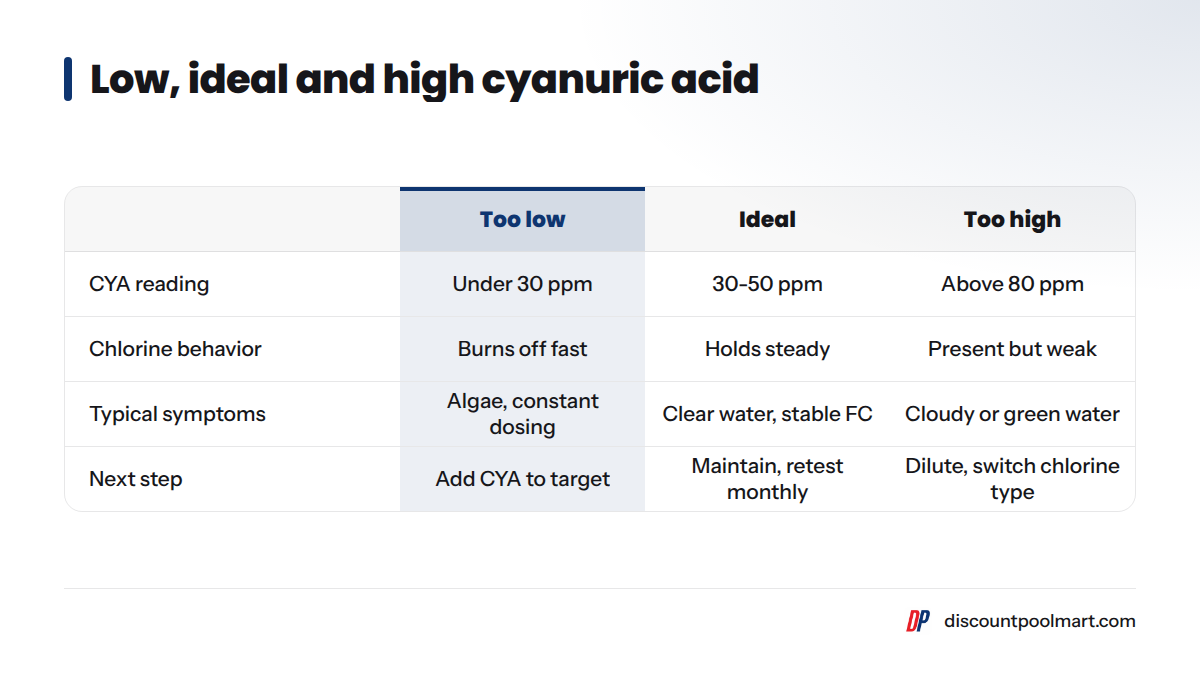
| Too low | Ideal | Too high | |
|---|---|---|---|
| CYA reading | Under 30 ppm | 30-50 ppm | Above 80 ppm (trouble zone) |
| Chlorine behavior | Burns off fast | Holds steady | Present but weak |
| Typical symptoms | Algae, constant dosing | Clear water, stable FC | Cloudy or green water despite "good" chlorine |
| Next step | Add CYA to target | Maintain, retest monthly | Dilute with fresh water, switch chlorine type |
The fix for a high cyanuric acid pool: Water is the only practical remedy. Drain part of the pool, refill with fresh water, and retest. Stop adding stabilized tablets. Use unstabilized liquid chlorine (sodium hypochlorite) until the number drops, then recheck.
Can you swim when CYA is high? The CDC's Healthy Swimming program stresses that pool water needs enough working disinfectant to protect swimmers from germs. High CYA slows chlorine, so the risk is poorly sanitized water, not CYA itself. If the water is cloudy or you can't hold a proper chlorine level, stay out until you fix it.
Why Tablets Push So Many LA Pools Into Over-Stabilization
At our stores, over-stabilization is the chemistry problem we see most in Los Angeles pools that run stabilized tablets year-round. I won't invent a statistic for it. It's simply what shows up at the test counter, week after week.
Here is why it happens:
- Long swim season. Strong sun and mild winters mean owners feed chlorine nearly every month of the year.
- Tablets add CYA with every dose. Chlorine gets used up. CYA doesn't. It builds.
- Little water replacement. Water loss is slow, and many pools never get a partial drain.
Your tablet routine may be over-stabilizing if:
- Your floater or feeder runs all year
- Your CYA has climbed with each test
- Chlorine tests fine, but algae keeps returning
- You haven't diluted or refilled in a long time
| Chlorine type | Adds CYA? | Notes |
|---|---|---|
| Trichlor tablets | Yes, a lot | Slow-dissolving, acidic |
| Dichlor granules | Yes | Fast-dissolving |
| Liquid chlorine (sodium hypochlorite) | No | Unstabilized, so it is a HASA-type liquid chlorine option when CYA runs high |
This table is educational only. For help choosing, ask us at the counter.
How to Test Cyanuric Acid at Home
Most kits check CYA with a turbidity test. You mix pool water with a reagent that turns it cloudy, then look down through the sample at a black dot on the bottom of a tube. The more CYA, the cloudier the mix. You read the number when the dot disappears.
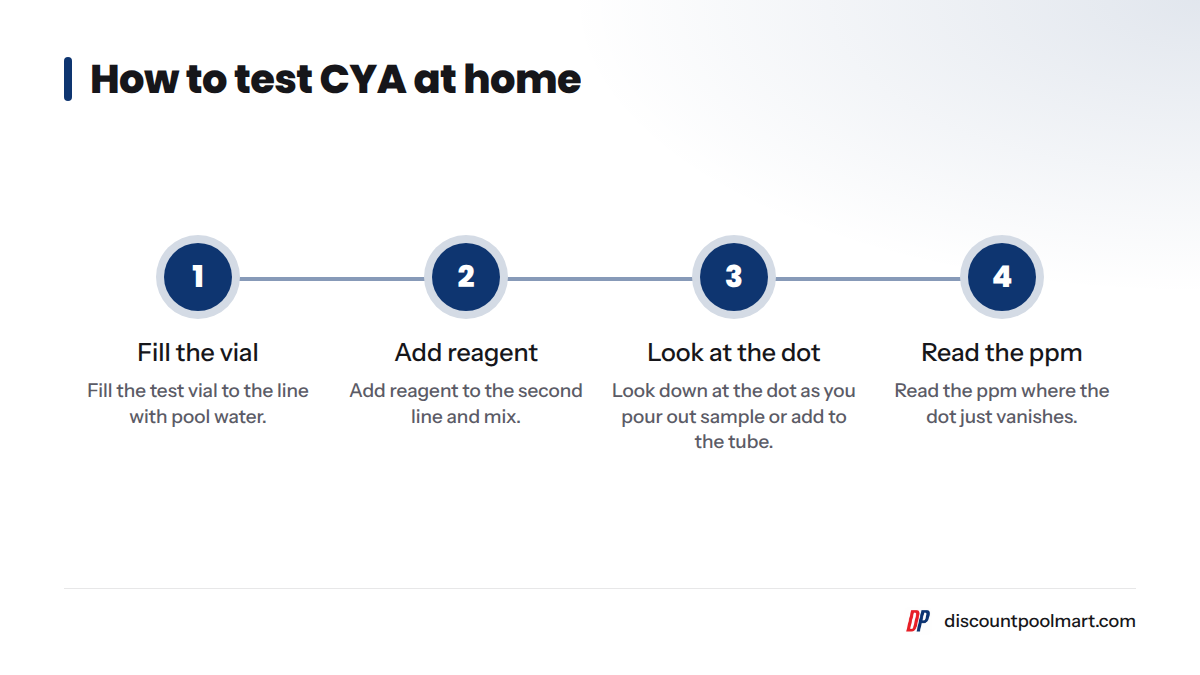
- Fill the test vial to the line with pool water.
- Add reagent to the second line and mix.
- Look down at the dot as you pour out sample or add to the tube.
- Read the ppm where the dot just vanishes.
The method has limits. The test reads in coarse steps, and judging "just vanished" varies with your eyes and the light. Treat the result as an estimate, not a lab figure.
Test monthly, and again after any refill or partial drain. A Taylor cyanuric acid reagent refills your kit, and the Taylor Complete Test Kit K-2005 covers CYA plus the other main readings. For strips versus drops versus digital, read our how to test pool water guide.
For experienced owners: Many serious pool keepers set their target FC as a share of CYA instead of a flat number. That free chlorine to CYA ratio is the idea behind the Trouble Free Pool community's CYA reference. It's a community resource, so treat its ratios as one school of thought and check them against your equipment maker's guidance.
Where CYA Fits Among Your Other Water Numbers
CYA is one of several readings that work together. Free chlorine sanitizes, and CYA decides how long and how strongly it works. pH affects how well chlorine performs and how comfortable the water feels. Total alkalinity steadies pH. Change one and the others often move.
This article covers what CYA is, not the full balancing routine. For the step-by-step order, see how to balance pool water, or start with our pool water chemistry guide.
Next steps: Bring a sample to Discount Pool Mart and we will test your CYA and talk through your number.
Cyanuric Acid FAQs
Are muriatic acid and cyanuric acid the same thing?
No. Muriatic acid lowers pH and alkalinity. Cyanuric acid stabilizes chlorine against sunlight.
Can you swim if cyanuric acid is high?
CYA itself isn't the main worry. High CYA weakens chlorine, so water can be under-sanitized even when your test shows chlorine. If the water looks cloudy or green, wait until you correct it. The CDC offers general healthy swimming guidance.
Is baking soda the same as cyanuric acid?
No. Baking soda raises total alkalinity. It does nothing to protect chlorine from UV.
Is cyanuric acid harmful to humans?
At normal pool levels, it isn't considered a concern for swimmers. Still, avoid swallowing pool water, and keep concentrated product away from skin, eyes, and kids. Follow the label's safety directions and check your local health department's guidance.
Do I need cyanuric acid in a saltwater pool?
Usually yes, for outdoor pools. Salt systems make chlorine, and the sun still breaks it down. Many manufacturers call for 60-80 ppm, but follow your generator's manual.
How do I lower cyanuric acid?
Drain part of the pool, refill with fresh water, then retest. Use unstabilized liquid chlorine in the meantime, and skip stabilized tablets until the number is back in range.
Sources
- Healthy Swimming, Centers for Disease Control and Prevention
- Environmental Health Services, San Bernardino County
- The Pool Chemistry of Cyanuric Acid, United Chemical
- Cyanuric Acid, Trouble Free Pool wiki
- Pool & Hot Tub Alliance
- HASA Pool
Related: HASA liquid chlorine guide