

Here is how to test pool water: take an elbow-deep sample away from returns and skimmers, then read it with test strips, a liquid drop kit, or a digital tester. Depending on the product, each method can read free chlorine, total chlorine, pH, total alkalinity, calcium hardness, and cyanuric acid (CYA). The team at Discount Pool Mart wrote this guide. We have tested customers' pool water across our 8 Los Angeles stores for decades.
I'll be straight with you: most bad pool numbers come from bad testing, not bad water. A sample grabbed beside a return jet, or a strip left in a hot car, sends people chasing problems that don't exist. This guide shows you how to get a trustworthy reading the first time. If you want to know what each number means, our pool water chemistry guide covers it.
Three Testing Methods at a Glance
| Method | How it works | What it typically reads |
|---|---|---|
| Test strips | Dip a pad strip, then compare pad colors to the bottle chart | Chlorine, pH, alkalinity, hardness; some strips add CYA |
| Liquid drop kit | Add reagent drops to a sample, then match color or count drops to an endpoint | Free and total chlorine, pH, alkalinity, hardness, CYA (kit dependent) |
| Digital tester or photometer | A meter measures the color of a reacted sample in a cuvette | Varies by model; many read chlorine, pH, alkalinity, CYA |
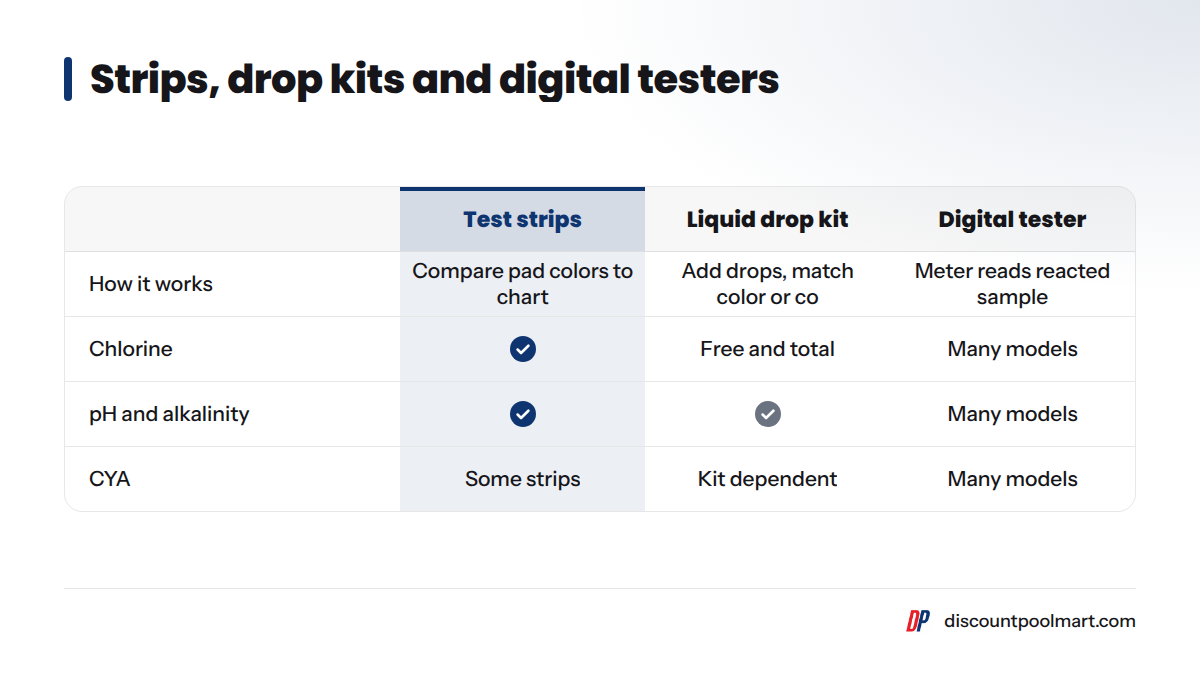
Coverage varies by brand and model, so check the parameter list on the package before you buy.
What to Gather and When to Test
Set everything out before you touch the pool. A rushed test is a sloppy test. You'll need:
- Your test method of choice (strips, drop kit, or digital tester)
- A clean sample container, rinsed with pool water
- Fresh, in-date reagents or strips
- A timer (your phone works)
- A notepad or the test log below
- Natural, neutral light for color reading
Test at the same time of day each session so your numbers compare fairly, and run the pump beforehand so the water is mixed. Many pool owners test in the evening. The exact hour matters less than keeping it consistent.
For frequency, the Centers for Disease Control and Prevention (CDC) publishes pool operation guidance, and your strip or kit maker lists its own routine. In my experience, weekly is a sensible minimum for a residential pool in season. Test more often after heavy use or a storm.
Step 1: How to Take a Pool Water Sample
Your sample is the foundation. If it's wrong, every step after it is wrong too.
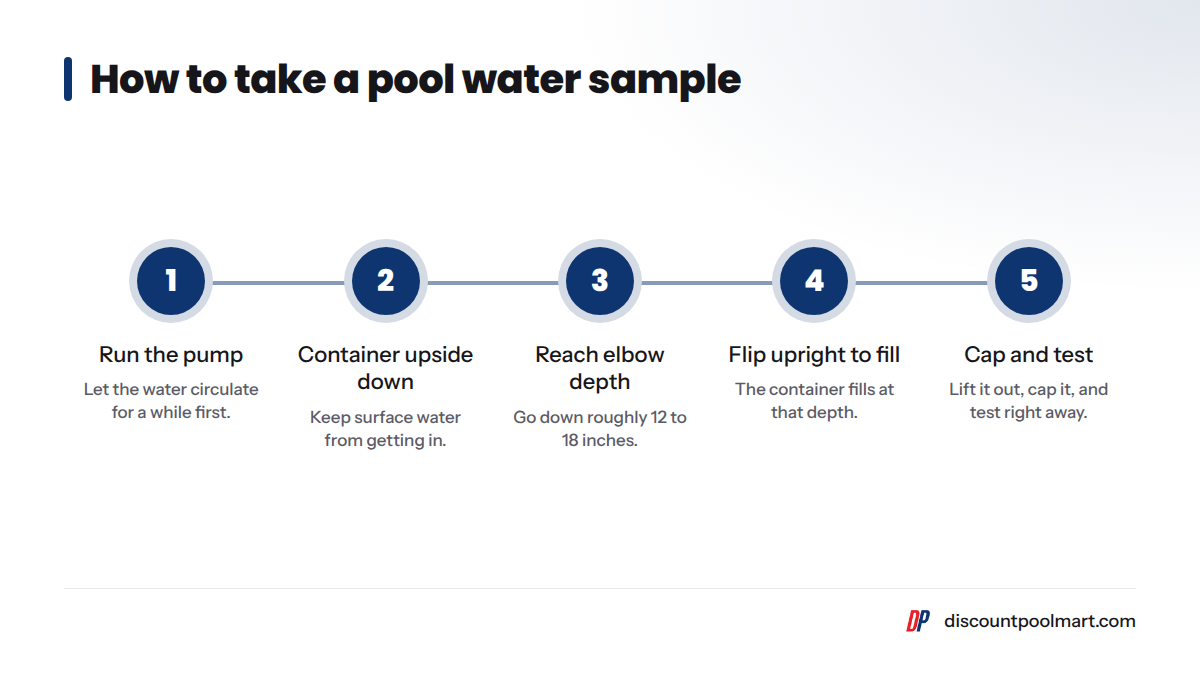
- Run the pump for a while so the water circulates.
- Turn your container upside down so no surface water gets in.
- Reach down to about elbow depth, roughly 12 to 18 inches.
- Flip the container upright so it fills at that depth.
- Lift it out, cap it, and test right away.
Some spots give misleading samples:
- Right beside return jets, where fresh chemical may be flowing out
- At a skimmer, where the water is surface-heavy
- Next to a floating chlorine dispenser
- At the surface, which can read differently from the body of the pool
Pick a spot away from the returns, and use the same one every time.
Step 2: How to Test Pool Water with Strips
Strips are the quickest way to test pool water at home. Let's break it down.
- Make sure your hands and the strip are dry.
- Pull out one strip and close the bottle right away.
- Dip the strip into the sample (or the pool at elbow depth) for the time on the label, usually a couple of seconds.
- Remove it without shaking it, and hold it level with the pads facing up.
- Wait the exact time on the label, then compare each pad to the bottle chart in good light.
Don't wait longer than the label says. Colors keep changing, and a late read is a wrong read.
Strips come in several types. A 5-way strip like the Leisure Time 45006A covers the basics, while a 7-in-1 strip such as AquaChek Silver adds more parameters. Read the parameter list on whatever you buy.
Keep strips from going bad
Strips react to moisture and heat. Keep the cap tight, store the bottle somewhere cool and dry, and never leave it in a car or on a sunny pool deck. Check the expiration date printed on the bottle. Manufacturers such as AquaChek and Taylor Technologies publish storage guidance for their products. In Los Angeles, a hot garage can ruin strips faster than you'd expect.
Step 3: How to Test Pool Chemicals with Drops
Liquid kits use reagents instead of pads. Two styles dominate, and they work differently.
Color-matching kits
OTO and DPD comparator kits have you add a set number of drops to a sample in a comparator cell. You then hold the cell against a color block and pick the closest match. A Blue Devil 5-way OTO kit is one example of this product type.
FAS-DPD test kit titration
A FAS-DPD test kit counts drops instead of comparing colors. You add DPD reagent to the sample, which turns it pink if chlorine is present. Then you add titrant drops one at a time, swirling after each, until the pink disappears. The kit's instructions convert that drop count into a chlorine reading. The Taylor Complete FAS-DPD kit is an example of this type.
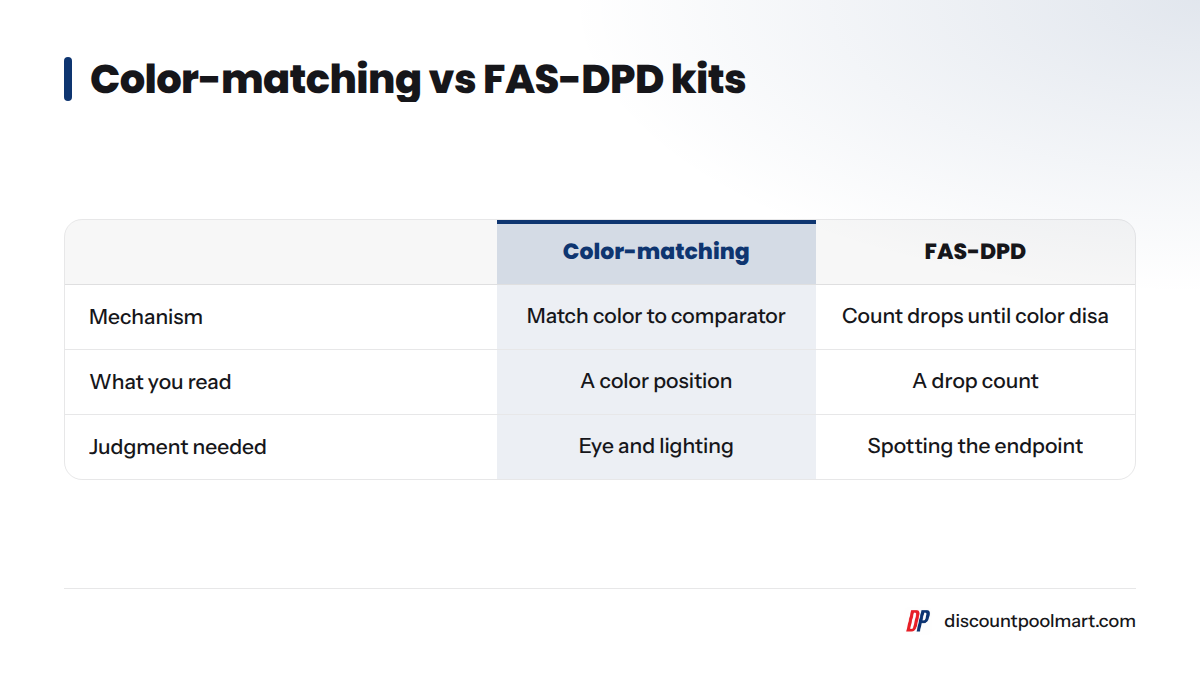
| Color-matching | FAS-DPD | |
|---|---|---|
| Mechanism | Match sample color to a printed comparator | Count titrant drops until the color disappears |
| What you read | A color position | A drop count |
| Judgment needed | Eye and lighting | Spotting the exact endpoint |
Free chlorine vs total chlorine with DPD
DPD reacts with chlorine to produce a pink color, and you run it in steps. The first reading, with the first DPD reagent, gives free chlorine. A second reagent added to the same sample gives total chlorine. The gap between the two is combined chlorine (chloramines). Follow your kit's exact sequence, because the order and drop counts differ by brand.
For CYA, most kits use a turbidity method. You fill a vial with sample and reagent, then watch for the dot on the bottom to disappear. Hardness and alkalinity usually call for titration, counting drops until the color changes. Rinse every cell between tests.
Step 4: Using a Digital Pool Water Tester
A digital pool water tester takes the eyeballing out of color reading. A photometer shines light through your reacted sample and reports a number.
Read your manual first, since models differ. The general flow looks like this:
- Rinse the cuvette (the small sample vial) with pool water.
- Fill it to the marked line, wipe the outside clean, and take a blank or zero reading if your model requires it.
- Add the reagent tablet or liquid and mix as directed.
- Wait the stated reaction time.
- Insert the cuvette and read the result.
Some strip systems use a phone instead. The AquaChek Select Connect strips with a photo-capture app let your phone camera read the pads, which helps when lighting is a problem.
A few habits keep digital readings honest:
- Do calibrate or verify the meter as your manual directs.
- Do keep the cuvette scratch-free and fingerprint-free.
- Do check reagent expiration dates.
- Don't read through a wet or foggy cuvette.
- Don't skip the reaction timer.
Step 5: Read Your Results
Here is what each reading tells you:
- Free chlorine: the chlorine available to sanitize your water right now.
- Total chlorine: free chlorine plus combined chlorine.
- pH: how acidic or basic the water is.
- Total alkalinity: the water's ability to resist pH swings.
- Calcium hardness: the amount of dissolved calcium in the water.
- Cyanuric acid (CYA): a stabilizer that helps protect chlorine from sunlight.
Build your own pool water testing chart
Target ranges differ by source and pool type, so use the figures from your manufacturer or your pool's documentation. As a starting reference, the CDC's pool chemical and operation guidance lists free chlorine and pH targets for pools. Check the source for the current numeric ranges that apply to you, then write your targets at the top of your log.
When a number falls outside your target, don't guess at a fix. Our guide on how to balance pool water covers the correct order of corrections.
Step 6: Misreading Errors We See in LA Stores
After many years of in-store consultations, the same slips show up again and again.
Sampling mistakes
- Dipping a cup at the surface or next to a return jet
- Testing right after adding chemicals, before the water has mixed
- Using a dirty or soapy container
Reading mistakes
- Reading under yellow indoor light or in harsh glare
- Waiting too long on strips, so the pads keep changing
- Mixing up free chlorine and total chlorine on the chart
Reagent mistakes
- Using expired reagents or old strips
- Storing a kit in a hot car or on a sunny deck
- Leaving the strip bottle open in humid air
From our 8 LA stores: when a customer's numbers look strange, we first ask how and where they took the sample, and where the kit lives. Those two answers explain a lot.
If your strips seem to disagree from one dip to the next, check those three groups first.
Step 7: Log Your Numbers and Get a Free In-Store Test
A log shows trends before they become problems. Copy this template:
| Date | Time | Method | Free Cl | Total Cl | pH | Alkalinity | Hardness | CYA | Notes |
|---|---|---|---|---|---|---|---|---|---|
Add notes on weather, heavy use, and anything you added to the pool.
What free in-store pool water testing involves
Bring about a pint-size sample in a clean container, collected elbow deep using the steps above. Test it soon after collecting. Our staff run it and walk you through the results. It's also a handy way to cross-check your own kit, and free in-store pool water testing is available at any of our Los Angeles locations.
Next steps
- Record your numbers.
- Compare them to your target ranges.
- If anything is off, follow our guide on how to balance pool water.
- Retest after the water has had time to circulate.
- If results still look odd, bring a sample to us.
FAQ
How can I test my pool water myself?
Collect a sample about 12 to 18 inches down, away from returns and skimmers. Then use test strips, a liquid drop kit, or a digital tester, following the product's instructions. Record each reading in a log so you can spot trends over time.
How often should you test pool water?
Follow your test kit maker's and the CDC's published guidance for your pool type. I suggest testing at least weekly in swim season, plus after heavy use, big storms, or any chemical addition once the water has circulated.
Why do my test strip results look different each time?
Usually the cause is sampling spot, lighting, timing, or strip age. Dip the same way, read at the label's exact time in neutral light, and keep the bottle sealed and cool. Heat and humidity damage strips quickly.
What is the difference between free and total chlorine?
Free chlorine is the chlorine still able to sanitize. Total chlorine is free chlorine plus chlorine already used up and bound to contaminants. The difference between them is combined chlorine, also called chloramines.
Do pool test reagents and strips expire?
Yes. Check the date printed on the bottle and follow the maker's storage guidance. Keep them sealed, cool, and out of direct sun. Replace anything expired, discolored, or stored in heat.
Can I test pool water without a kit?
Not reliably. Looks and smell can't tell you chlorine, pH, or alkalinity. A strip pack is an inexpensive starting point, and you can always bring a sample to one of our stores for a free test.