
Every residential pool needs a core set of rescue equipment within arm's reach: a reaching pole or shepherd's hook, a ring buoy with throw rope, a waterproof first aid kit, and a posted CPR sign. This guide covers each piece in detail, with placement tips and an inspection schedule drawn from Discount Pool Mart's four decades of hands-on safety consultations with Los Angeles homeowners.
What Counts as Pool Rescue Equipment?
Pool rescue equipment refers to the life-saving tools that let a bystander help a distressed swimmer without entering the water. These tools fall into three categories: reaching devices (poles and hooks), throwing devices (ring buoys and ropes), and first aid supplies. They sit apart from barrier equipment like fences and covers and from detection equipment like alarms.
Rescue gear is one layer of a broader safety strategy. For the full picture - fencing, covers, and alarms included - see our pool safety equipment guide.
Why Every Homeowner Needs Rescue Equipment Poolside
A child can slip beneath the surface in seconds, often without a splash or a scream. According to the Centers for Disease Control and Prevention, drowning is the leading cause of death for children ages 1 through 4, and most of those incidents happen in residential pools.
That statistic hits hard for anyone with a backyard pool. The principle we teach every customer who walks into our store is simple: reach or throw, don't go. Untrained rescuers who jump in often become victims themselves. Swimming pool rescue equipment lets a homeowner extend help from the safety of the deck.
California pool safety guidelines call for a layered approach that pairs rescue equipment with barriers and alarms. (For fence-specific requirements, read our California pool fence guide. For alarm options, check our pool alarm comparison.) Keeping proper rescue gear on hand also signals responsibility to insurers and demonstrates a reasonable standard of care.
Residential Pool Rescue Equipment You Need
Building a pool safety equipment list doesn't require guesswork. The items below cover what every home pool should have on deck.
Reaching Pole and Shepherd's Hook (Pool Life Hook)
A reaching pole lets you extend a rigid arm to a struggling swimmer and pull them to the wall. A shepherd's hook pool accessory - sometimes called a pool life hook - adds a curved end that can hook around a torso or limb.
- Length: 12 to 16 feet covers most residential pools. If a swimmer could be more than 8 feet from the nearest edge, start at 12 feet minimum. Wider pools call for 16 feet.
- Material: Fiberglass or anodized aluminum holds up against sun, chlorine, and moisture. Non-conductive material is a must around water.
- Hook style: A blunted shepherd's crook reduces the chance of injury during a frantic rescue.
Telescoping poles pull double duty for cleaning and rescue. Our guide to the best pool poles covers compatible options.
Ring Buoy for Residential Pools
A ring buoy (also called a life ring or life preserver) gives a swimmer something buoyant to grab while you pull them to safety. I always tell customers to look for a U.S. Coast Guard-approved model. That label means the device has been tested and certified to meet federal buoyancy and performance standards.
- Size: A 20-inch ring buoy residential pool setup handles most backyards. Larger or deeper pools may benefit from a 24-inch buoy.
- Throw rope: Attach at least 50 feet of line so the buoy can reach the farthest point of the pool. Choose rope between ¼-inch and ⅜-inch in diameter for a secure grip.
Rescue Throw Rope
A standalone rescue throw rope pool kit features a weighted end or a small lemon-shaped buoy that helps you land an accurate toss. Use one when a swimmer is beyond the reach of your pole but you need faster deployment than threading a ring buoy's line.
For a typical backyard pool, 50 to 60 feet of rope covers most scenarios. Keep the rope neatly coiled so it deploys without tangling.
Poolside First Aid Kit
A waterproof poolside first aid kit should live within steps of the water. Here is what belongs inside:
- Adhesive bandages (assorted sizes)
- Sterile gauze pads and medical tape
- Antiseptic wipes
- Instant cold packs
- CPR pocket face shield
- Burn ointment
- Scissors and tweezers
- Eye wash solution (for chlorine irritation)
- Sunburn relief gel
- Insect sting treatment pads
- Emergency contact card with your pool's street address
CPR Sign and Emergency Information
Post a weatherproof CPR instruction sign at eye level near the pool's main entry point. Include your home address - guests may not know it when calling 911 - and local emergency numbers. You don't need to become a CPR instructor, but a clear visual guide gives any adult a fighting chance while help is on the way.
| Equipment | Purpose | Recommended Size / Length | Key Feature |
|---|---|---|---|
| Reaching Pole / Shepherd's Hook | Reach and pull swimmer to wall | 12–16 ft | Non-conductive, blunted hook |
| Ring Buoy | Throw to swimmer in distress | 20″ or 24″ (USCG-approved) | Attached 50 ft throw rope |
| Rescue Throw Rope | Throw to swimmer beyond pole reach | 50–60 ft | Weighted end or lemon buoy |
| First Aid Kit | Treat injuries poolside | N/A | Waterproof, pool-specific contents |
| CPR Sign | Guide bystander emergency response | N/A | Weatherproof, visible placement |
Picking the Right Size and Type for Your Pool
Choosing pool rescue equipment as a homeowner comes down to your pool's dimensions and who will be using the gear.
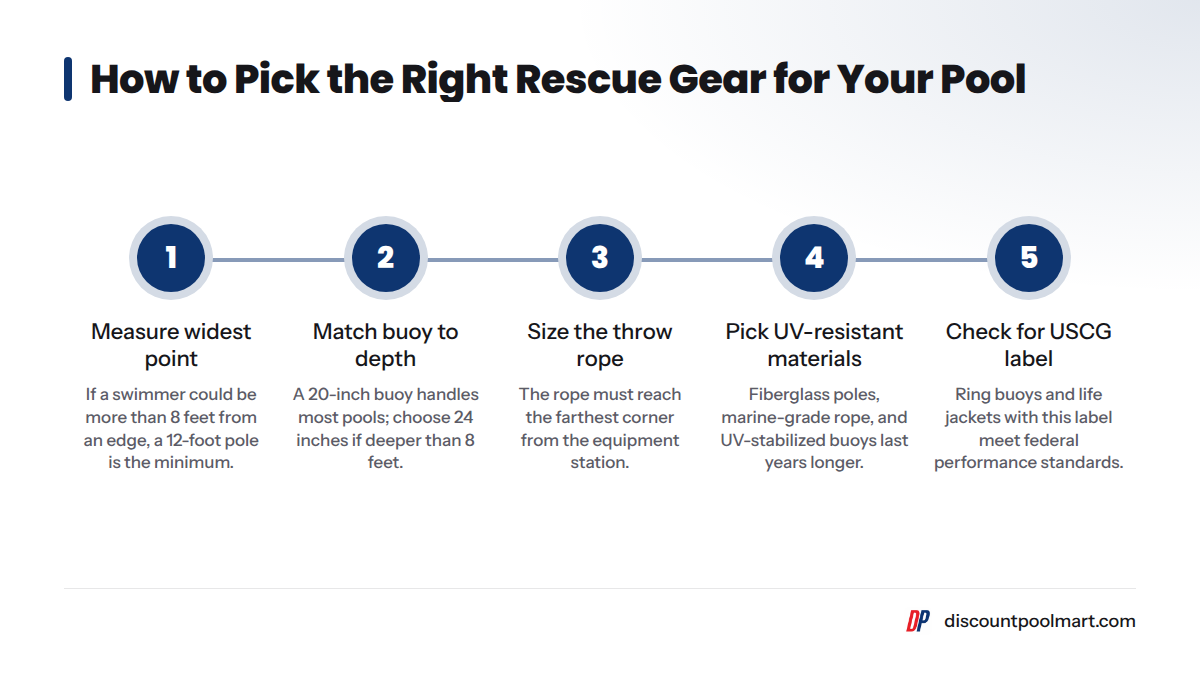
- Measure your pool's widest point. If a swimmer could be more than 8 feet from an edge, a 12-foot pole is the minimum. Pools wider than 12 feet at any point should have a 16-foot pole.
- Match the ring buoy to pool depth. A 20-inch buoy handles most residential setups. Choose 24 inches if your pool is deeper than 8 feet or unusually wide.
- Size the throw rope to your layout. The rope must reach the farthest corner of the pool from wherever the equipment station sits.
- Pick UV-resistant, non-corrosive materials. Los Angeles sun breaks down cheap plastics fast. Fiberglass poles, marine-grade rope, and UV-stabilized buoys last years longer.
- Check for the USCG-approved label. Ring buoys and life jackets carrying this label meet federal performance standards, and that small price premium is worth it.
Not sure which size fits your pool? Bring your pool dimensions to any Discount Pool Mart location and our team will recommend the right fit based on four decades of residential pool consultations.
Where to Place Pool Rescue Equipment
Place your residential pool safety equipment where any person - including a panicked guest - can grab it within seconds. Gear that sits locked in a shed or tucked behind furniture might as well not exist.
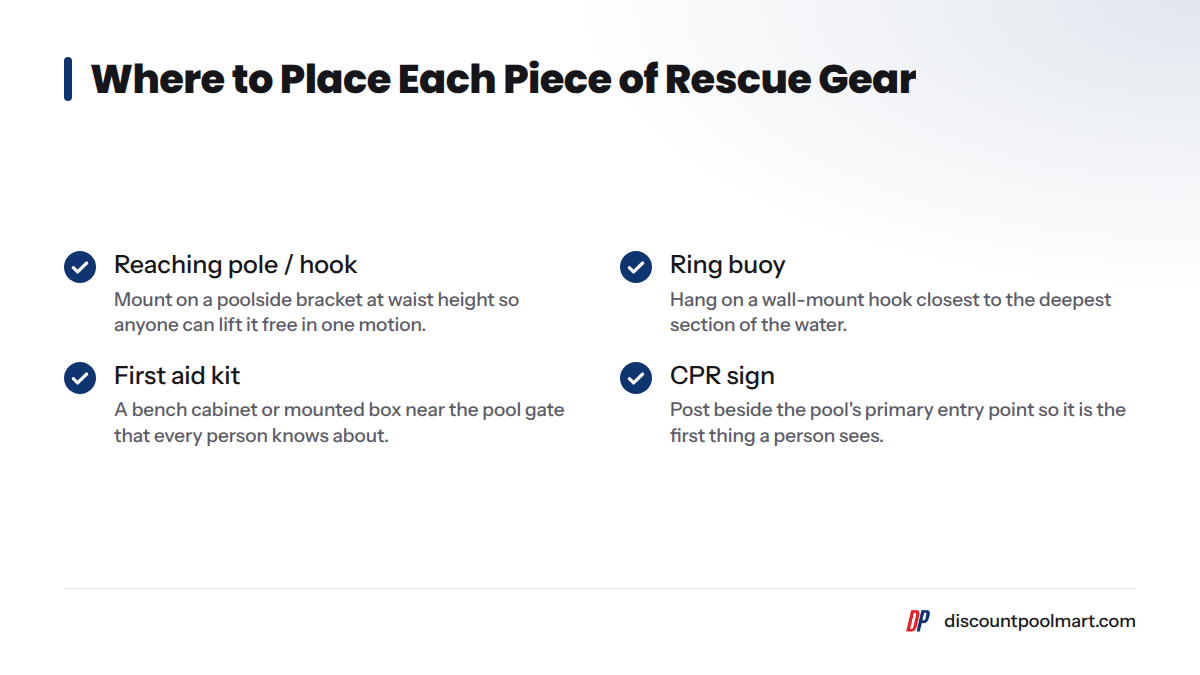
- Shepherd's hook / reaching pole: Mount on a poolside bracket near the deep end. The bracket should hold the pole horizontally at about waist height so anyone can lift it free in one motion.
- Ring buoy: Hang on a wall-mount hook within 10 feet of the pool edge, positioned closest to the deepest section of the water.
- First aid kit: Store in a shaded, accessible spot that every household member and guest knows about. A bench cabinet or mounted box near the pool gate works well.
- CPR sign: Post at eye level beside the pool's primary entry point so it is the first thing a person sees when approaching the water.
If your pool has multiple access points, consider a second reaching pole or ring buoy at the opposite end. In our experience with L.A. backyards, a kidney-shaped pool with a raised spa at one end almost always benefits from a duplicated station.
Inspection and Maintenance Schedule for Pool Safety Gear
Rescue equipment that fails during an emergency is worse than no equipment at all - it wastes precious seconds. A simple inspection routine keeps every piece ready.
| Task | Frequency | What to Check |
|---|---|---|
| Reaching pole / shepherd's hook | Monthly | Telescoping function, cracks, rust, secure mounting |
| Ring buoy | Monthly | Buoyancy, rope integrity, UV damage, strap/hook condition |
| Rescue throw rope | Monthly | Fraying, knots, weighted end secure, proper coiling |
| First aid kit | Quarterly | Expired items, depleted supplies, waterproof seal |
| CPR sign | Quarterly | Legibility, weatherproofing, secure mounting |
| Mounting brackets | Seasonally | Rust, loose screws, structural integrity |
| Post-storm check | After any major weather event | All items for displacement, water damage, debris |
Replace any piece that shows UV degradation, fraying, cracking, or lost buoyancy right away. At the start and end of each swim season, perform a full equipment audit. In Southern California, where pools often stay open year-round, I recommend a thorough check every March and November as bookends, with monthly spot checks in between. Extreme heat waves and Santa Ana wind events also make good triggers for a quick walk-around.
One more thing worth separating out: pool toys, inflatable rings, and foam noodles are not rescue equipment. They aren't designed to support a panicking swimmer's weight and can deflate or slip away at the worst moment.
Shop Pool Rescue Equipment Near Me at Discount Pool Mart
Looking for pool rescue equipment for sale from a retailer that actually knows residential pool safety? Discount Pool Mart carries a full inventory of reaching poles, shepherd's hooks, USCG-approved ring buoys, rescue throw ropes, waterproof first aid kits, CPR signs, and poolside mounting brackets. As an authorized retailer with over 40 years of Los Angeles homeowner safety consultations, our in-store team matches equipment to your specific pool layout - not a generic recommendation.
Visit any of our L.A.-area locations or browse online. If you're setting up a brand-new pool, our pool safety cover guide rounds out the barrier side of your safety plan.
Frequently Asked Questions
What pool rescue equipment should every homeowner have?
At minimum, every residential pool should have a reaching pole or shepherd's hook (12–16 ft), a U.S. Coast Guard-approved ring buoy with at least 50 feet of throw rope, a waterproof poolside first aid kit, and a posted CPR instruction sign with emergency contact information.
Where should I place rescue equipment around my pool?
Mount the reaching pole and ring buoy near the deep end on a poolside bracket, place the first aid kit in a shaded but accessible spot, and post the CPR sign at eye level near the pool's main entry point. Every item should be unlocked, visible, and reachable within seconds.
How often should pool rescue equipment be inspected?
Inspect reaching poles, ring buoys, and throw ropes monthly for damage, UV degradation, and proper function. Check first aid kits and CPR signs quarterly. Perform a full audit at the start and end of each swim season, and after any major storm or extreme weather event.
What does U.S. Coast Guard-approved mean for pool equipment?
U.S. Coast Guard-approved means the device has been tested and certified to meet federal performance and buoyancy standards for life-saving equipment. Look for the USCG approval label on ring buoys and life jackets before you buy.
What size ring buoy do I need for a residential pool?
A 20-inch ring buoy works for most home pools. Larger or deeper pools may benefit from a 24-inch model. Attach at least 50 feet of ¼-inch to ⅜-inch throw rope so the buoy can reach the farthest point of the water.
What should be in a poolside first aid kit?
A pool-specific first aid kit should include adhesive bandages, gauze, antiseptic wipes, instant cold packs, a CPR pocket face shield, burn ointment, scissors, tweezers, eye wash for chlorine irritation, sunburn relief gel, insect sting pads, and an emergency contact card listing your pool's address and local emergency numbers.