

A pool safety cover is a reinforced barrier that anchors into your deck, bears weight to prevent accidental submersion, and meets the ASTM F1346 performance standard. It is not the same thing as a solar blanket or a winter tarp. A true safety cover protects children, pets, and anyone who might wander too close to the water. If you own a pool in Los Angeles, choosing the right one is one of the smartest moves you can make for your family and your property.
I have spent years helping LA homeowners at Discount Pool Mart pick covers that match their pool shape, neighborhood conditions, and California's legal requirements. This pool safety cover guide walks you through every decision point: cover types, sizing, regulations, installation, and upkeep.
What a Pool Safety Cover Actually Does
A pool safety cover stretches taut across the water and locks into spring-loaded anchors drilled into the surrounding deck. When properly installed on an inground pool, it acts as a load-bearing barrier - one strong enough to support the weight of a child or pet who steps onto it.
That distinction matters. Not every cover on the market does this.
Winter Cover vs. Safety Cover vs. Solar Cover
These three products serve very different purposes:
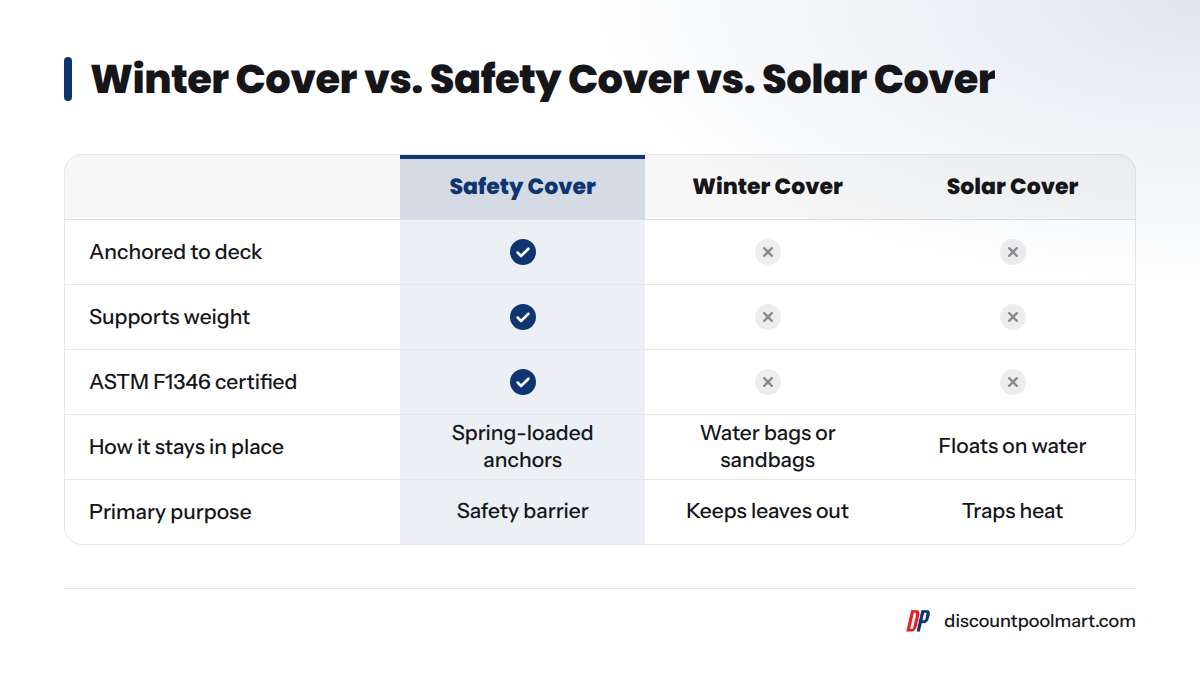
- Winter cover: A loose-fitting tarp held down by water bags or sandbags. It keeps leaves out during the off-season but cannot support weight and offers no real safety protection.
- Solar cover (solar blanket): A floating bubble-wrap-style sheet that traps heat and reduces evaporation. It is not anchored, cannot bear weight, and is never rated as a safety device.
- Safety cover: Anchored directly into the deck with hardware, designed and tested to support weight, and certified under ASTM F1346.
The difference between a winter cover vs. safety cover comes down to one question: can someone fall through it into the pool? With a winter cover, the answer is yes. With a properly installed safety cover, the answer is no.
If you want to learn more about solar heating options, the pool safety equipment guide on our site explains how safety layers work together.
Why Every LA Pool Needs a Safety Cover
Los Angeles pools stay open year-round. That means the drowning risk never takes a seasonal break. The U.S. Consumer Product Safety Commission reports that drowning remains a leading cause of unintentional death for children ages one through four. A physical barrier over the water is one of the most direct ways to reduce that risk.
Beyond child safety, a cover keeps wind-blown debris out of your water, reduces liability exposure, and cuts down on cleaning time between swims.
What a safety cover does for you:
- Prevents accidental falls into the pool for children, pets, and guests
- Blocks leaves, dirt, and wind-driven debris
- Reduces homeowner liability
- Qualifies as an approved safety feature under California law
ASTM F1346 Standard and the California Swimming Pool Safety Act
What ASTM F1346 Requires
ASTM International publishes ASTM F1346, titled "Standard Performance Specification for Safety Covers and Labeling Requirements for All Covers for Swimming Pools, Spas, and Hot Tubs." Under this standard, a safety cover must support a minimum weight without allowing a person to slip underneath. It also must not accumulate standing water on its surface deep enough to create a secondary drowning hazard.
Any cover that carries a true "safety cover" label should meet ASTM F1346's testing criteria. If a manufacturer cannot confirm ASTM F1346 compliance, the product is not a safety cover - no matter what the marketing says.
California Swimming Pool Safety Act: What Pool Owners Need to Know
California's Swimming Pool Safety Act, codified in Health & Safety Code Sections 115920 through 115929, requires that any new or remodeled residential pool include at least two approved safety features. A pool safety cover that meets ASTM F1346 counts as one of those features. Other options on the list include pool fencing, self-closing gates, and pool alarms.
Combining a compliant safety cover with a code-compliant pool fence gives you two layers of protection and satisfies the state's two-feature minimum.
We stock ASTM F1346-compliant covers at Discount Pool Mart specifically because so many of our LA customers need to meet these California requirements.
Pool Safety Cover Types: Mesh vs. Solid vs. Hybrid
Three main categories of pool safety covers exist. Each one handles water, debris, and sunlight differently.
Mesh Safety Cover
A mesh safety cover is woven from polypropylene or polyester. Rainwater filters through the fabric into the pool, while leaves and larger debris stay on top. Mesh covers weigh less than solid covers, which makes them easier to install and remove. Because water drains through, you never need a cover pump.
The tradeoff: fine dust and silt can pass through the weave, and some algae growth may occur because sunlight still reaches the water.
Solid Safety Cover
A solid safety cover is made from reinforced vinyl and blocks all sunlight and debris. It keeps pool water cleaner during extended closures. But because rainwater collects on top, a solid cover requires either a built-in mesh drain panel or a cover pump to prevent dangerous water accumulation. Solid covers are heavier than mesh and typically cost more.
Hybrid Safety Cover
A hybrid safety cover combines a solid center panel with a mesh perimeter or mesh drain strips set into a solid surface. This design blocks most sunlight and fine debris while still allowing some water drainage, reducing the need for a cover pump. Hybrids split the difference on weight, maintenance, and price between mesh and solid options.
| Feature | Mesh | Solid | Hybrid |
|---|---|---|---|
| Water drainage | Drains through fabric | Requires pump or drain panel | Partial drainage through mesh strips |
| Debris blocking | Blocks leaves; passes fine silt | Blocks all debris and sunlight | Blocks most debris; passes some fine particles |
| Weight | Lightest | Heaviest | Moderate |
| UV/sunlight blocking | Low | Complete | High |
| Algae risk | Higher | Minimal | Low to moderate |
| Maintenance effort | Low | Moderate (pump needed) | Low to moderate |
| Typical price range | Lower | Higher | Mid-range |
| Best for | Year-round LA pools, easy handling | Extended closures, pristine water | Balanced debris and light control |
Pool Cover Sizing: How to Get Your Measurements Right
Getting the dimensions right is the single most common question we hear at the shop. Here is the step-by-step process.
Measuring Your Pool Dimensions
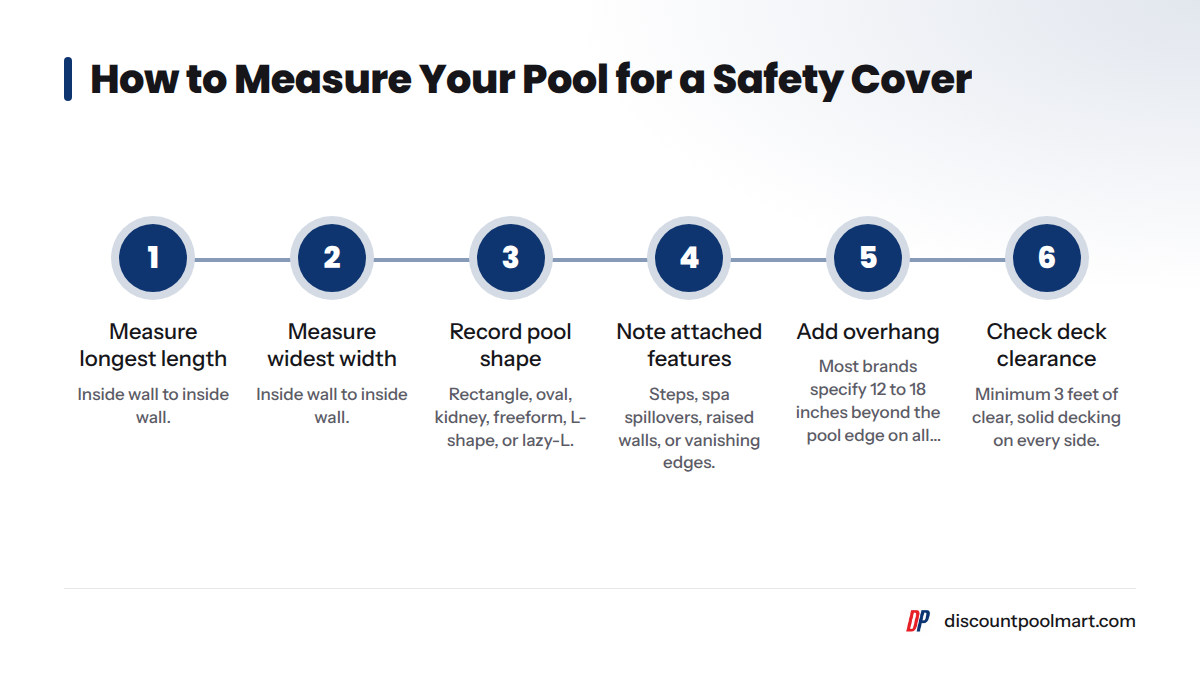
- Measure the longest length of the pool from inside wall to inside wall.
- Measure the widest width the same way.
- Record the pool shape - rectangle, oval, kidney, freeform, L-shape, or lazy-L.
- Note any attached features such as steps, spa spillovers, raised walls, or vanishing edges.
- Add the manufacturer's recommended overhang to each measurement. Most brands specify 12 to 18 inches beyond the pool edge on all sides.
Deck Clearance and Overhang Requirements
Deck clearance is the unobstructed flat surface surrounding your pool where pool safety cover anchors will be drilled. You typically need a minimum of 3 feet of clear, solid decking on every side. Planters, boulders, raised bond beams, or adjacent structures reduce your usable anchor zone and may require custom strap lengths.
Measure the distance from the pool edge to the nearest obstacle on every side before ordering.
Freeform and Custom Pool Shapes
LA is full of freeform and custom-shaped pools. For non-rectangular pools, you will need an A-B measurement grid. That means measuring from a fixed reference line to the pool edge at regular intervals - usually every 12 to 24 inches - to create a plotted outline. Most manufacturers accept this plot as a template for a custom-cut cover.
Discount Pool Mart can walk you through this process in-store or connect you with an installer who measures on-site.
Sizing checklist:
- Pool length (wall to wall)
- Pool width (wall to wall)
- Pool shape noted
- Overhang added (12 to 18 inches per side)
- Deck clearance measured (minimum 3 feet)
- Obstacles mapped (planters, raised walls, slides, diving boards)
- Deck material identified (concrete, pavers, stone, wood)
How to Choose the Right Pool Cover for an LA Pool
Climate Factors: Sun, Santa Ana Winds, and Debris
Los Angeles delivers intense UV exposure nearly every month, which breaks down cover materials over time. A mesh safety cover with UV-resistant webbing handles sun well. Santa Ana winds can lift loose covers or pile debris against anchoring points, so a tight, properly tensioned cover is non-negotiable.
Homes near canyons or mature trees deal with heavy leaf loads. That favors mesh covers, which let water drain and keep weight from building up on the surface. If wind-driven dust and fine pollen bother you more than leaves, a solid or hybrid safety cover will keep your water cleaner.
Pool Usage Patterns
Many LA pool owners swim 10 to 12 months a year. If you only cover your pool for short stretches between uses, a lightweight mesh cover is the easiest to put on and take off. If you close the pool for a few months during winter or an extended vacation, a solid or hybrid cover keeps the water in better shape for reopening.
Budget and Long-Term Value
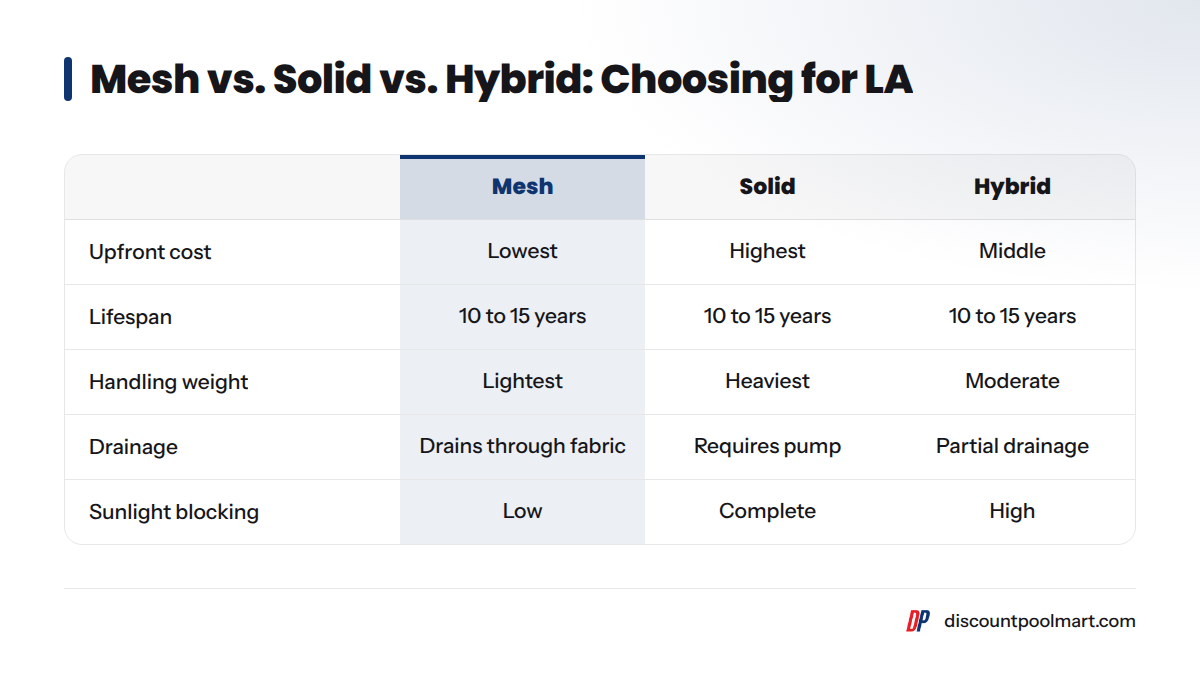
Mesh covers carry the lowest upfront cost and last 10 to 15 years with proper care. Solid covers cost more and may need pump maintenance, but they can save money on chemicals and cleaning by blocking all sunlight. Hybrids fall in the middle. I think of the purchase as a multi-year investment rather than a one-time expense, and I encourage customers to do the same.
Quick decision guide:
- Choose mesh if you want easy handling, good drainage, and the lowest price.
- Choose solid if you want the cleanest water and complete light blocking.
- Choose hybrid if you want a balance of debris protection and drainage.
For a broader look at layered protection options, including pool alarms that meet California legal requirements, multiple safety features work together to keep your family safe.
Safety Cover Installation: What to Expect
Tools and Preparation
A typical safety cover installation requires a hammer drill with a masonry bit, a tamping tool for setting anchors, a hex wrench, and a measuring tape. You will also need the cover, its springs, and the anchor hardware that ships with it. Before drilling, clear the deck of furniture and sweep it clean.
Anchoring Systems: Spring-Loaded and Flush-Mount
Most inground pool safety cover anchors use spring-loaded, flush-mount brass or stainless steel hardware. These anchors sit level with the deck surface when the cover is off, so nobody trips over them. When it is time to cover the pool, you twist each anchor head up, hook the cover's D-ring strap to a stainless steel spring, and stretch it to the raised anchor. Spring tension keeps the cover taut across the water.
Professional vs. DIY Installation
Drilling anchor holes into a concrete or stone deck requires precision. A misplaced hole can crack a paver or weaken a deck edge. I generally recommend professional installation for first-time buyers, especially on older decks or custom shapes. Discount Pool Mart can connect you with experienced local installers who handle everything from measurement to final tensioning.
Maintaining Your Pool Safety Cover
Seasonal Care for Year-Round LA Pools
Because LA pools see year-round use, your cover may go on and off more frequently than covers in colder climates. After every use, brush off leaves and debris before folding. Inspect straps and stitching for wear each time you deploy the cover.
Cleaning and Storage
Hose down the cover with fresh water and a mild, non-abrasive cleaner once a month during active use. Avoid bleach or harsh chemicals that can degrade the fabric. When storing the cover, fold it loosely and keep it in a dry, shaded area. A mesh storage bag allows airflow and prevents mildew.
When to Replace Your Safety Cover
Most quality safety covers last between 10 and 15 years. Replace yours when you see fraying webbing, broken stitching, rust on anchor hardware, or loss of tension across the surface. A cover that sags or cannot hold weight no longer meets ASTM F1346 performance criteria and should not be trusted as a safety barrier.
Frequently Asked Questions About Pool Safety Covers
Which pool covers are the best for safety? Covers certified under ASTM F1346 are the only pool covers that qualify as true safety covers. Mesh, solid, and hybrid covers from reputable manufacturers all meet this standard. For most LA homeowners, a mesh safety cover offers the best combination of durability, ease of use, and value.
How do you put on a pool safety cover? Unfold the cover over the pool, align it with the anchor positions on the deck, attach each D-ring strap to its corresponding stainless steel spring, and hook each spring onto the raised anchor. Work from one end to the other, alternating sides to distribute tension evenly.
Are pool safety covers worth it? Yes. A safety cover prevents accidental drowning, blocks debris, reduces chemical use, lowers liability, and satisfies one of California's required approved safety features under the Swimming Pool Safety Act. Over a 10- to 15-year lifespan, the cost per year is modest compared to the protection it provides.
What is the best color for a pool safety cover? Green and tan are the most popular choices because they blend with landscaping and concrete decks. Darker colors absorb more heat and may degrade slightly faster under intense LA sun. Lighter colors reflect UV better and tend to last a bit longer, but the difference is marginal if the fabric has built-in UV inhibitors.
Do I need a pool safety cover in Los Angeles? California law does not mandate a safety cover specifically, but the California Swimming Pool Safety Act requires at least two approved safety features for new or remodeled residential pools. A safety cover is one of the easiest and most effective features to add. Given LA's year-round swimming season, having a cover on standby is a practical choice for any pool owner.
What is the difference between a safety cover and a winter cover? A safety cover is anchored into the deck, supports weight, and meets ASTM F1346. A winter cover is a loose tarp held down by water bags. It blocks debris but cannot prevent someone from falling through into the pool.