

Every pool filter cleaning starts with the same two moves: turn off the pump, then bleed the pressure out of the tank. What you do next depends on the filter you own. A sand filter gets backwashed and rinsed. A cartridge filter comes apart, gets hosed off, and sometimes soaks. A DE filter gets backwashed, torn down so the grids can be cleaned, and then recharged with fresh DE poured through the skimmer.
At Discount Pool Mart, our technicians have spent more than 40 years on Los Angeles repair calls, and a lot of those calls sound alike. The pressure gauge keeps climbing, the jets feel weak, and the water turns hazy two days before a backyard party. Often nothing is broken. The filter just needs a proper clean, done in the right order. This guide lays out that order for all three filter types and covers the mistakes we fix most often. If you're doing DIY pool filter cleaning for the first time, start here.
Quick Answer: How Pool Filter Cleaning Differs by Filter Type
The cleaning method changes because each filter traps dirt differently. Sand catches debris as water pushes down through a deep bed of media. A cartridge catches it on pleated fabric. A DE filter coats fabric grids with a fine powder made from diatomaceous earth, and it strains out the smallest particles of the three.
| Filter type | How it traps debris | Cleaning method | Tools needed | Typical time | Waste water? | Recharge needed? |
|---|---|---|---|---|---|---|
| Sand | Water flows down through a bed of sand, glass, or zeolite | Backwash, then rinse | Backwash hose | 10 to 15 minutes | Yes | No |
| Cartridge | Pleated polyester fabric | Remove, hose, soak if needed | Garden hose, nozzle, soak bucket, cleaner | 30 to 60 minutes plus soak | Minimal | No |
| DE | DE powder coating fabric grids | Backwash, plus periodic teardown | Backwash hose, garden hose, mask, DE powder | 1 to 2 hours for teardown | Yes | Yes, after every backwash or teardown |
Above ground pool filter cleaning follows the same steps. Above-ground systems use these same filter types, usually in smaller tanks, so the instructions below still apply.
Jump to your filter: sand, cartridge, or DE.
Before You Start: Identify Your Filter, Shut Off the Pump, and Check the Pressure Gauge
How to Tell Sand, Cartridge, and DE Filters Apart
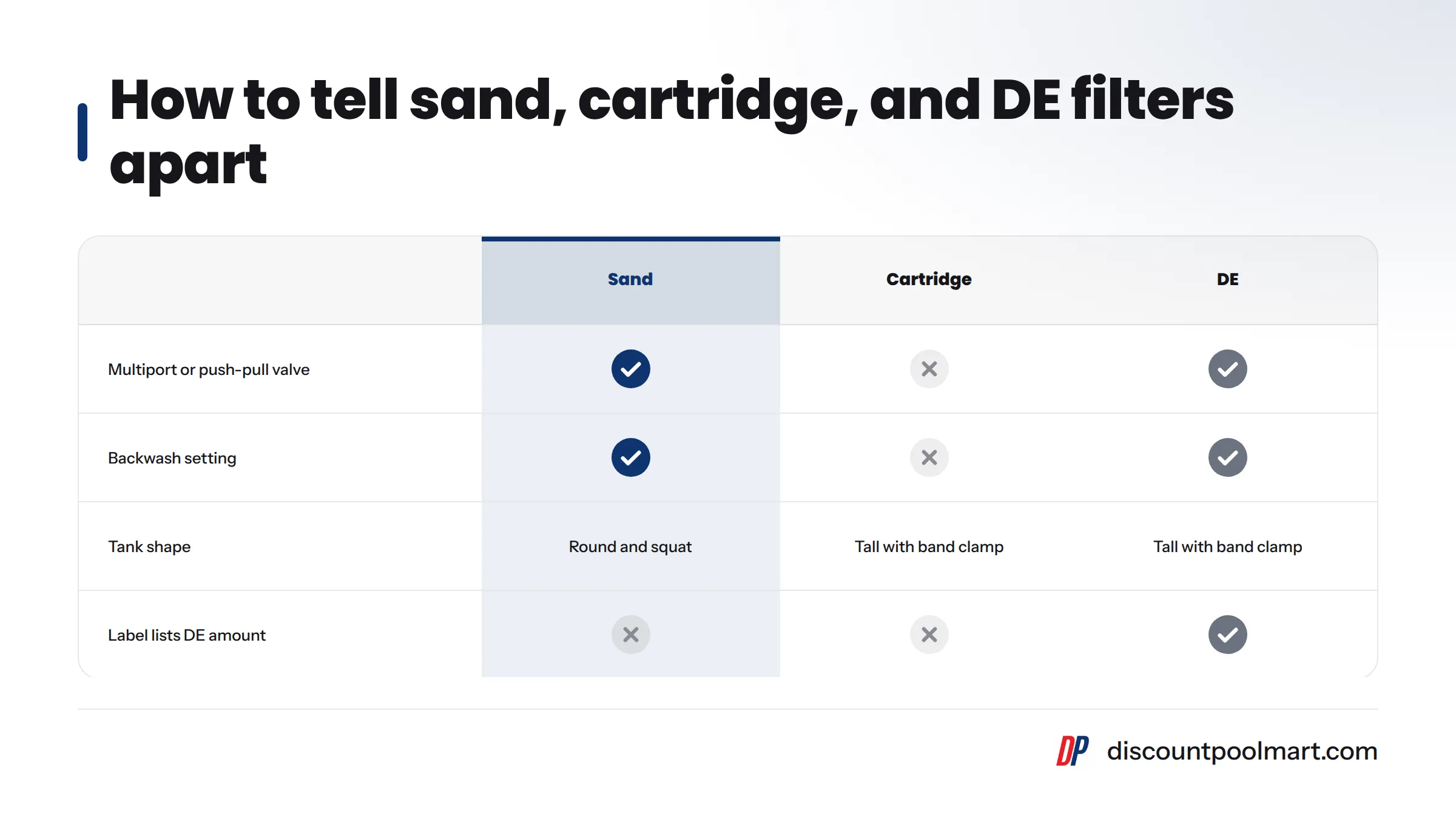
You can figure this out in about 30 seconds at the equipment pad:
- Look for a valve. A multiport valve has a handle with six or seven labeled positions. A push-pull (slide) valve has a plunger handle on the side. Either one means you have sand or DE.
- No valve at all? Then it's a cartridge filter. It has no backwash setting, just a tank, a clamp or lid, a gauge, and an air relief valve.
- Read the label. Pentair, Hayward, Jandy, and Waterway print the model and filter type on the tank. If the label gives a rating in square feet and also lists a DE amount, it's a DE filter.
- Check the shape. Sand tanks are usually round and squat. Cartridge and DE tanks tend to stand tall, with a band clamp around the middle.
Still choosing a filter for your pool? Our comparison of DE, cartridge, and sand filters answers that question. This guide only covers cleaning.
Shut Off the Pump and Release Pressure
Turn the pump off at its switch or timer. That's the only electrical step in this whole job. Next, open the air relief valve (the bleeder) on top of the tank and wait until the hissing stops. Here is why: a tank under pressure can throw a lid or clamp hard enough to hurt you. Don't loosen a clamp until the gauge reads zero.
Read the Gauge and Record Your Clean Baseline PSI
Your clean baseline PSI is the pressure reading taken right after a thorough cleaning, with the pump at its normal speed. Write that number on the tank in permanent marker. Once the reading climbs a set amount above it, the filter is due. Many manufacturer manuals put the trigger at about 8 to 10 PSI over the clean reading, but your model's manual makes the final call. A stuck needle tells you nothing. If your gauge doesn't drop back to zero with the pump off, put in a replacement pressure gauge.
Check your manual: Steps, pressure limits, and DE amounts vary by model. Your filter manufacturer's owner's manual overrides any general guide, including this one.
Supplies checklist:
- Garden hose with a spray nozzle
- Backwash hose (sand and DE)
- Pool filter cleaner or degreaser, such as a cartridge filter cleaner spray
- Bucket or soak container big enough for your cartridge
- Silicone O-ring lubricant (never petroleum jelly)
- DE powder (DE filters only)
- Dust mask or respirator for handling DE
How to Clean a Sand Filter: Backwash and Rinse Step by Step
If you've been searching how to clean pool sand filter media, the answer mostly comes down to backwashing. Backwashing sends water through the filter in reverse, so trapped dirt lifts out of the sand and leaves through the waste port. Rinsing then settles the sand bed again so leftover debris doesn't get pushed back into the pool. Here's how to backwash a pool filter:
- Turn off the pump.
- Set the multiport valve to BACKWASH, or pull up the handle on a push-pull valve.
- Roll out the backwash hose to a legal discharge point (see the callout below).
- Turn on the pump and watch the sight glass or the water coming out of the hose.
- Run it until the water comes out clear, usually two to three minutes.
- Turn off the pump.
- Set the valve to RINSE and run the pump for about 30 to 60 seconds.
- Turn off the pump and move the valve back to FILTER.
- Restart the pump, bleed any air from the relief valve, and write down the new pressure.
What each multiport position does: FILTER is for normal running. BACKWASH reverses the flow to flush the media. RINSE settles the bed after a backwash. WASTE sends water straight out without filtering it, which comes in handy when you're vacuuming heavy debris. RECIRCULATE moves water past the media. CLOSED stops all flow, so never run the pump on that setting.
Occasional Deep Clean With a Sand Filter Cleaner
Backwashing won't remove the oils, lotions, and scale that glue sand grains together. A sand filter cleaner breaks down that film, and once or twice a season is usually enough. Follow the label for the dose and soak time, then backwash and rinse.
This short demo shows the deep clean:
LA discharge rules: The City of Los Angeles stormwater program, run by LA Sanitation and Environment, treats pool backwash as a non-stormwater discharge. Keep it out of the gutter, the street, and the storm drain. Statewide stormwater permits come from the California State Water Resources Control Board. Before you backwash, ask your city whether the hose should go to a sewer cleanout.
How to Clean a Cartridge Filter: Remove, Hose, and Soak Step by Step
Cartridges take more hands-on work than the other two types. In our view they're also the easiest to get right, and most owners have the routine down by their second clean. Here's how to clean a pool cartridge filter:
- Turn off the pump.
- Open the air relief valve until the gauge reads zero.
- Remove the drain plug and let the tank empty.
- Loosen the clamp band or lid.
- Lift out the cartridge or cartridges.
- Hose each pleat from top to bottom, aiming into the folds at a 45-degree angle. Leave the pressure washer in the garage.
- Inspect the pleats and end caps for tears, flattened spots, or cracks.
- Soak the cartridge in filter cleaner or degreaser for as long as the label says, if oil or scale is still there.
- Rinse the cartridge well after it soaks.
- Clean the tank O-ring, look for cracks or flat spots, and give it a light coat of silicone lubricant.
- Reassemble the filter and put the drain plug back in.
- Restart the pump, bleed the air, and write down your new baseline.
What to Clean Cartridges With
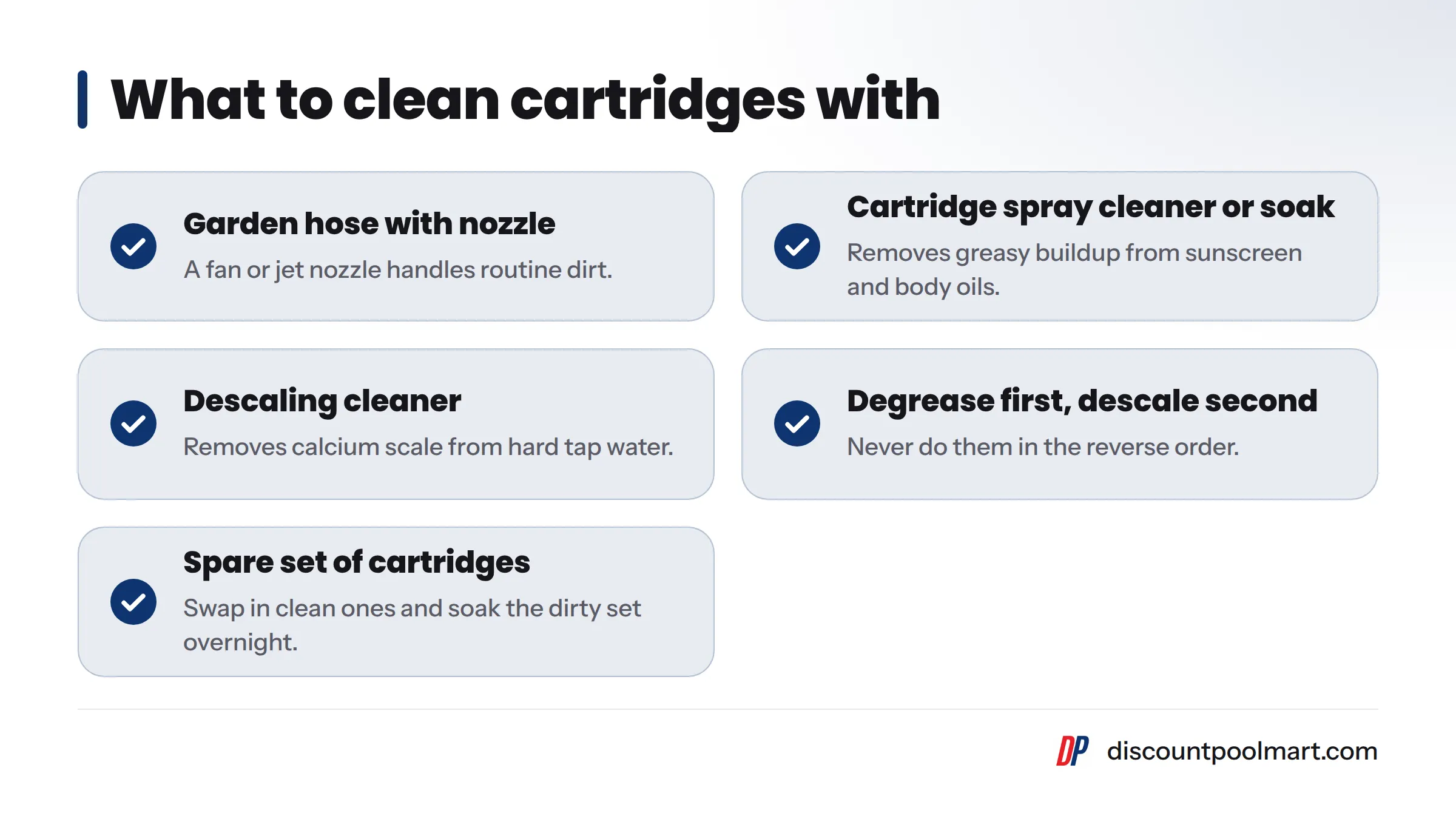
For routine dirt, a garden hose with a fan or jet nozzle does the job. Greasy buildup from sunscreen and body oils calls for a cartridge spray cleaner or a soak product made for pool cleaning filters. Calcium scale is common with hard LA tap water, and it needs a descaling cleaner. Always degrease first and descale second, never the other way around.
Tech tip: Keep a spare set of cartridges. Drop the clean set in, soak the dirty set overnight, and the pump keeps running the whole time.
How to Clean a DE Filter: Backwash, Teardown, Grid Cleaning, and Recharge Step by Step
Learning how to clean a DE pool filter really means learning two jobs: a quick backwash and a full teardown once in a while.
Backwash Between Teardowns
Use the same valve steps as the sand filter. Run BACKWASH until the water comes out clear, then RINSE if your valve has that setting, then go back to FILTER. Backwashing leaves old DE stuck to the grids, so it only buys you time until the next full cleaning.
Full Teardown and Grid Cleaning
- Turn off the pump and open the air relief assembly.
- Drain the tank through the drain plug.
- Remove the clamp and lift off the lid.
- Lift out the grid assembly and manifold together as one unit.
- Hose each grid from top to bottom until all the DE is gone.
- Soak the grids in filter cleaner if oil or scale won't come off.
- Inspect every grid for tears or worn spots, and check the DE filter manifold and standpipe for cracks.
- Reassemble the stack and lube the tank O-ring before you close the clamp.
Reassemble and Recharge DE Through the Skimmer
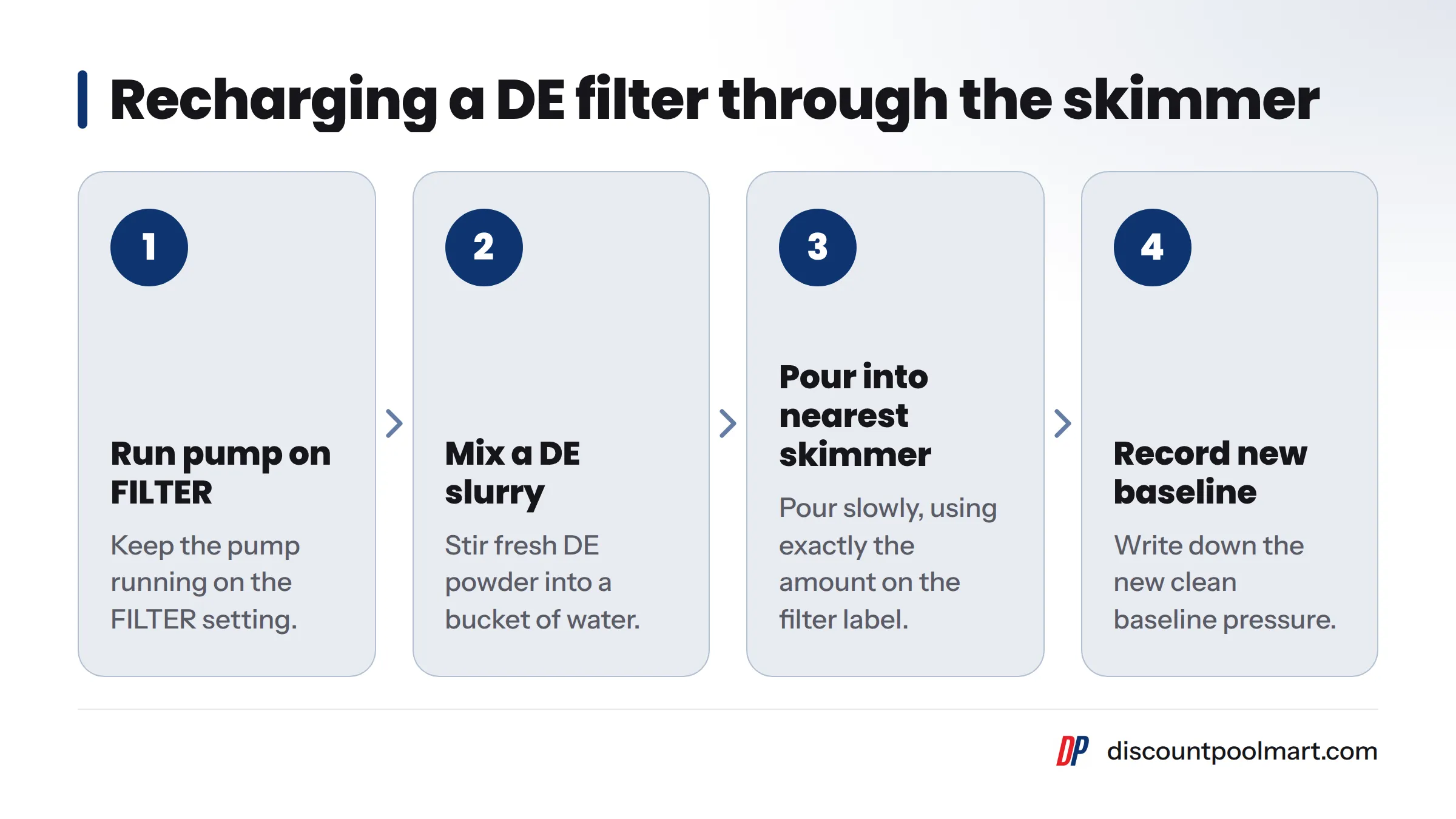
With the pump running on FILTER, stir fresh DE powder into a bucket of water until it forms a slurry. Pour it slowly into the skimmer nearest the equipment. Add exactly the amount printed on your filter's label or in the manual, since that number is based on the filter's square footage. Then write down your new clean baseline.
DE dust safety: Pool-grade DE can contain crystalline silica. OSHA's crystalline silica guidance explains that breathing fine silica dust carries real health risks. Wear a dust mask, pour gently, and stand upwind. Bag spent DE and put it out with household trash, and keep it out of storm drains as LA rules require.
This longer video walks through DE grid cleaning step by step:
Let the Pressure Gauge Decide How Often to Clean
The gauge tells you when to clean, not the calendar. Our technicians treat the timing below as a rough guide and nothing more.
| Filter type | Pressure trigger | Typical deep clean | SoCal seasonal note |
|---|---|---|---|
| Sand | Rise above clean baseline per manual | Sand cleaner once or twice a season | Expect more backwashing during summer pool parties and Santa Ana wind debris |
| Cartridge | Rise above clean baseline per manual | Soak a few times a year | Clean after heavy pollen and ash events |
| DE | Rise above clean baseline per manual | Full teardown at least once a year | Plan the teardown before peak swim season |
Next steps: fit swimming pool filter cleaning into the rest of your 5-step pool cleaning routine and our SoCal pool maintenance calendar.
Common Filter-Cleaning Mistakes Our LA Technicians See Most
Every one of these comes from our own service calls, and we see each of them over and over.
- Opening the tank under pressure. Bleed it first, every time.
- Turning the multiport handle while the pump runs. That tears the spider gasket inside the valve.
- Skipping RINSE. Dirt left in the lines blows right back into the pool.
- Over-backwashing. A slightly dirty sand bed actually filters better than a spotless one. Backwash only when the gauge says to.
- Pressure washing cartridges. It shreds the fabric and pushes dirt deeper.
- Dry or missing O-rings. A dry O-ring pinches and leaks. Keep a spare filter tank O-ring on the shelf.
- Never logging a baseline. Without one, the gauge reading means nothing.
- Forgetting to recharge DE. Bare grids clog fast and can get damaged.
- Adding DE to a cartridge filter. It cakes the pleats and does nothing useful.
One Silver Lake homeowner called us because her pressure stayed high after every backwash. Her valve had run on CLOSED for a few seconds during a handle change. That cracked a lateral and sent sand back into the pool. Shutting off the pump first takes about a minute, and that habit would have saved her the repair.
Signs Cleaning Is No Longer Enough: Worn Sand, Cartridges, and DE Grids
Sand or Alternative Media
Look for channeling (water cutting paths through the bed), mudballing (clumps of sand and oil), and sand on the pool floor. Once sand has channeled or clumped, you can't reuse it. Replace it. Glass media and zeolite outlast sand, but they wear down too. Change them when your manual says to, or when cleaning no longer brings the pressure back down.
Cartridges
Frayed or flattened pleats, cracked end caps, and a baseline that keeps creeping up after a thorough soak all tell you the cartridge is done. Put in a matching element, such as this Pentair Clean & Clear Plus 240 cartridge if that's your model.
DE Grids and Manifold
DE blowing back into the pool after a recharge is the classic sign of a torn grid or a cracked manifold. We judge grids by their condition at each teardown, not by a fixed date. Any grid with a tear, a soft spot, or fabric that won't release DE gets replaced. Quad-style filters use grid cartridges like this Pentair Quad DE 100 replacement.
Clean, soak, or replace? Let's break it down:
- Pressure high? Clean (backwash, hose, or tear down).
- Still high after cleaning? Deep clean (soak or use a media cleaner).
- Still high, or media or DE getting into the pool? Replace the worn part.
Our upcoming pool filter parts guide will cover part matching. For electrical or pump problems, check our pool pump repair service page once it's live.
Pool Filter Cleaning FAQ
What can I use to clean my pool filter cartridges? A garden hose with a spray nozzle handles routine cleaning. For oils and sunscreen film, use a cartridge spray cleaner or a filter soak, and use a descaler for calcium. Skip household bleach mixtures, dish soap, and pressure washers, since they can leave residue or damage the fabric.
Can I reuse the sand in my pool filter? Only if it still flows freely and filters well. Replace it if you see channeling, mudballing, or sand in the pool, or if the pressure won't settle after a deep clean. Sand that has clumped from oils won't come back with backwashing alone.
How often should you change the glass in a pool filter? Follow the interval from your filter or media manufacturer. Glass media usually lasts longer than sand, but it still wears out. Change it when cleaning no longer gets you back to your clean baseline pressure, or when media starts showing up in the pool.
Why is my filter pressure still high after cleaning? Check for a return valve that's partly closed, a clogged pump basket, a bad gauge, or media that needs replacing. In DE filters, adding too much DE raises pressure too. Make sure to test your pool water, because scale-forming water clogs filters faster.
Do I have to add DE after every backwash? Yes. A backwash flushes out part of the DE coating, so add back the backwash amount listed in your manual. After a full teardown, add the full amount on the label.
Should I clean the filter after shocking the pool? Yes. Shock knocks out contaminants, and they end up in the filter. Let the pump run for a day after you shock the pool, then clean the filter once the pressure climbs.
Can I pressure wash a pool filter cartridge? No. A pressure washer frays the fabric and pushes debris deeper into the pleats. Use a regular garden hose nozzle held at an angle.
Sources
- Diatomaceous earth, Wikipedia
- Crystalline Silica, Occupational Safety and Health Administration (OSHA)
- LA Sanitation and Environment, City of Los Angeles
- California State Water Resources Control Board
Related: pool equipment, pool filters