

A variable speed pool pump runs on a permanent magnet (ECM) motor with programmable controls, so it can turn at almost any speed (RPM) instead of one fixed speed. California's Title 20 rules and the federal DOE pool pump standards now push nearly every replacement filtration pump toward variable speed. The reason is simple: a pump that runs slowly uses far less electricity.
We see the same thing at our counters every week. An old pump starts screaming, then it quits, usually on the hottest Saturday in July. The owner comes in ready to buy the same model again and learns that California rules have changed. The new pump costs more up front, and the difference also shows up on every power bill after that.
At Discount Pool Mart, we've spent years helping Los Angeles pool owners make this switch. This guide covers what the technology is, why it saves energy, what the law requires, and how to tell whether it fits your pool equipment setup.
What a Variable Speed Pool Pump Actually Does
A variable speed pool pump is a circulation pump with a permanent magnet motor and built-in electronics. Together they let you set its speed anywhere in a wide RPM range. You can program a different speed for each job, such as low speed for filtering and higher speed for vacuuming, so the pump only draws the power that job needs.
The Permanent Magnet Pool Pump Motor
Older pumps use induction motors, which lose energy as heat and noise. An electronically commutated motor (ECM) uses permanent magnets and onboard electronics to control rotation precisely. A permanent magnet pool pump motor stays cooler and wastes less energy. It can also slow to a quiet idle and still keep the water moving.
Speed Presets, Timers, and Automation
Most variable speed units have a control panel on the motor where you store several speed presets and timers. You can also connect them to a pool automation controller, which runs the pump on a schedule alongside your heater, lights, and cleaner.
Quick definitions
- RPM: revolutions per minute, which is how fast the motor spins.
- GPM: gallons per minute, which is how much water moves through the system.
- Turnover rate: how long it takes to circulate the pool's full volume once.
- kWh: kilowatt-hours, the unit your utility bills you for.
Variable Speed Pool Pump vs Single Speed and Two-Speed Models
Let's break it down.
Single-speed pumps have an induction motor that runs at one fixed RPM, usually full speed, the whole time it's on. For most of the day, that means far more flow than filtration needs.
Two-speed pumps also use an induction motor but add a low setting. Low speed saves energy, but you only get two choices.
Variable speed pumps pair a permanent magnet motor with a full speed range, so you pick the exact flow each task needs.
| Feature | Variable speed | Two-speed | Single-speed |
|---|---|---|---|
| Motor type | Permanent magnet (ECM) | Induction | Induction |
| Speed control | Full programmable range | High and low | One fixed speed |
| Noise | Very quiet at low RPM | Quieter on low | Loud |
| Filtration at low flow | Excellent | Good on low | Limited |
| Relative energy use | Lowest | Moderate | Highest |
| California replacement sales | Meets current rules | Mostly phased out for typical inground filtration pumps | Not allowed for most residential filtration pumps |
So how does the dual speed vs variable speed pool pump choice play out? A two-speed pump gets you partway there. A variable speed pump lets you fine-tune every task, and in my experience, that fine-tuning is where the real savings come from. Our single, dual and variable speed pump comparison goes into more detail.
Why Slower Speeds Cut the Power Bill
Here is why slow wins.
The Pump Affinity Laws Without the Jargon
The pump affinity laws describe how centrifugal pumps behave. Flow rises and falls in step with speed, but power draw changes with roughly the cube of speed. Cut the speed in half and, on paper, you get about half the flow for about one-eighth of the power.
| Pump speed | Flow (GPM) | Theoretical power draw |
|---|---|---|
| 100% | 100% | 100% |
| 75% | 75% | about 42% |
| 50% | 50% | about 12.5% |
Half Speed Still Turns Over the Pool
A pump running at half speed for twice as long pushes the same amount of water through your filter, and it uses a fraction of the kWh. You still hit your turnover goals. You just get there more quietly and for less money.
Reality check: Real-world savings come in below the theoretical math, because motor losses, plumbing resistance, and filter pressure each take a share.
Variable Speed Pool Pump Savings for LA-Area Pool Owners
What the DOE and ENERGY STAR Say
The U.S. Department of Energy says that switching to a smaller, higher-performing pump and running it less can save as much as 75% of pool pump energy costs (Energy Saver: Swimming Pool Pumps, U.S. DOE). ENERGY STAR certifies pool pumps that meet its stricter performance specification, so certified models make a sensible place to start shopping.
LADWP and SCE Rate Plans Change the Math
Los Angeles households pay tiered or time-of-use rates through LADWP or Southern California Edison. On a time-of-use plan, moving long low-speed runs outside peak hours can stretch your savings further. Check your own plan before you set a schedule.
What Our Customers Tell Us
This is anecdotal feedback, not a guarantee. Customers at our LA-area stores who replace old single-speed pumps often come back and tell us their summer bills dropped by an amount they could actually see. The pattern is consistent. Owners who program low speeds get the biggest wins, and owners who leave the pump at high RPM all day get the smallest.
Finding a Variable Speed Pool Pump Rebate
Rebates come and go, so check what's available right now:
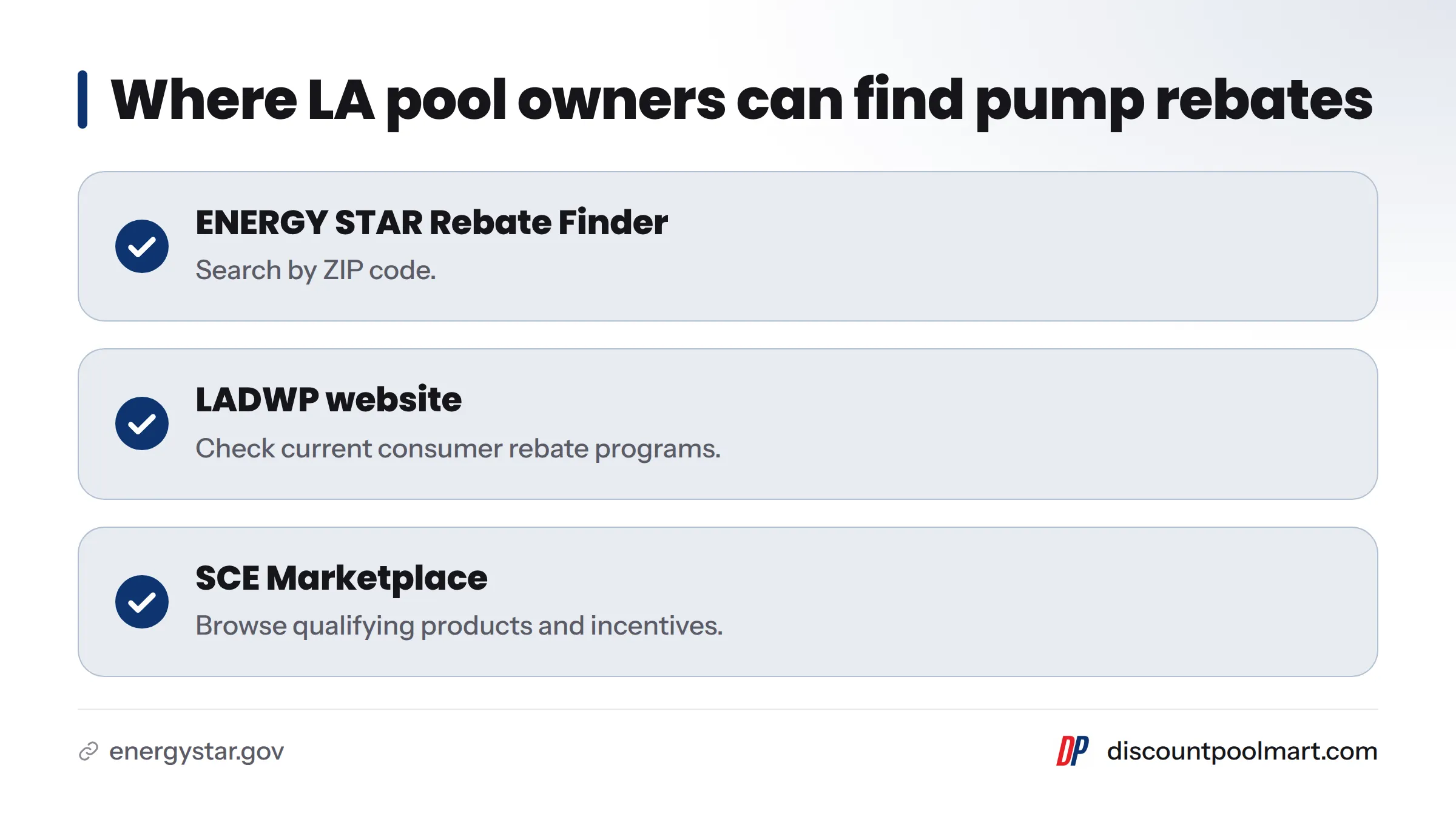
- Search by ZIP code with the ENERGY STAR Rebate Finder.
- LADWP customers can check the LADWP website for current consumer rebate programs.
- SCE customers can browse the SCE Marketplace for qualifying products and incentives.
This short video walks through a savings example and shows how filtration schedules affect the numbers:
Your savings depend on pool size, run schedule, speed settings, and utility rate plan.
Quieter Evenings, Cleaner Water, and Less Wear
Energy savings get most of the attention, but owners bring up these benefits just as often:
- Quieter operation. At low RPM, many units run quietly enough for an evening on the patio.
- Better filtration. Slower-moving water gives the filter more time to catch fine debris.
- Less wear. A cooler motor puts less heat stress on bearings and seals.
- Programmability. Built-in timers and diagnostics replace mechanical clocks.
Variable speed pumps also connect to most automation controllers. For setup ideas, read our guides to pool automation systems and pool pump scheduling.
California Title 20 Pool Pump Rules and the Federal Standard
California requires multi-speed capability for residential pool pump motors. Federal standards then set minimum performance levels that most standard-size filtration pumps can only meet with variable speed motors. Put the two together and variable speed becomes the practical choice for most replacements.
What Title 20 Requires
The California Energy Commission's appliance program enforces Title 20. Since January 1, 2008, Title 20 has required residential pool pump motors of 1 horsepower or more to run at two or more speeds, with the low speed no more than half the maximum.
The Federal DOE Dedicated-Purpose Pool Pump Standard
The DOE set performance standards for dedicated-purpose pool pumps in 10 CFR 430.32, using a metric called weighted energy factor (WEF). Pumps made on or after July 19, 2021 must comply.
| Date | Rule change |
|---|---|
| January 1, 2008 | Title 20 requires two or more speeds on residential pool pump motors of 1 HP or more |
| July 19, 2021 | Federal WEF standards take effect for dedicated-purpose pool pumps |
When Your Old Pump Quits
Bring the model label, or a photo of it, to one of our stores, and we'll help you find a compliant replacement. If you'd rather not do the swap yourself, our pool pump installation service can handle it.
What We're Selling at Our LA Stores
This is first-party information from our Los Angeles-area stores, based on residential filtration pump sales since the 2021 federal standard took effect.
The direction is clear. Variable speed units now make up the large majority of the residential filtration pumps we sell. Single-speed sales mostly come from small specialty uses that the rules still allow.
Questions We Hear at the Counter
"Why does it cost more?" "Can I keep my old timer?" "Will my heater still work?" That last one matters. Heaters, pressure cleaners, and spa jets often need higher flow, so you program short high-speed windows for them.
Is a Variable Speed Pool Pump Worth It?
For most owners, I'd say yes. Run through this checklist:
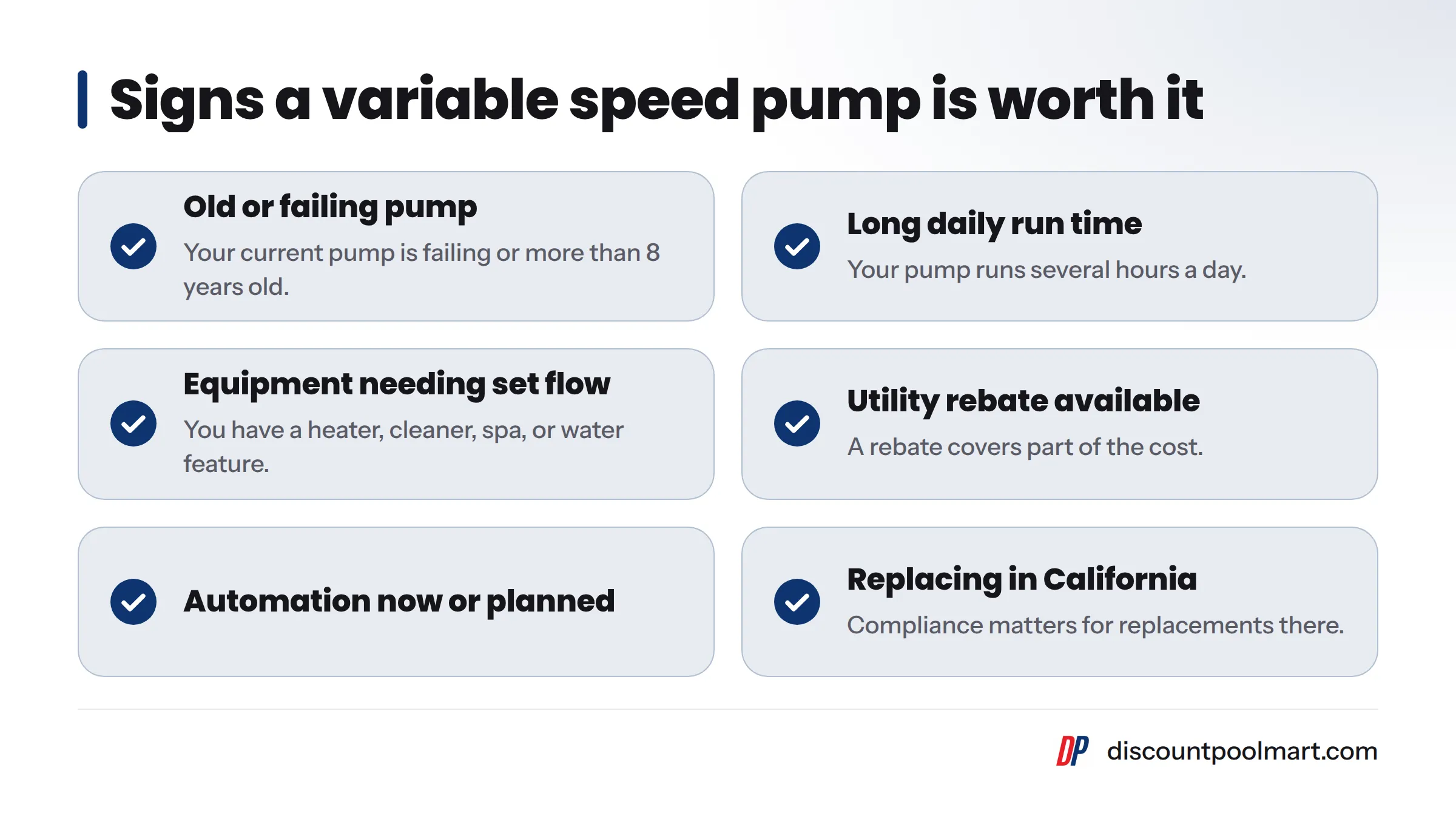
- Your current pump is failing or more than 8 years old.
- Your pump runs several hours a day.
- You have a heater, cleaner, spa, or water feature that needs a set flow (see our heater comparison).
- A utility rebate covers part of the cost.
- You have automation now or plan to add it.
- You're replacing a pump in California, where compliance matters.
We see the strongest payback when someone installs a variable speed pool pump for inground pool circulation. Jandy, Pentair, and Hayward all make variable speed lines. For sizing and model comparisons, start with our best pool pump buying guide, then browse our pool pumps collection or visit a Discount Pool Mart store near you.
Frequently Asked Questions
What is a variable speed pool pump? It's a pump with a permanent magnet motor that runs at programmable speeds, so it uses less energy than a fixed-speed pump.
How much does a variable speed pool pump save? The DOE estimates savings of up to 75% of pump energy costs with a right-sized, higher-performing pump. Your results depend on how you set it up.
Variable speed pool pump vs single speed: what's the difference? A single-speed pump always runs at full RPM. A variable speed pump adjusts its speed to each task.
Is a two-speed pump still allowed in California? For most standard inground filtration pumps, federal WEF standards effectively require variable speed.
Are there rebates in Los Angeles? Sometimes. Check the LADWP, SCE, and ENERGY STAR links above to see what's offered now.
Should a variable speed pump run 24 hours a day? Some owners run it at a very low speed all day, while others use set windows. Our pump scheduling guide covers both approaches.
Does Discount Pool Mart carry Jandy variable speed pool pumps? Check our pool pumps collection for current availability.
What size or brand should I buy? Size depends on your plumbing and pool volume. Our buying guide walks you through it.
Next steps: find your old pump's label, check for rebates, and come talk to us. A variable speed pool pump is the upgrade we'd make on our own pools.