

Pool water testing takes about five minutes a week. Fill a clean vial with water from elbow depth, then test it with strips, a liquid drop kit, or a digital tester. Check pH, free chlorine, combined chlorine, total alkalinity, calcium hardness, and cyanuric acid. If you have a saltwater pool, check salt too. Then compare each reading to the pool water testing chart below.
That's all there is to the method. The harder part is knowing whether your numbers are right. Every week someone comes up to our counter at Discount Pool Mart holding a cup of pool water and a strip they can't read. They think something is "off" but can't tell which number to believe. This guide shows you how to get readings you can rely on. Last updated October 2026.
Quick Answer: How to Test Pool Water and What the Readings Should Be
- Pick a method: test strips, a liquid reagent drop kit, or a digital photometer.
- Collect a sample: take it from elbow depth, away from jets and skimmers.
- Run each test: pH, free and total chlorine, alkalinity, hardness, CYA, and salt if your pool uses it.
- Compare to the ranges: label each reading low, ideal, or high.
The table in the next section lists the target for each reading.
Ideal Pool Chemical Levels: The Pool Water Testing Chart
These ranges come from the residential water quality guidance in the ANSI/APSP/ICC-5 and ANSI/APSP/ICC-11 standards, published through the Pool & Hot Tub Alliance (PHTA). The CDC's Healthy Swimming program gives its own pool recommendations: at least 1 ppm free chlorine and a pH between 7.2 and 7.8.
| Parameter | What it measures | Ideal range | Acceptable range | Source |
|---|---|---|---|---|
| pH | How acidic or basic the water is | 7.4-7.6 | 7.2-7.8 | ANSI/APSP/ICC-5 via PHTA; CDC |
| Free chlorine | Chlorine still available to sanitize | 2-4 ppm | 1-4 ppm | ANSI/APSP/ICC-5 via PHTA; CDC (1 ppm minimum) |
| Combined chlorine (chloramines) | Chlorine that contaminants have already used up | 0 ppm | 0.2 ppm or less | ANSI/APSP/ICC-5 via PHTA |
| Total alkalinity | How well the water resists pH swings | 80-120 ppm | 60-180 ppm | ANSI/APSP/ICC-5 via PHTA |
| Calcium hardness | Dissolved calcium in the water | 200-400 ppm | 150-1,000 ppm | ANSI/APSP/ICC-5 via PHTA |
| Cyanuric acid (CYA / stabilizer) | Protects chlorine from sunlight | 30-50 ppm | 0-100 ppm | ANSI/APSP/ICC-5 via PHTA |
| Salt (saltwater pools only) | Salt that feeds the chlorine generator | Per your generator manufacturer | Hayward lists 2,700-3,400 ppm, ideal 3,200 | Hayward |
If you want more detail on each of these swimming pool water testing parameters, our guide to the 6 main pool water parameters explains them one at a time.
What "ppm" Means
Ppm stands for parts per million. A free chlorine reading of 3 ppm means there are three parts chlorine in every million parts of water.
Out of range? This page only covers testing. To learn how to fix each reading, see our pool water chemistry guide.
Step 1: Choose a Pool Water Testing Kit (Strips, Drops, or Digital)
All swimming pool water testing kits measure the same things. They differ in how you read the result and how much guessing you have to do.
Test Strips
A strip has small pads that change color when you dip it in the water. You hold it up to the chart on the bottle and find the closest match. Strips are fast and work well for a quick midweek check. The downside is that color matching is a judgment call, and the shades are hard to tell apart near the edges of a range.
Liquid Reagent Drop Test Kits
Drop kits use reagents that either change the water's color or let you count drops. DPD reagent turns the sample pink when chlorine is present. Phenol red goes from yellow to red as pH rises. The FAS-DPD method takes this further: you add titrant one drop at a time until the pink disappears, and every drop stands for a set amount of chlorine. Counting drops is more reliable than comparing shades.
I'll be honest: this is the swimming pool water testing kit I recommend to most owners. The Taylor K-2006 FAS-DPD test kit tests free and combined chlorine, pH, alkalinity, hardness, and CYA. Many service pros use the larger Taylor K-2006C service kit. For something simpler to start with, the Blue Devil 5-way OTO pool test kit and the Poolmaster 5-way test kit test chlorine, pH, and alkalinity. One limitation: OTO reagent only reads total chlorine, so it can't tell you how much is free chlorine and how much is combined.
Digital Photometers and Electronic Testers
A digital pool water tester uses a light sensor to read the color of the sample and shows the result as a number. You don't have to match colors at all. Salt meters for saltwater pools are also electronic, but they measure conductivity instead of color.
| Method | Speed | Reading detail | Ease of reading | Best for |
|---|---|---|---|---|
| Liquid drop kit (FAS-DPD) | Moderate | Fine, drop by drop | Clear endpoints | Weekly full tests, chloramine tracking |
| Test strips | Fastest | Rough estimate | Subjective color match | Quick midweek checks |
| Digital tester | Fast | Numeric display | No color judgment | Owners who struggle with colors |
For a side-by-side look, read our comparison of test strips vs drops vs digital.
Step 2: Collect a Clean, Representative Water Sample
Even the best kit can't fix a bad sample. Here is the routine our staff use:
- Rinse the vial or cup with pool water.
- Choose a spot away from return jets, skimmers, and chlorinators or floaters.
- Hold the container upside down and push it straight down to elbow depth.
- Turn it upright underwater so it fills, then bring it up.
- Test right away. If you're taking it to a store, cap it and drop it off the same day.
Common sampling mistakes: scooping water from the surface, sampling right next to a tablet feeder, using a cup with leftover soap or old reagent, and leaving the sample in a hot car.
Step 3: Run Each Test and Write Down the Results
Using Test Strips
Dip the strip once and pull it straight out without swishing it around. Hold it flat so the colors from one pad don't run into the next. Read it in daylight at the exact time the label gives. If the pads look faded or the bottle was left open, buy a new bottle.
Using a Drop Kit
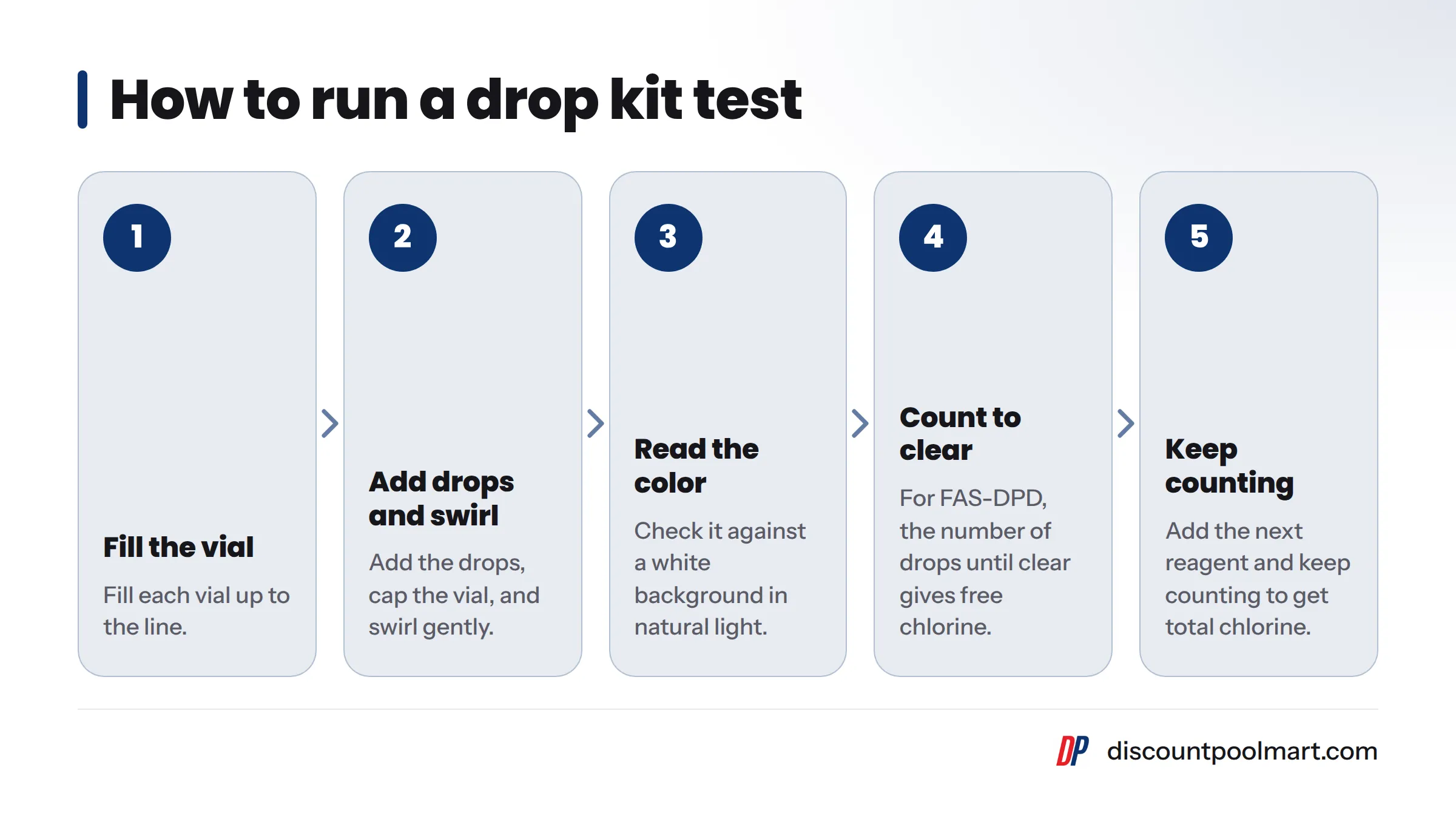
Fill each vial to the line, add the drops, cap it, and swirl gently. Read the color against a white background in natural light. For FAS-DPD, count drops until the sample turns clear. That number gives you free chlorine. Then add the next reagent and keep counting to get total chlorine.
A lot of owners get caught by one particular error. Taylor Technologies notes that very high chlorine can interfere with phenol red and show a false pH color. Taylor also recommends replacing reagents on a regular schedule, since old reagents give unreliable results. Check the dates on your bottles at the start of every season.
This short video shows a full Taylor chlorine and pH test:
Using a Digital Tester
Follow the manufacturer's instructions step by step. That means taking the blank or zero reading and waiting the full time after you add reagent.
Testing Salt Levels in Saltwater Pools
Use a salt meter, salt strips, or a titration kit such as Taylor's saltwater test kit. Compare your result to the salt level your generator displays. If you haven't chosen a system yet, see our comparison of salt water vs chlorine pools.
Testing log. Copy this into a notebook or spreadsheet and fill in a row every time you test:
| Date | pH | FC | CC | TA | CH | CYA | Salt | Notes |
|---|---|---|---|---|---|---|---|---|
Step 4: Label Each Reading Low, Ideal, or High
Use the chart to mark every number as low, ideal, or high. To get combined chlorine, subtract free chlorine from total chlorine. If a result looks wrong, test again before you add any chemicals.
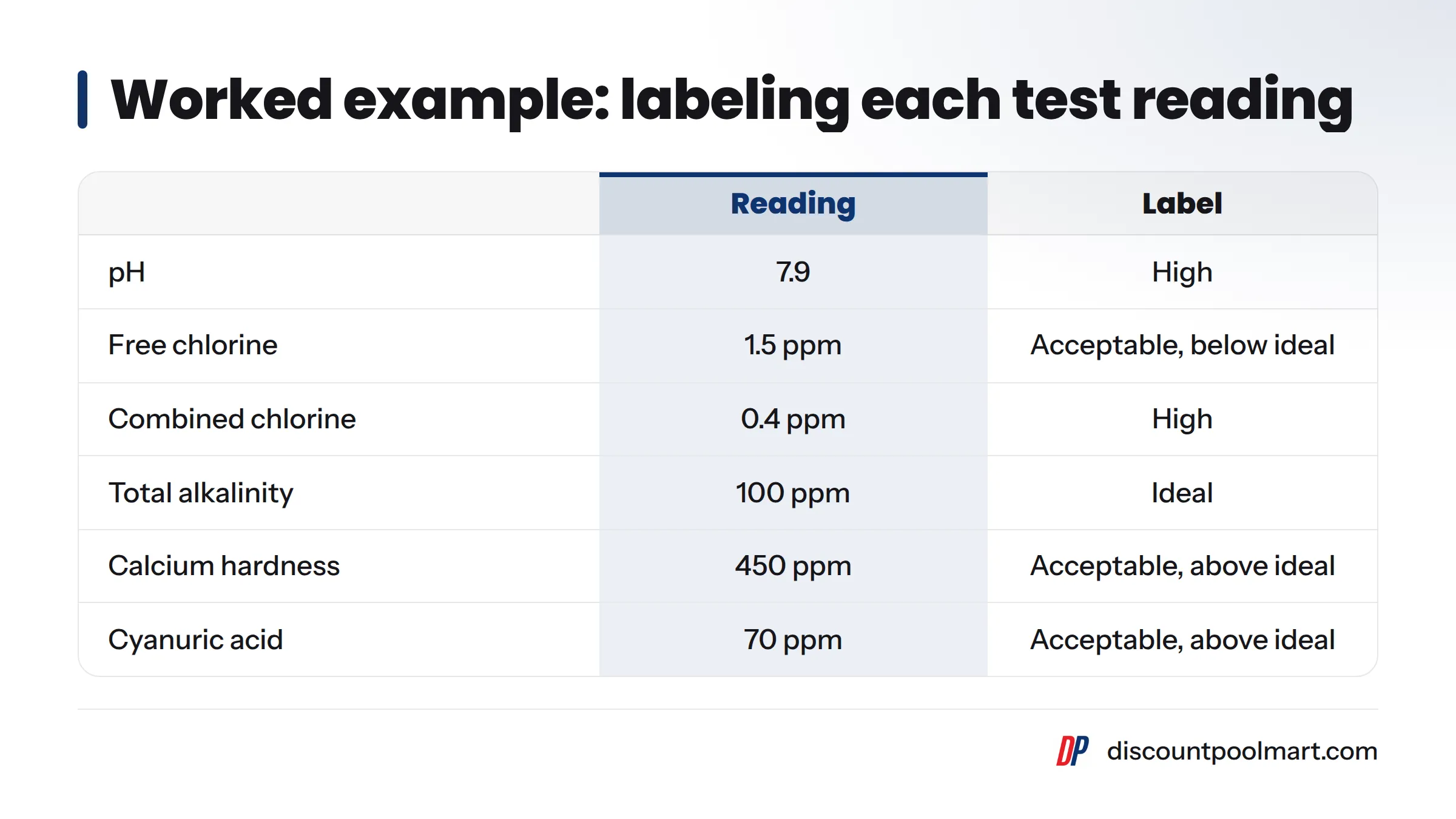
Worked example:
- pH 7.9: high
- FC 1.5 ppm: acceptable, below ideal
- TC 1.9 ppm, so CC is 0.4 ppm: high
- TA 100 ppm: ideal
- CH 450 ppm: acceptable, above ideal
- CYA 70 ppm: acceptable, above ideal
In this example, pH and combined chlorine need fixing first. For supplies, visit our chemistry supplies page, and for the order to make adjustments in, read how to balance pool water.
How Often to Test Pool Water
| Situation | What to test | Frequency |
|---|---|---|
| Routine | pH, free chlorine | At least weekly |
| Peak swim season or heavy use | pH, free and combined chlorine | Two to three times a week |
| After rain, storms, or a heat wave | pH, free chlorine | Within a day |
| After a pool party | pH, free and combined chlorine | The next morning |
| Full panel | TA, CH, CYA, salt | Monthly |
This is the schedule our team recommends, not an industry rule. It works well alongside our LA pool maintenance checklist.
Which Readings LA-Area Pools Miss Most, Season by Season
Our staff have noticed these patterns while testing customers' water at Discount Pool Mart's Los Angeles-area stores. They're what we see at the counter, not measured statistics.
| Season | Readings that most often miss | What we see at the counter |
|---|---|---|
| Spring (opening) | Free chlorine, pH | Pools coming out of a slow winter, often with several readings off at once |
| Summer | Free chlorine, combined chlorine, CYA | Heat and heavy swimming use up chlorine quickly, and stabilized tablets push CYA up |
| Fall | Calcium hardness, total alkalinity | Months of evaporation and refilling leave minerals behind |
| Winter | pH | Owners test less often, so pH drifts and nobody catches it |
This table tells you which tests to watch more closely in each season. Our SoCal pool maintenance calendar covers the rest of the year.
Pool Water Testing Near Me: When to Bring a Sample to Our Stores
Keep testing at home every week. Bring a sample to a store when:
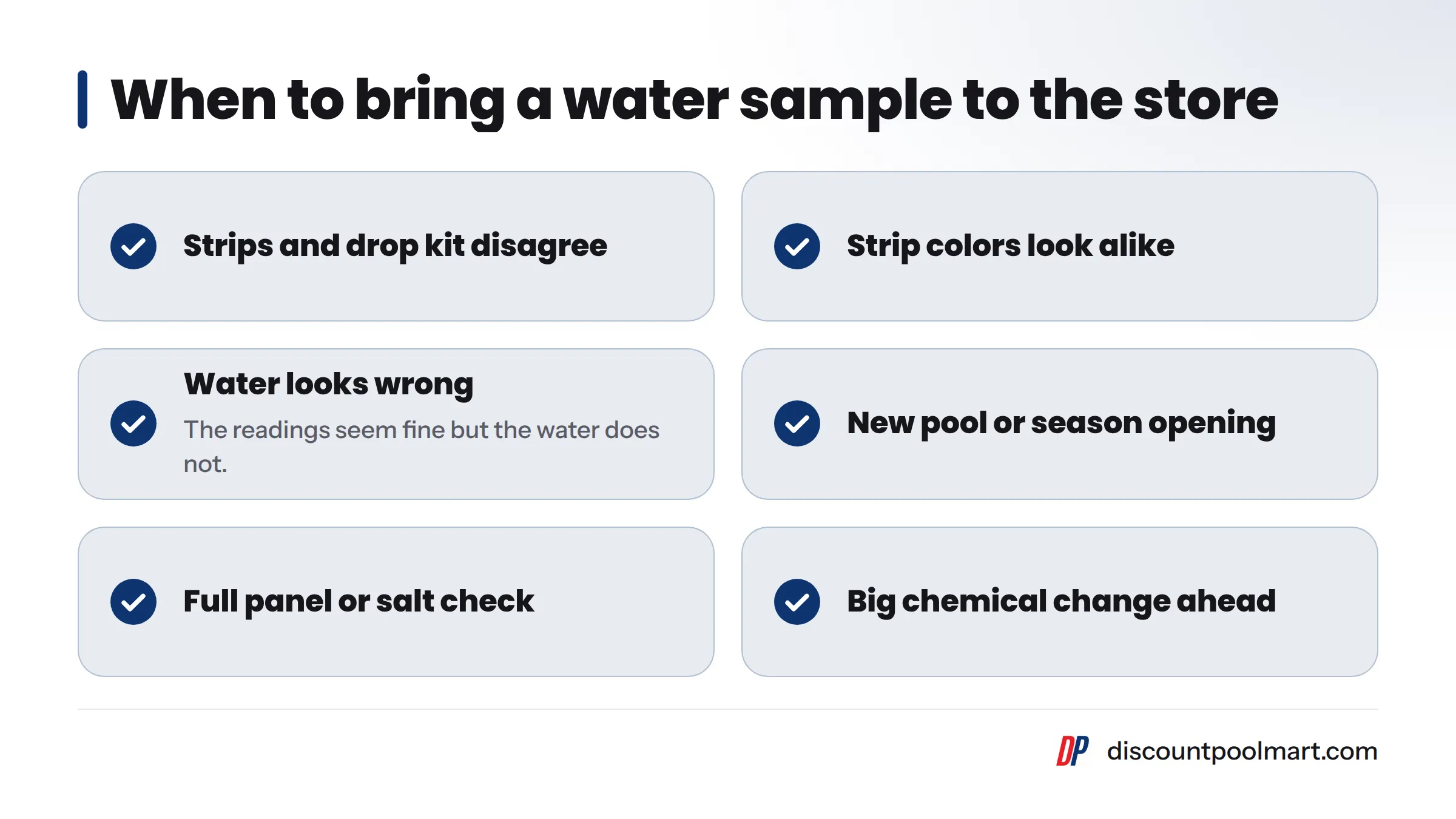
- Your strips and your drop kit give different results.
- You can't tell the colors on the strip apart.
- The water looks wrong even though the readings seem fine. Our guide to cloudy pool water causes may help.
- You just bought the pool or are opening it for the season.
- You need a full panel or a salt check.
- You're about to make a big chemical change.
Bring a capped sample taken from elbow depth to any Discount Pool Mart store for in-store water testing. We'll go through each reading with you, and you can pick up a test kit while you're there.
Pool Water Testing FAQ
How often should pool water be tested? Test it yourself at least once a week. Have a professional run a full panel every month, and any time the water looks off.
Can pool stores test my water? Yes. Discount Pool Mart offers in-store water testing at its LA-area stores.
What does a high pH reading look like on a test? Phenol red gets darker red as pH rises. A reading above 7.8 falls at the dark end of the color chart.
Are test strips accurate enough? They're fine for quick checks. For weekly tests and tracking chloramines, a drop kit or digital tester gives clearer readings.
What's the difference between free and total chlorine? Free chlorine is the chlorine still available to sanitize. Total chlorine is free chlorine plus combined chlorine. If combined chlorine is above 0.2 ppm, read our guide on how to shock a pool.
How long do test strips and reagents last? They don't last forever. Taylor recommends replacing reagents regularly. Throw away strips that are past their date or that have changed color in the bottle.
Do saltwater pools need different testing? They need every test in the chart plus a salt reading, compared against your generator manufacturer's range.
What should I do after I get my results? Go to our pool chemistry guide to fix anything out of range. Testing a spa? See our hot tub water care guide.
Sources
- Pool & Hot Tub Alliance (PHTA), ANSI/APSP/ICC-5 and ICC-11 standards
- Healthy Swimming, Centers for Disease Control and Prevention
- Taylor Technologies, Pool and Spa Water Testing
- Hayward Pool Products, Salt Chlorination
Related: pool shock and sanitizers, pool shock and sanitizers