

Pool stain removal starts with naming the stain, and two cheap tests do most of that work. Hold chlorine on the mark. If it fades, it's organic. Press a vitamin C (ascorbic acid) tablet against it. If it lifts, it's metal. If neither test changes it and the spot feels rough and crusty, you have calcium scale. Each type has its own fix: shock and brush organic stains, lift metal stains with ascorbic acid and follow up with a sequestrant, and scrub or treat calcium.
That's the short version. If you own a pool in Los Angeles, the longer version is worth reading. At Discount Pool Mart, we've spent more than 40 years looking at stained plaster across Southern California, and the same lesson keeps coming back: test, don't guess. A brown spot shaped like a leaf can turn out to be iron. A dark patch that looks like dirt can be copper. If you treat it as the wrong type, you spend money on chemicals and the mark stays put.
Green or black spots? They may be algae, not a stain. Algae needs a different treatment, so check our pool algae guide before you reach for a stain remover.
How to Identify Your Pool Stain: Metal, Organic, or Calcium
Color is a good first clue, but it can't confirm anything by itself. Use this chart to narrow things down before you run a test.
Pool Stain Identification Chart
| Stain type | Typical color | Texture | Common location | Likely cause | Confirming test |
|---|---|---|---|---|---|
| Iron | Rust, reddish-brown | Smooth | Floor, steps, near fill point | Well water, rusting metal objects | Vitamin C lightens it |
| Copper | Blue-green, teal, sometimes dark | Smooth | Near return jets, walls | Corroding copper plumbing or heater parts | Vitamin C lightens it |
| Manganese | Dark purple, brown, black | Smooth | Floor, broad patches | Well water | Vitamin C lightens it |
| Organic (tannins) | Brown, tan, pink, green-brown | Smooth, leaf-shaped | Under trees, deep end | Leaves, berries, debris | Chlorine lightens it |
| Calcium scale | White, gray | Rough, crusty | Waterline tile, returns | High pH and calcium hardness | Neither test changes it |
| Green or black spots | Green, black | Fuzzy or raised | Corners, shady walls | Possibly algae | See the pool algae guide |
The EPA lists the same color signatures in its Drinking Water Standards and Guidance for Nuisance Chemicals: iron causes rusty staining, copper leaves blue-green stains, and manganese produces black-to-brown staining. A pool collects whatever metals come in with the fill water, so these stains show up on plaster the same way they show up in sinks.
Pool metal stains: iron, copper, and manganese
A metal stain is a deposit of oxidized metal that drops out of the water and bonds to the pool surface. Chlorine has a part in this. It oxidizes dissolved metals, and that oxidation often makes them plate onto plaster.
Organic pool stains: tannins from leaves, berries, and debris
An organic stain is discoloration from the tannins and pigments in plant matter that sat on the surface. If leaves spend one night on the deep-end floor, they can leave a perfect silhouette.
Calcium scale and mineral deposits
Calcium scale is a hard, white crust of calcium carbonate. It forms when the water holds more calcium than it can keep dissolved. You'll usually feel it before you see it.
Color can mislead. Always confirm with a spot test before you buy a treatment.
Step 1: Run the Chlorine and Ascorbic Acid Pool Stain Test
Both checks take a few minutes and cost almost nothing. Let's break it down.
Chlorine spot test (organic check)
Chlorine oxidizes organic material, which is why it bleaches out tannin stains.
- Place a small amount of granular chlorine on the stain, or hold a chlorine tablet against it, as the product label directs.
- Wait a few minutes.
- Brush the spot and look closely.
- If it faded, the stain is organic.
Ascorbic acid pool stain test (metal check)
Ascorbic acid works the opposite way. It's a reducing agent, so it turns oxidized metal deposits back into a form that dissolves in the water.
- Crush a plain vitamin C tablet onto the stain or hold it firmly against the mark.
- For stains in the deep end, drop the tablet into a sock, tie the sock to your telescopic pole, and press it on the spot.
- Hold it there for about 30 seconds.
- If the stain lightens, it's metal.
I'd call the sock-on-a-pole trick the most useful move in DIY pool stain removal. You don't have to get in the water, and you get an answer in under a minute.
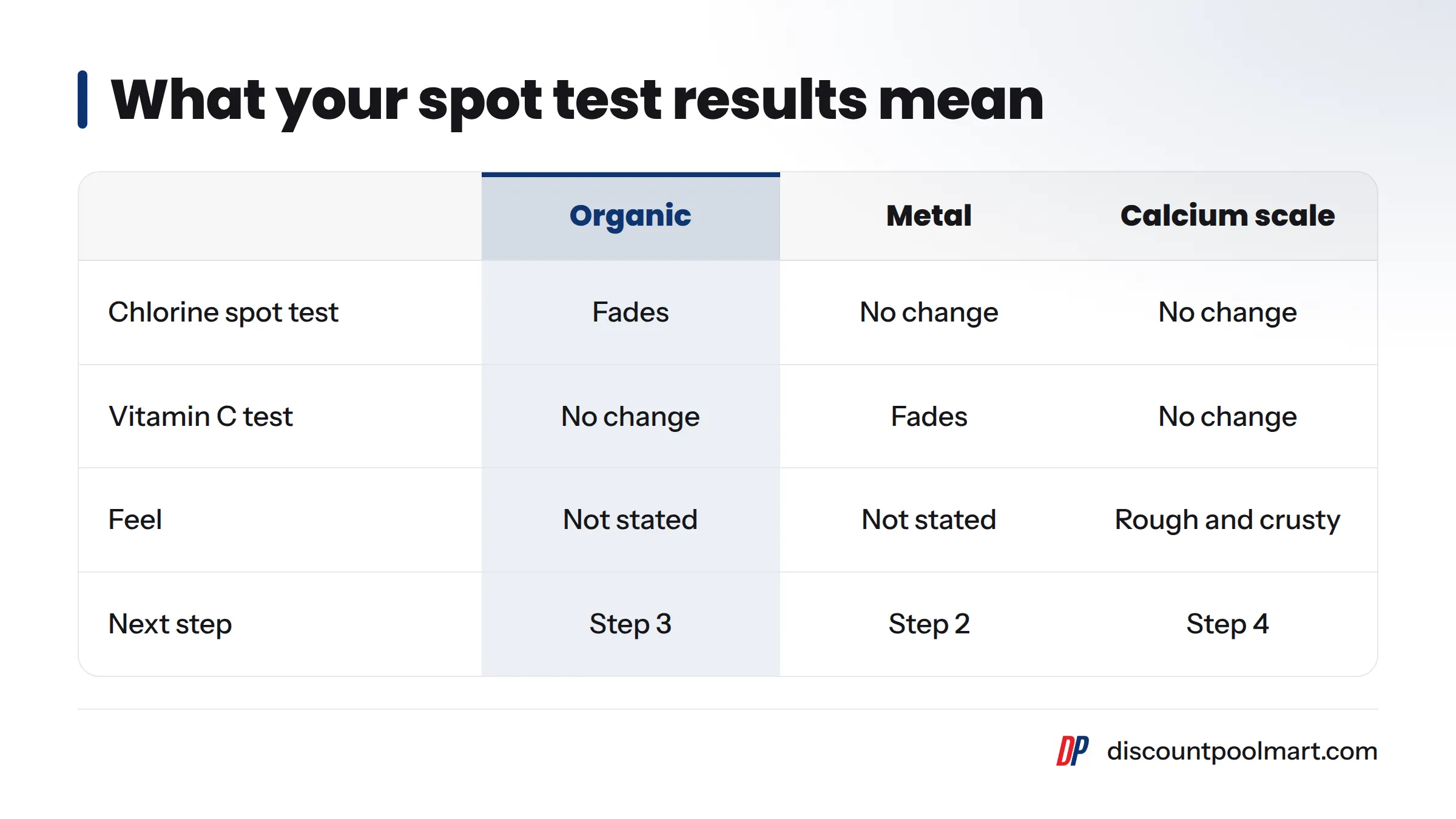
What your results mean
- Fades with chlorine → organic stain. Go to Step 3.
- Fades with vitamin C → metal stain. Go to Step 2.
- Neither works, rough and crusty → calcium scale. Go to Step 4.
- Neither works, smooth, or green/black → possible algae or surface damage. Call a pro.
Before you treat anything, test your pool water so you know your starting numbers.
Safety first. Wear the gloves and eye protection the product label lists. Never mix acids, including ascorbic acid or vinegar, with chlorine products. Read each product's Safety Data Sheet, which manufacturers must provide under OSHA's Hazard Communication standard. If someone is exposed, follow the label or SDS directions and contact America's Poison Centers at 1-800-222-1222.
Step 2: How to Remove Metal Stains From a Pool
This is the full sequence for iron, copper, and manganese stains:
- Test and balance your water using our pool water chemistry page.
- If the stain remover's label says to lower chlorine, lower it. High chlorine can work against the treatment.
- Apply an ascorbic-acid-based stain remover at the dose on its label. We stock Poolife Stain Lift and United Chemical Pool Stain Treat for this job.
- Run the filter and brush the stained areas.
- Add a metal sequestrant such as ClearView Mineral Magnet, following the label.
- Retest, then raise chlorine gradually as the label directs.
- Clean your pool filter. It now holds the metals you just lifted.
A metal sequestrant is a chelating agent. It binds dissolved metals and keeps them suspended so they can't settle out as stains again.
Customers often ask us which product is the best pool stain removal option. Our answer is whichever one matches your test result. A strong metal remover won't touch a tannin stain, and shock won't do anything to iron.
If the water tints after a lift, that's normal. The released metals can color the water for a short time, and the sequestrant and filtration clear it.
Spot-treating small metal stains vs whole-pool treatment
For one or two marks, spot treat with the sock-on-a-pole method or a stain eraser. If the discoloration covers much of the pool, use a whole-pool dose.
Why metal stains come back
Lifting the stain doesn't remove the metal. It's still dissolved in the water. Once chlorine climbs back up, it oxidizes that metal again and the metal settles back onto the surface. That's why you can't skip the sequestrant step.
Step 3: Clear Organic Pool Stains From Leaves, Berries, and Debris
Organic stains are usually the easiest to remove, because the chlorine you already use does the work.
- Skim and vacuum all debris.
- Balance pH so chlorine works at full strength.
- Shock the pool according to the label. Our guide on how to shock a pool walks you through it, and the products are in our pool shock and sanitizers collection.
- Brush the stained areas.
- Keep the pump running, and repeat if a shadow remains.
Stubborn or dried organic stains
Dried stains can come out too. Spot-apply chlorine directly on the mark as the label directs, then brush. Older tannin marks may need a few rounds.
Surface warning: Use a nylon brush on vinyl liners. Never use steel bristles or pumice on vinyl. For stains on the bottom of a pool liner, use a liner-safe eraser such as the OREQ Stain Out Eraser for vinyl, which is made for that surface.
Step 4: Calcium Scale Removal on Tile and Plaster
Waterline scale vs floor deposits
Waterline scale forms when water evaporates and leaves minerals behind on the tile. Floor deposits feel different. They're rough patches on the plaster, a lot like sandpaper.
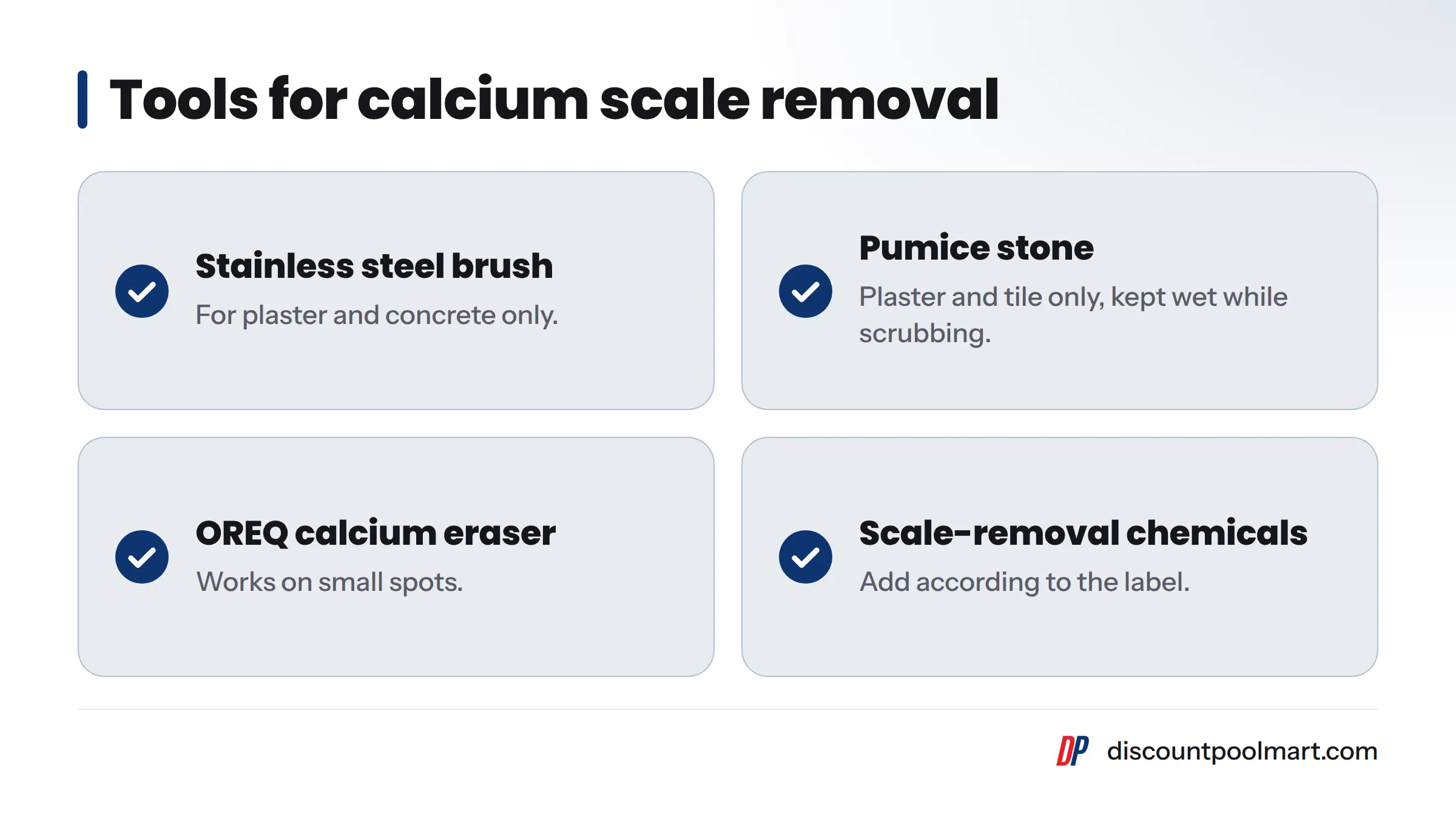
Brushing, pumice stones, and scale removers
- A Pooline stainless steel brush is for plaster and concrete only.
- The manufacturer says pumice stones belong on plaster and tile only. Keep them wet while you scrub.
- The OREQ Stain Out Eraser for Calcium works on small spots.
- Add scale-removal chemicals according to the label.
Why high pH and calcium hardness cause scale
When pH and calcium hardness both run high, the water can't keep all of its calcium dissolved, and the excess comes out as scale. Look up your targets in our six chemistry parameters guide and keep your levels there.
Heavy scale that calls for a drained-pool acid wash or resurfacing is work for a professional.
Iron and Copper Stains in LA Pools: What 40+ Years of Service Calls Show
I'll be honest: this is the section I wish more stain guides included. The mark on your plaster is a symptom. Until you fix the source, the stain will keep coming back.
Well water and fill-water metals in Southern California
Our technicians often find rust-brown floor stains in pools that are filled or topped off from private wells. Each top-off adds a little more iron or manganese. If you're on municipal water, your utility publishes an annual Consumer Confidence Report that lists what's in your supply. I'd read it before your next big refill.
Older copper plumbing and heat exchangers
Blue-green staining near the return jets is a familiar pattern in pools with older copper plumbing or heater heat exchangers. Water with low pH or other aggressive chemistry slowly dissolves copper and carries it into the pool. If you're thinking about a heater upgrade, our heater types comparison is a good place to start.
From our service techs: "Two calls stick with us. One was a well-water pool with rust-brown blotches across the deep end. The stain lifted, then came back after every top-off until the owner kept a sequestrant in the water. The other had blue-green streaks right below the returns. The pH had been running low for months, and the heater was paying for it."
Step 5: Stop Stains Before They Settle
Most stains can be prevented with a few routine habits:
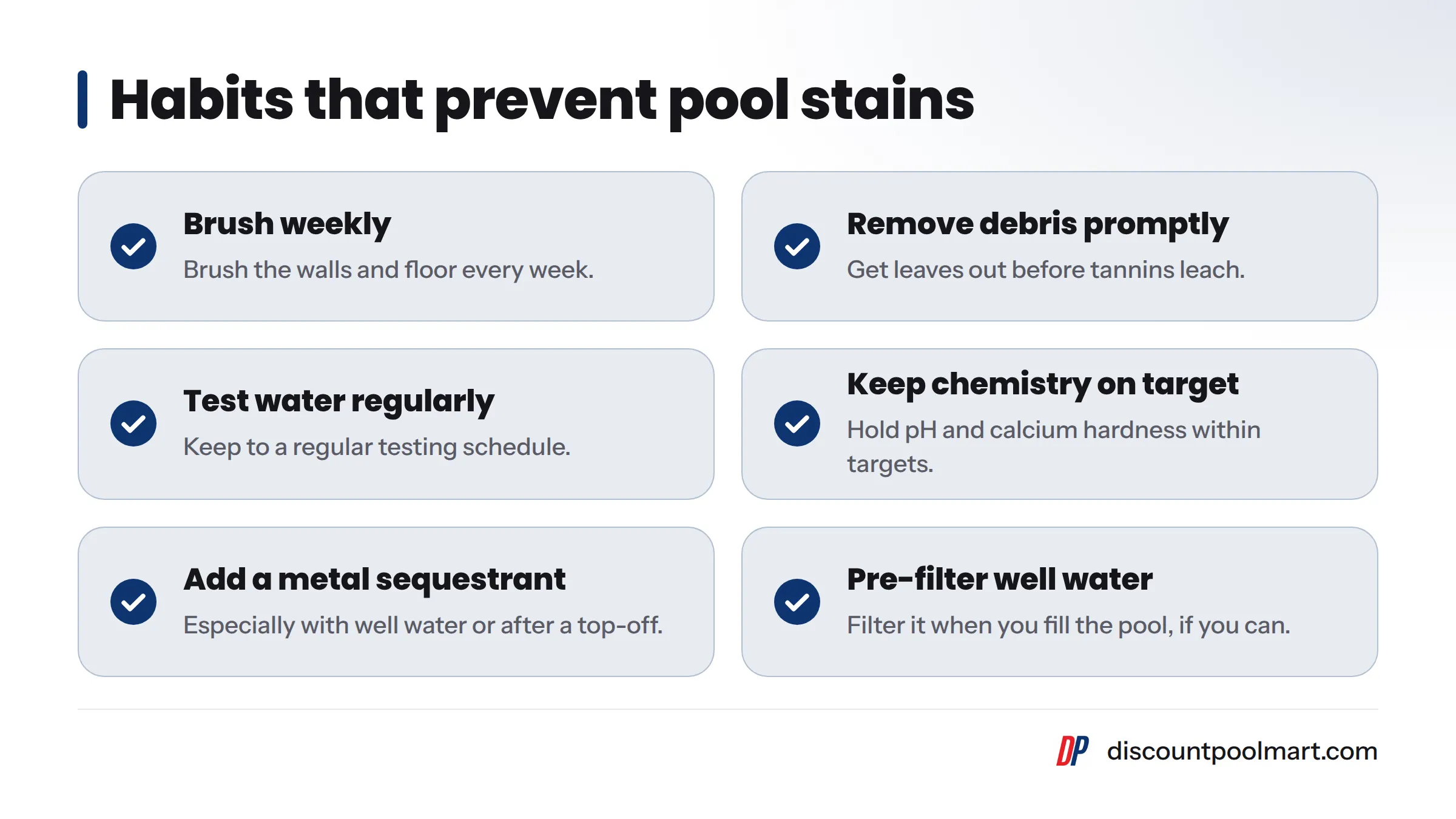
- Brush the walls and floor every week.
- Remove leaves and debris promptly, before tannins have time to leach out.
- Test your water on a regular schedule.
- Keep pH and calcium hardness within the pool water chemistry targets.
- Add a metal sequestrant according to the label, especially if you use well water or have just topped off. Hasa Super Stain Out is labeled for both removal and prevention.
- Pre-filter well water when you fill the pool, if you can.
- Keep up with regular pool cleaning.
- Follow our SoCal pool maintenance calendar through the seasons.
Signs a Stain Needs a Pool Service Professional
Not every stain is a DIY job. Bring in a pro if:
- The stain doesn't respond to either test.
- Stains keep returning even with a sequestrant in the water.
- The staining covers large areas.
- You see signs of etching, surface damage, or plaster deterioration.
- You suspect corrosion in the heater or plumbing.
- Green or black spots might be algae (see the pool algae guide).
Next steps: bring a water sample to any Discount Pool Mart store. We'll test it, talk through what you're seeing, and point you to our service and repair team if you need it.
Pool Stain Removal FAQs
How do I remove stains from my swimming pool floor? Run both spot tests first, then follow the track that matches. Shock and brush for organic stains, use ascorbic acid plus a sequestrant for metal, and scrub or use a scale remover for calcium.
What causes brown stains on the pool floor? Usually iron or tannins from leaves. The vitamin C test lightens iron, and chlorine lightens tannins. Once you know which one you have, follow Step 2 for iron or Step 3 for tannins.
Can you remove a stain that has dried? Often, yes. Dried organic stains respond to spot-applied chlorine, and dried metal stains respond to ascorbic acid. Results vary, so no product can promise full removal.
Does Dawn and vinegar remove pool stains? We don't recommend it. Dish soap foams in the pool, and vinegar is an acid that must never come into contact with chlorine products. Stick with labeled pool products.
What removes chlorine stains? Chlorine itself rarely stains. Bleached or discolored spots under tablets usually come from undissolved product sitting on the surface. Use a floater or feeder and brush the area.
Can I remove pool stains without draining the pool? For most surface stains, yes. Spot test, treat, brush, and add a sequestrant. Draining is mainly for heavy scale or surface damage that needs professional work.
How do I remove stains from the bottom of a pool liner? Run the same two tests, then use a liner-safe stain eraser and a nylon brush. The same method works for above ground pool stain removal.
Why do metal stains come back after treatment? The metals are still dissolved in your water. A sequestrant, plus fixing the source, keeps them from settling again.