





Shocking a pool, also called superchlorination, means adding a large dose of chlorine or a non-chlorine oxidizer to destroy chloramines and other contaminants. Here is how to shock a pool safely: put on gloves and eye protection, test the water, calculate the dose from your pool volume and the product label, add the shock at dusk with the pump running, and keep everyone out of the water until chlorine drops back to a safe level.
Reviewed by Discount Pool Mart water chemistry staff. Last updated October 2026.
Quick Answer: How to Shock Your Pool Safely and How Much to Add
Standing by the pool with a bag of shock in your hand? Start here:
- Put on chemical-resistant gloves and safety goggles, then read the product label.
- Test free chlorine and combined chlorine with a test kit or strips.
- Work out your pool volume in gallons, then use the label to calculate the dose.
- Wait until dusk so the sun doesn't burn off the chlorine.
- Add the shock near the return jets while the pump and filter run.
- Circulate overnight, retest at sunrise, and swim only when the label says it's safe.
The dose rule: your dose = the label rate per 10,000 gallons × (your pool gallons ÷ 10,000).
What Does Shocking a Pool Do?
Free chlorine does the sanitizing. When it reacts with sweat, sunscreen, and urine, it turns into combined chlorine, also known as chloramines. Those compounds cause the sharp "chlorine" smell and the red eyes most people blame on too much chlorine. Superchlorination pushes chlorine high enough to break chloramines apart, a point chemists call breakpoint chlorination. Once the water passes it, free chlorine can get back to sanitizing.
Learning how to shock a pool for the first time?
- Find your pool's volume before anything else. Every dose depends on it.
- Above-ground and inflatable pools follow the same steps with much smaller doses.
- If a video or forum post disagrees with the product label, go with the label.
Step 1: Put On Protective Gear and Read the Product Label
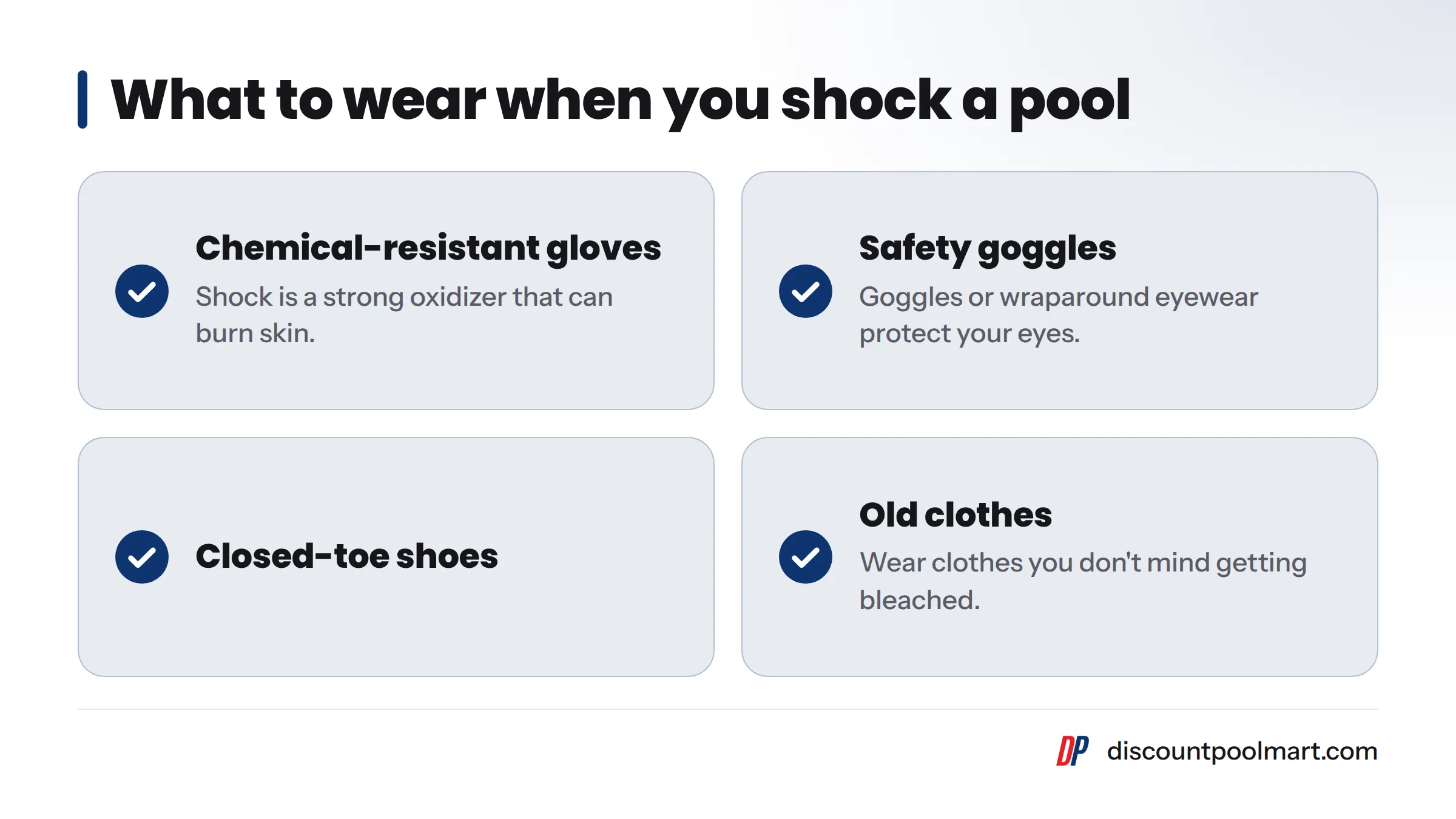
Gear up before you open the bag or jug. Pool shock is a strong oxidizer, and careless handling can burn skin and eyes.
What to Wear When You Shock a Pool
- Chemical-resistant gloves
- Safety goggles or wraparound eyewear
- Closed-toe shoes
- Old clothes you don't mind getting bleached
What the Pool Shock Label Tells You
The label gives you the dose, whether to pre-dissolve, how long to wait before swimming, and how to store the product. We treat it as the rulebook, and federal law backs that up. The U.S. Environmental Protection Agency regulates pool chlorine products as registered pesticides, and its introduction to pesticide labels from the EPA says it plainly: "the label is the law." If you use a product in a way the label doesn't allow, you break federal law.
Three rules apply every single time:
- Always add chemical to water. Never add water to chemical.
- Never mix two different chemicals, even if both say "shock."
- Work outdoors and stand upwind of the bucket and the pool.
Step 2: Test Free and Combined Chlorine Before You Shock
Test first. The results tell you whether the pool actually needs shock and how big a dose to use.
Test Kit vs Test Strips
Strips are quick and work fine for a daily check. A DPD/FAS drop test kit gives more precise free and combined chlorine readings, and you want that precision when you're picking a shock dose. Here is why we push testing so hard: at our counters, we meet plenty of customers who shocked on a hunch. A two-minute test would have shown them the pool needed something else.
Reading Your Chlorine Results
The math is simple: total chlorine − free chlorine = combined chlorine. Test kits report readings in parts per million (ppm). If your test shows combined chlorine, or you can smell chlorine at the pool, the water needs a shock.
Check pH, alkalinity, and cyanuric acid before you shock as well, because shock does a poor job in unbalanced water. Balancing is a separate topic. Our pool water chemistry guide explains each reading, and our walkthrough on how to balance pool water in the right chemical order gets your numbers in range before you move on to Step 3.
Step 3: Work Out Your Pool Volume and Shock Dose
Measure the pool, find your gallons, then do the label math. Most overdoses and underdoses start with a guess, and that includes most wrong answers to how much shock to put in a pool.
| Pool shape | Formula (feet) | Result |
|---|---|---|
| Rectangle | Length × Width × Average depth × 7.5 | Gallons |
| Round | Diameter × Diameter × Average depth × 5.9 | Gallons |
| Oval | Length × Width × Average depth × 5.9 | Gallons |
For average depth, add the shallow-end and deep-end depths and divide by two.
Turning the Label Rate Into Your Dose
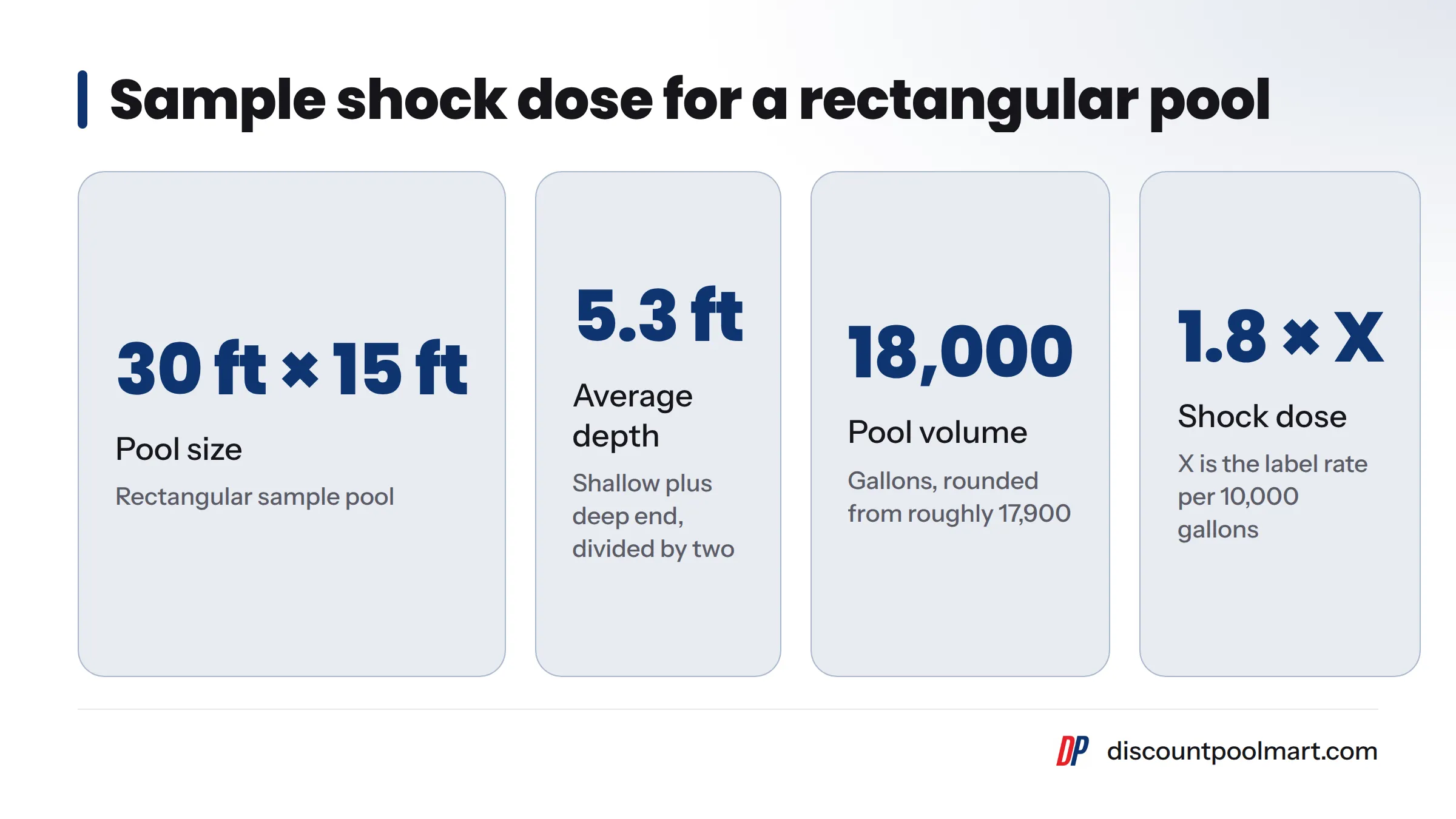
Let's break it down with a sample pool. Say the label calls for X per 10,000 gallons, and your rectangular pool measures 30 ft × 15 ft with an average depth of 5.3 ft. That comes to roughly 17,900 gallons, so round it to 18,000.
18,000 ÷ 10,000 = 1.8, which makes your dose 1.8 × X. If the label lists a higher rate for heavy chloramines or algae, plug that rate into the same formula.
Comparing the Types of Pool Shock
| Shock type | Form | How it's typically added | Sanitizes and kills algae? | Notes |
|---|---|---|---|---|
| Calcium hypochlorite (cal-hypo) | Dry granules | Pre-dissolve if the label says to | Yes | Adds calcium to the water |
| Sodium hypochlorite (liquid chlorine) | Liquid | Pour slowly near the return jets | Yes | No dissolving needed; loses strength in storage |
| Non-chlorine shock (potassium monopersulfate) | Dry granules | Broadcast per the label | Oxidizes only; does not kill algae | Shorter swim wait per the label |
Calcium hypochlorite is the classic bagged shock. If you're figuring out how to shock a pool with granular chlorine, cal-hypo is usually what you're holding, and the label decides whether you pre-dissolve it. Learning how to shock a pool with liquid chlorine is simpler: it's the same type of chemical as household bleach at a higher strength, and you pour it straight in. Non-chlorine shock clears chloramines but won't touch algae, so we see it as a maintenance tool rather than a rescue product.
Not sure which one suits your pool? Our pool chemical guide for LA homeowners compares the options. Every Discount Pool Mart location stocks all three types, and our staff will look over your test results with you before you buy.
Step 4: Shock at Dusk to Limit UV Loss Under the SoCal Sun
Wait for sunset. Ultraviolet light breaks down unstabilized chlorine quickly. Shock at noon in July and much of what you paid for disappears into the air before it reaches your contaminants.
Cyanuric acid, the stabilizer, shields chlorine from UV breakdown, which is why outdoor pools use it, as this background on cyanuric acid from Wikipedia explains. Stabilizer slows the loss but doesn't stop it. Liquid chlorine and cal-hypo add no stabilizer at all.
What we tell customers at the counter: In Los Angeles, the sun works against you from late spring through October. Shock after the sun drops behind the fence line, and the chlorine gets the whole night to work without UV pulling it down.
Step 5: Add the Shock With the Pump Running
Circulation spreads the shock evenly. Without it, chlorine collects in one spot and can bleach plaster or vinyl. Whether you're learning how to shock a pool with chlorine or with a non-chlorine product, the routine looks the same:
- Turn on the pump and filter, and leave them running.
- If the label tells you to pre-dissolve dry shock, fill a clean plastic bucket about three-quarters full with pool water. Add the shock to the water, never the reverse, and stir gently with a wooden or plastic stick.
- Walk around the edge of the pool and pour slowly near the return jets.
- Brush any undissolved granules off the floor and steps.
Warning: Never put shock in the skimmer, and never put it in a chlorinator or floater holding tablets. Cal-hypo mixed with trichlor tablets can start a fire or set off a violent reaction. Never pre-mix two products in the same bucket.
Want to see the pour-and-circulate routine before you try it? This short demo shows it clearly:
Step 6: Run the Pump, Retest, and Wait Before Swimming
How Long to Circulate After Shocking
Follow the label first. After an evening shock, our staff runs the pump through the night so the full volume of water passes through the filter more than once.
Retest at Sunrise
Test again the next morning and look for two things: free chlorine still holding, and combined chlorine at or near zero. When you see both, the shock worked.
How Long After Shocking a Pool Can You Swim?
Customers ask us some version of "shock pool how long before swim" almost every day. Our answer: wait as long as the product label says, then test before anyone gets in. Chlorine shock labels list a reentry level, and swimmers should stay out until free chlorine falls to that number. Non-chlorine shock usually carries a much shorter wait, though the label still has the final word.
Troubleshooting: Free chlorine gone by morning, or the water still hazy? Something is consuming your chlorine, often algae, a dirty filter, or low stabilizer. Start with our guide to keeping your pool crystal clear, and clean your pool filter if the pressure gauge reads high.
When to Shock a Pool in High-UV, High-Evaporation Conditions
Southern California pools deal with two problems at once. Intense sun burns off chlorine, and evaporation forces frequent top-offs with fresh tap water that dilutes your chemistry. A schedule that keeps a Seattle pool clean falls short in the San Fernando Valley for exactly that reason.
Should I shock today? Shock if any of these apply:
- You smell a strong "chlorine" odor at the pool
- Your test shows combined chlorine
- You just had a party or heavy swim day
- A rainstorm passed through
- You're in a multi-day heatwave
- Ash from a wildfire settled on the water
- The water looks dull or cloudy
After four decades of in-store consultations, here's our take: most LA pools do well with a weekly evening shock in summer and one every other week in cooler months, plus extra shocks after any of the triggers above. Your test kit still gets the final say. For heat and smoke events, read our guides to pool care during a heatwave and cleaning up after wildfire ash. Our SoCal pool maintenance calendar maps out the full year.
Common Pool Shock Safety Mistakes to Avoid
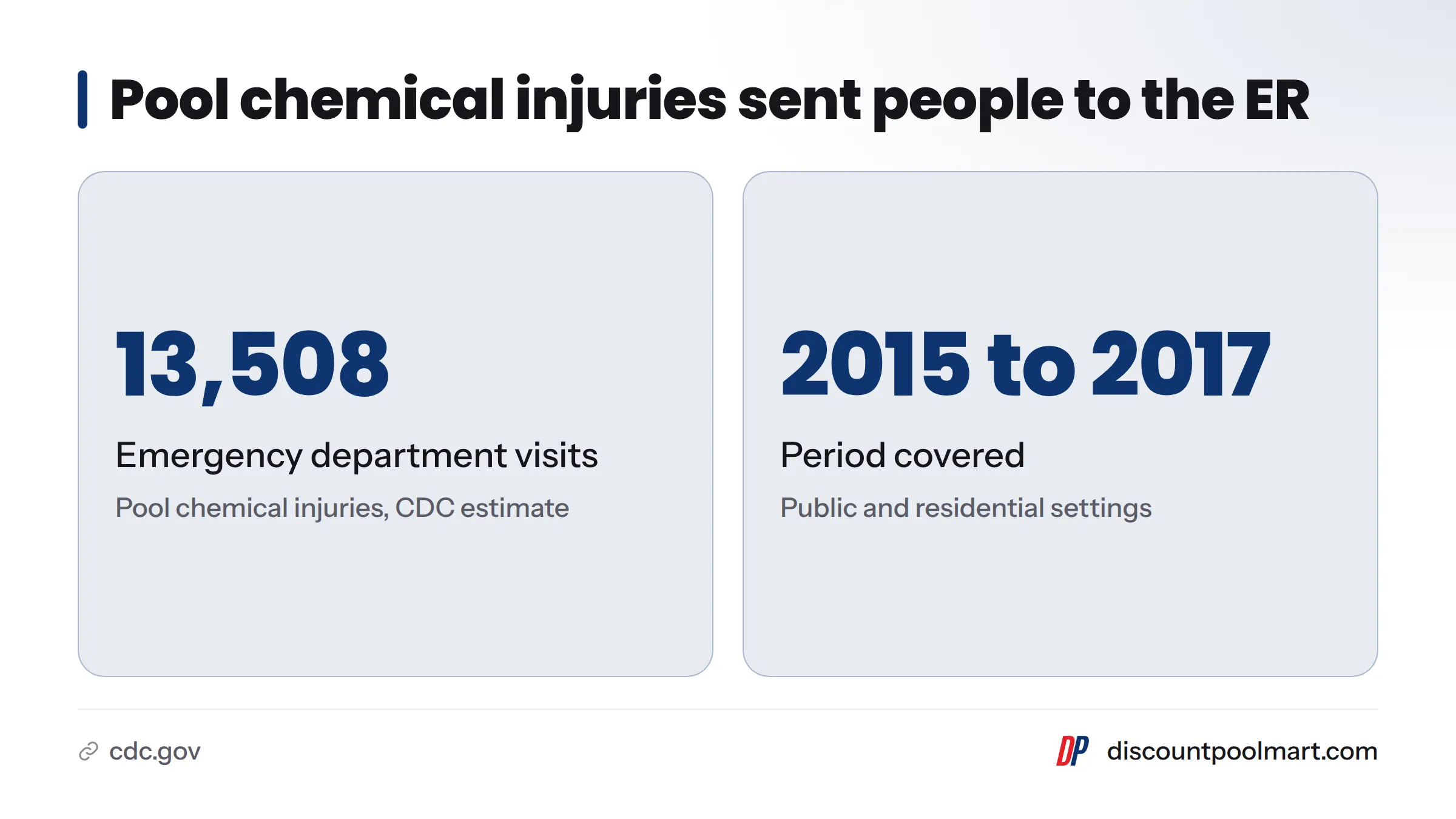
These mistakes happen more often than most pool owners think. A CDC report on pool chemical injuries in public and residential settings estimated 13,508 emergency department visits for pool chemical injuries from 2015 to 2017. Here's what we see go wrong most often:
- Skipping gloves and eyewear
- Pouring water onto dry shock instead of shock into water
- Mixing shock types, or adding shock to a tablet feeder
- Shocking in the midday sun
- Dosing by guesswork instead of volume
- Leaving the pump off
- Letting people swim before chlorine drops
- Storing shock in heat or sun, or next to acid and other chemicals
For a full storage and handling routine, read our guide on how to handle pool chemicals safely.
If shock gets on skin, in eyes, or is swallowed: call Poison Control at 1-800-222-1222 through America's Poison Centers, or get medical care right away.
Pool Shock FAQs
We hear these questions about shocking a pool at the counter more than any others.
Can you shock your pool too often? Yes. Shocking over and over without testing wastes product, can keep chlorine above swim-safe levels, and with cal-hypo, keeps adding calcium. Test first and follow the label.
How much shock do you put in a pool? Multiply the label rate per 10,000 gallons by your pool gallons divided by 10,000.
How long after shocking a pool can you swim? Wait the time printed on the label, and wait until your free chlorine test reads at or below the label's reentry level.
How do you shock a saltwater pool? Knowing how to shock a saltwater pool comes down to two options: run your chlorine generator's superchlorinate or boost mode, or add chlorine shock per the label. Our saltwater pool chlorinator guide covers the generator side.
Why is my pool water dark green, and will shock fix it? Dark green almost always means algae. Chlorine shock is part of the fix, but you'll also need brushing, filtration, and a bigger dose than a routine shock.
Is pool shock dangerous? It can be when mishandled. Wear your gear, never mix products, and store shock somewhere cool and dry, away from other chemicals.
Should you dissolve dry shock before adding it? Follow the label. Many cal-hypo products call for pre-dissolving, especially in vinyl and painted pools.
Next steps: add this routine to your Los Angeles pool maintenance checklist, and if your numbers don't make sense, bring a water sample to any Discount Pool Mart store.
Sources
- Introduction to Pesticide Labels, U.S. Environmental Protection Agency
- Pool Chemical Injuries in Public and Residential Settings, United States, 2008–2017, CDC Morbidity and Mortality Weekly Report
- Cyanuric Acid, Wikipedia
- America's Poison Centers
Related: pool water chemistry