

Pool care after wildfire ash takes seven steps, and doing them in order counts for more than how hard you work. First, protect the pool while ash is still falling. Next, skim, vacuum to waste, and clean the filter. Then correct pH, alkalinity, and phosphates, shock and clarify, and only after all that decide whether to keep the water. This guide walks Los Angeles pool owners through each step, and it covers what most homeowners need to know about how to clean pool after wildfire ash anywhere in Southern California.
The morning after usually looks the same. A gray film covers the surface, the steps have disappeared under cloudy water, and black flakes pack the skimmer basket. It looks like someone poured cement dust into the pool. We've seen this on many backyard pools in the San Fernando Valley and Simi Valley, and almost every one of them recovered. What saved them was the order of the work, not the amount of it.
Quick summary: the 7-step post-fire pool cleanup
- Protect the pool while ash is still falling.
- Skim floating ash before it sinks.
- Turn off automatic cleaners and vacuum settled ash to waste.
- Clean or backwash the filter, again and again.
- Test and correct pH, total alkalinity, and phosphates.
- Shock, add clarifier, and keep the water circulating until it clears.
- Decide whether to keep the water or drain and refill.
Safety first: Smoke and ash pool maintenance starts with protecting yourself. The CDC's wildfire guidance recommends limiting exposure to smoke and ash. Wear gloves, eye protection, and a well-fitted N95 or P100 respirator while you clean. Check the current Air Quality Index on AirNow before you head outside, and read every chemical label. The City of Pasadena's pool advisory also says to keep everyone out of the water until cleanup is finished.
What you'll need
- Leaf net plus fine mesh or an old cotton sheet to wrap it
- Telescoping pole (telepole)
- Vacuum head and hose
- Test strips or a drop test kit
- Phosphate remover, shock, and pool clarifier
- Filter cartridge cleaner (cartridge filters) or DE powder (DE filters)
- Gloves, goggles, N95 or P100 mask
How Wildfire Ash in Pool Water Affects Chemistry and Equipment
Wildfire ash is the fine, powdery residue left after vegetation, buildings, and vehicles burn. Once it lands in a pool, it causes four separate problems, all at the same time. Here's how each one works.
High pH after ash: where it comes from
Wood ash is alkaline. As it dissolves, it pushes pH and total alkalinity upward. High pH after ash makes chlorine kill germs more slowly, and the water can turn cloudy or leave scale on surfaces.
Pool phosphates after wildfire, and the chlorine they cost you
Ash carries organic matter and phosphates, which are plant nutrients. The organic load uses up free chlorine (the active sanitizer in your water) quickly. When chlorine runs low, the phosphates feed algae. That's why some pools turn green a week after the sky clears. Our guide to preventing pool algae in Southern California explains how nutrients and sanitizer interact.
Fine particles, filters, and automatic cleaners
Ash particles are tiny. They clog filter media fast and stay suspended as haze, which is the usual cause of a cloudy pool after a fire. Robotic and suction cleaners pull in heavy loads of the stuff and choke on it.
Is wildfire ash in your pool toxic?
Ash from burned homes may contain metals and other harmful residues. LA County Public Health and the CDC both advise wearing protective gear and keeping skin contact to a minimum. We're a pool supply company, not a health agency, so we don't make our own health claims about pool water. Follow public health guidance before anyone swims.
Step 1: Protect Your Pool While Ash Is Still Falling
My honest advice: don't start the deep clean while ash is still coming down. If you do, you'll end up doing it twice.
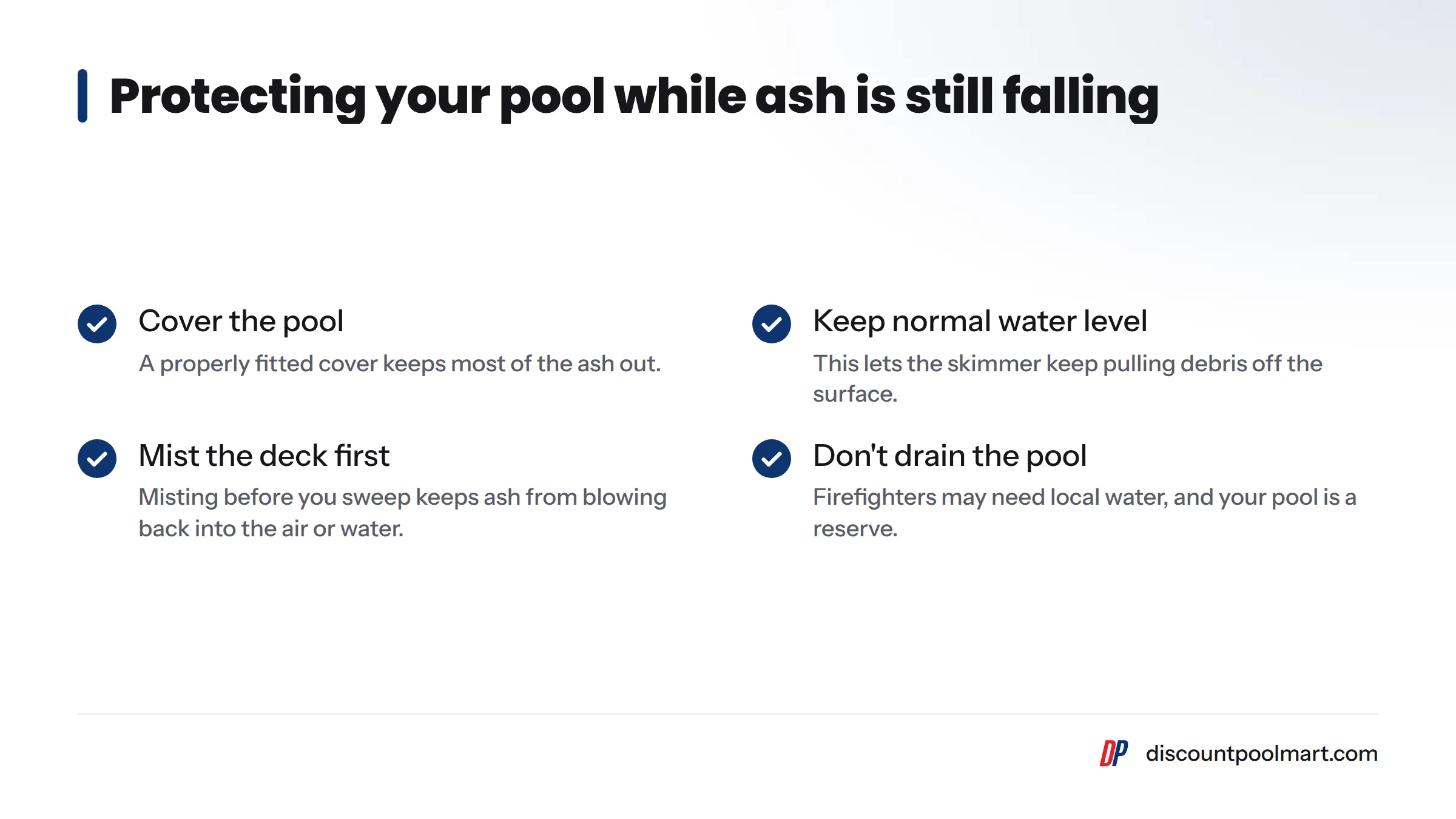
- Cover it if you can. A properly fitted cover keeps most of the ash out. You can compare options in our pool safety cover guide, or pull out the reel you already own using our solar pool cover guide.
- Keep the water at its normal level so the skimmer can keep pulling debris off the surface.
- Mist the deck before you sweep. Pasadena recommends this so ash doesn't blow back into the air or the water.
- Don't drain during an active fire. LA owners on Reddit's r/pools have pointed out that firefighters may need local water. Your pool also works as a water reserve.
Step 2: Skim Floating Ash Before It Sinks
Floating ash is the easiest ash to remove. Once it sinks, getting it out costs you filter cycles and chemicals.
Wrap the leaf net in fine mesh
A standard leaf net lets powder slip straight through. Stretch fine mesh, a nylon stocking, or a thin cotton sheet over the net, then skim slowly so the film stays in one piece. A stiff pole makes the job easier, and our roundup of the best pool poles shows which ones stay rigid at full length.
Empty skimmer and pump baskets often
On the first day, check both the skimmer basket and the pump basket every few hours. A packed basket starves the pump of water.
Step 3: Turn Off Automatic Cleaners and Vacuum Pool to Waste
Why robotic cleaners clog on fine ash
Robotic cleaner bags and suction-side cleaners fill with powder within minutes and push the rest back into the water. Pause them in your automation schedule until the floor is clean. Running them too early is one of the most common mistakes people make when cleaning a pool after a fire.
What it means to vacuum pool to waste
Vacuum to waste sends the water you vacuum straight out through the waste line, so it never passes through the filter. You need a multiport valve, which most sand and DE filters have, or a plumbed waste line. Most cartridge setups don't have either.
How to do it:
- Prime the hose and connect the vacuum head to the skimmer.
- Turn the pump off, set the multiport to WASTE, then restart the pump.
- Move slowly so the ash doesn't rise into a cloud.
- Add water from a garden hose as you go, and stop before the level drops below the skimmer.
Our full guide on how to vacuum a pool covers priming and hose handling. Discharge rules differ from city to city, so check with LA Sanitation & Environment or your local public works department before you send water anywhere.
Step 4: Backwash the Pool Filter After Ash, or Clean the Cartridge
Clean the filter based on the pressure gauge, not your usual calendar. After an ashfall, that can mean cleaning it every day.
| Filter type | How it handles fine ash | Cleaning method | How often during cleanup | Warning signs |
|---|---|---|---|---|
| Cartridge | Traps fine ash well, but the pleats load fast | Hose off each pleat, then soak in cartridge cleaner per the label | Whenever pressure rises noticeably above your clean reading | Pressure climbs within hours, weak return flow |
| Sand | Lets the finest particles pass, so haze can linger | Backwash until the sight glass runs clear, then rinse | After each vacuum session and whenever pressure rises | Water stays hazy, short cycles between backwashes |
| DE | Catches the finest particles | Backwash, then recharge with diatomaceous earth per the label | When pressure rises, and after every backwash | DE blowing into the pool, fast pressure spikes |
If pressure jumps right back up after cleaning, or the grids or cartridges look torn, our page on common pool filter problems explains how to fix them.
Step 5: Test and Correct pH, Alkalinity, and Phosphates
Test before you add anything
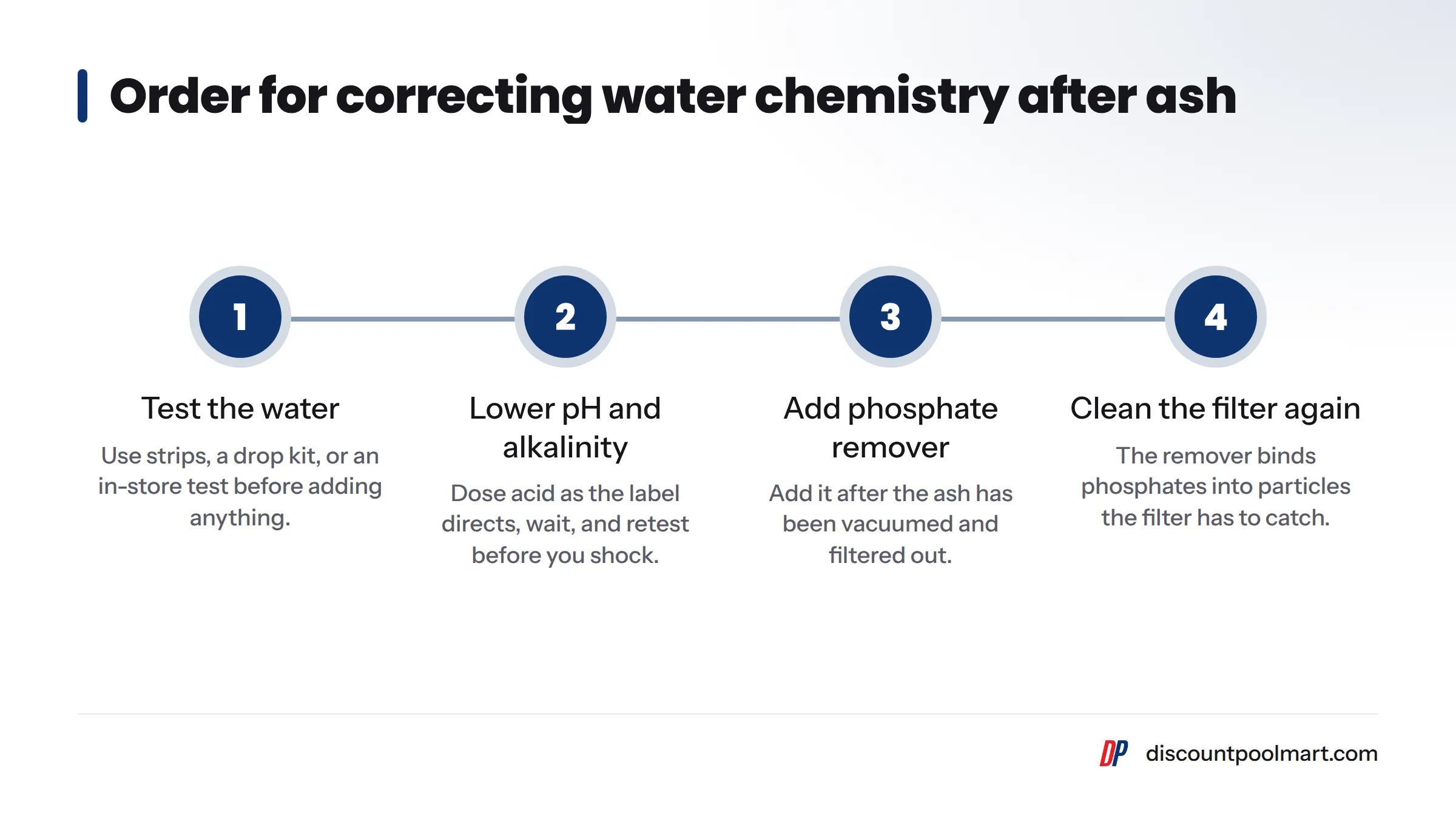
You can use strips or a drop kit, or bring a sample to a Discount Pool Mart store. Our guide on how to test pool water compares the three methods. I'd choose the in-store test for the first reading after a fire, because ash can throw several numbers off at the same time.
Lower pH and alkalinity first
Correct pH and total alkalinity before you shock, because chlorine works far better in balanced water. Dose acid exactly as the product label directs, wait, and retest.
Add phosphate remover after the solids are out
Phosphate remover works best after you've vacuumed and filtered out the ash. Add it at that point, following the label. Then clean the filter again, because the remover binds phosphates into particles that your filter has to catch.
Step 6: Shock and Circulate Until a Cloudy Pool After Fire Clears
Shock treatment
Shock raises chlorine high enough to burn off the organic load that ash leaves behind. HASA's post-wildfire tech note recommends superchlorinating or using a chlorine-free oxidizer, then adding a clarifier or filter aid right after. You'll find dosing details in our HASA liquid chlorine guide.
Clarify, filter, clean again
A pool clarifier clumps fine particles together so the filter can catch them. Run the pump around the clock, then clean the filter again once the pressure climbs.
When the water won't cooperate
| Symptom | Likely cause | Next move |
|---|---|---|
| Still cloudy after shock | Fine ash still suspended, dirty filter | Add clarifier, clean filter, see how to fix cloudy pool water |
| Chlorine won't hold | Organic load remains, pH high | Rebalance pH, shock again, retest the next day |
| Green tint days later | Phosphates feeding algae | Phosphate remover plus algae treatment |
| Filter pressure spikes fast | Ash loading the media | Vacuum more to waste, clean the filter more often |
Step 7: Decide Whether to Drain and Refill
Most pools don't need draining. Here's the rule we follow:
- Keep the water if the ash is out, the chemistry holds after correction, and the water clears.
- Consider draining and refilling if debris from burned structures fell in, the chemistry won't stabilize after several rounds of treatment, or the water still looks contaminated.
If you do drain, confirm local discharge rules with your city and with LA Sanitation, and check water-use restrictions with LADWP or your water supplier. Statewide conservation updates come from the California State Water Resources Control Board, so check there too if you're managing pool care after wildfire ash in California outside the city limits.
If the fire damaged your shell, deck, plumbing, or electrical equipment, call a licensed professional. For pumps, our licensed pool pump repair team in Los Angeles can inspect the equipment. Rain on top of ash causes its own problems, which our guide to pool care after heavy rain covers.
What Our Post-Fire Cleanups in San Fernando Valley and Simi Valley Show
Our technicians and store water-testing team saw the same patterns again and again:
- Phosphates spiked in pools where ash sat on the floor for days, and those pools turned green the fastest.
- pH and alkalinity crept back up even after the first correction, because the ash kept dissolving.
- Filters needed repeated cleaning, often several times in the first week.
- The most common mistake was running a robotic cleaner too early. It clogged the unit and stirred ash back into the water.
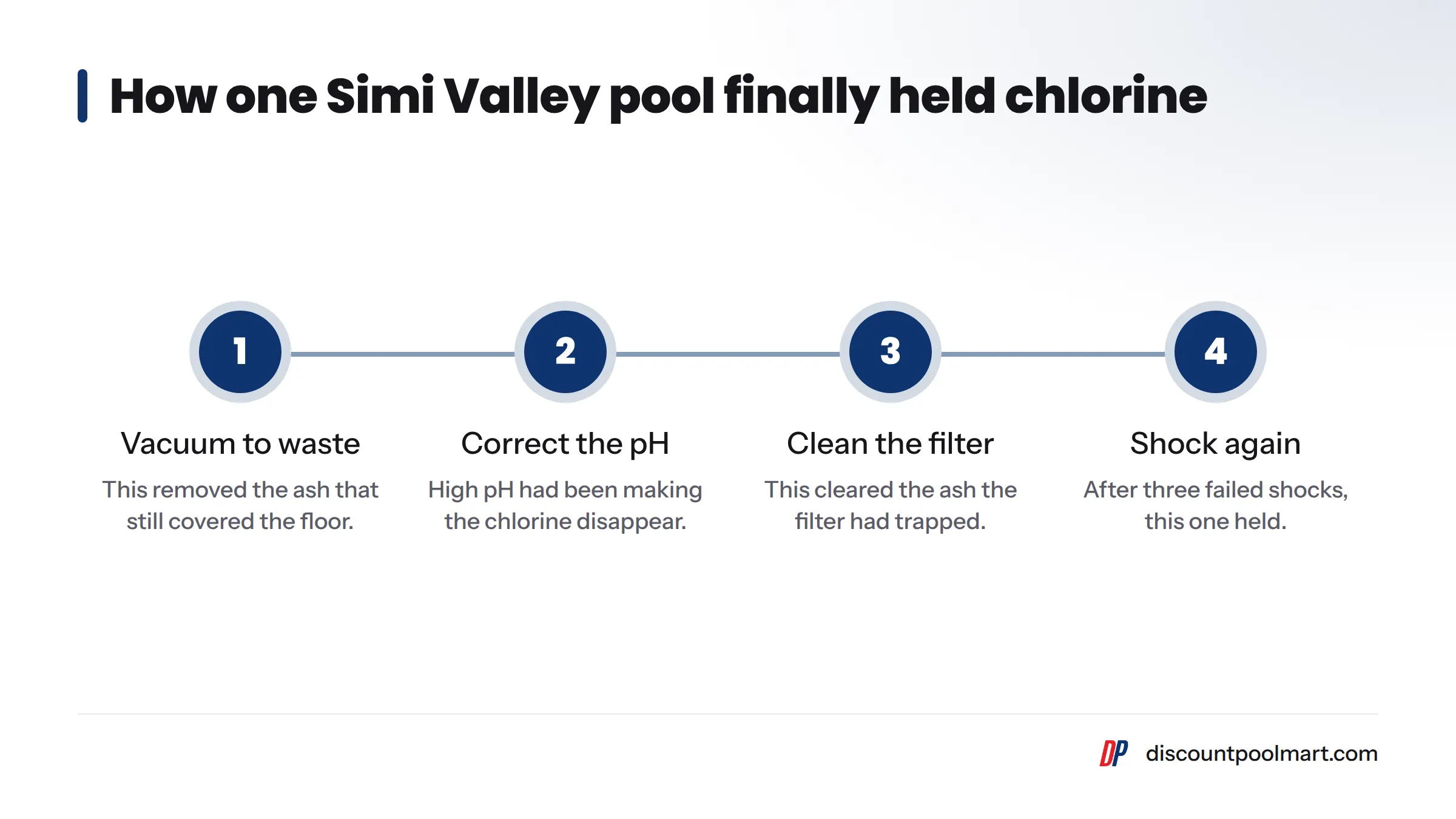
One Simi Valley owner had already shocked three times before coming in. The chlorine kept disappearing because the pH was high and ash still covered the floor. Once the owner vacuumed to waste, corrected the pH, and cleaned the filter, the next shock held. In my view, that one pool shows the main lesson of this guide: the order of the steps decides the result.
Get your water tested free. Bring a water sample to any Discount Pool Mart location for an in-store test with dosing guidance, or ask our team to book a post-fire cleanup service. In Los Angeles, good pool care after wildfire ash starts with a reliable reading.
FAQ
Is wildfire ash toxic? It can be. Public health agencies, including the CDC and LA County Public Health, advise wearing protective gear because ash may contain harmful residues.
Does fire ash dissolve in water? Partly. When ash sits in pool water, the minerals dissolve and raise pH and alkalinity. The fine solids stay suspended or settle to the floor, so you have to filter or vacuum them out.
What's the fastest way to clear a cloudy pool after ash? Vacuum to waste, balance the pH, shock, add clarifier, and clean the filter each time the pressure rises.
Can I run my robotic cleaner with ash in the pool? Not until you've vacuumed out most of the settled ash yourself.
When is it safe to swim? Follow local public health guidance. Stay out of the water until you've finished the cleanup steps and the water tests balanced.
Should I drain my pool after a wildfire? Usually not. Drain only if the chemistry won't stabilize or if debris from burned structures got into the pool.
Why does my pool keep turning green? Leftover phosphates and low chlorine are the usual cause. Treat the phosphates and keep free chlorine steady.
Does this apply to above-ground pools? Yes. Above-ground pool care after wildfire ash follows the same steps, but vacuum more gently. See our above ground pool maintenance guide.
Sources
- Wildfires, Centers for Disease Control and Prevention
- AirNow Air Quality Index, U.S. EPA and partners
- Los Angeles County Department of Public Health
- Pool Maintenance Guidelines for Smoke, Ash, or Fire Damage, City of Pasadena
- Pool Care and Repair After Wildfires Tech Notes, HASA
- Do I Need to Drain My Pool in LA Due to Bad Air Quality, Reddit r/pools
- LA Sanitation & Environment, City of Los Angeles
- Los Angeles Department of Water and Power
- California State Water Resources Control Board