


A pool heater not working almost always shows up in one of four ways: it won't ignite, it heats slowly, it throws an error code, or it shuts off early. Behind those symptoms, most cases come down to a short list of causes: low water flow (usually a dirty filter or a stopped pump), power, gas supply, or the thermostat setting. Find your symptom below and start there.
Written and last reviewed in October 2026 by the Discount Pool Mart service team in Los Angeles.
Jump to your symptom:
- Heater won't ignite or turn on
- Heater runs but heats slowly
- Heater shows an error code
- Heater shuts off early or cycles
We've stood at plenty of equipment pads next to frustrated owners holding a thermometer that reads cold. A lot of those "broken" heaters turned out to be fine. Something around them had stopped cooperating. Let's break it down.
Quick Checks Before You Troubleshoot a Pool Heater
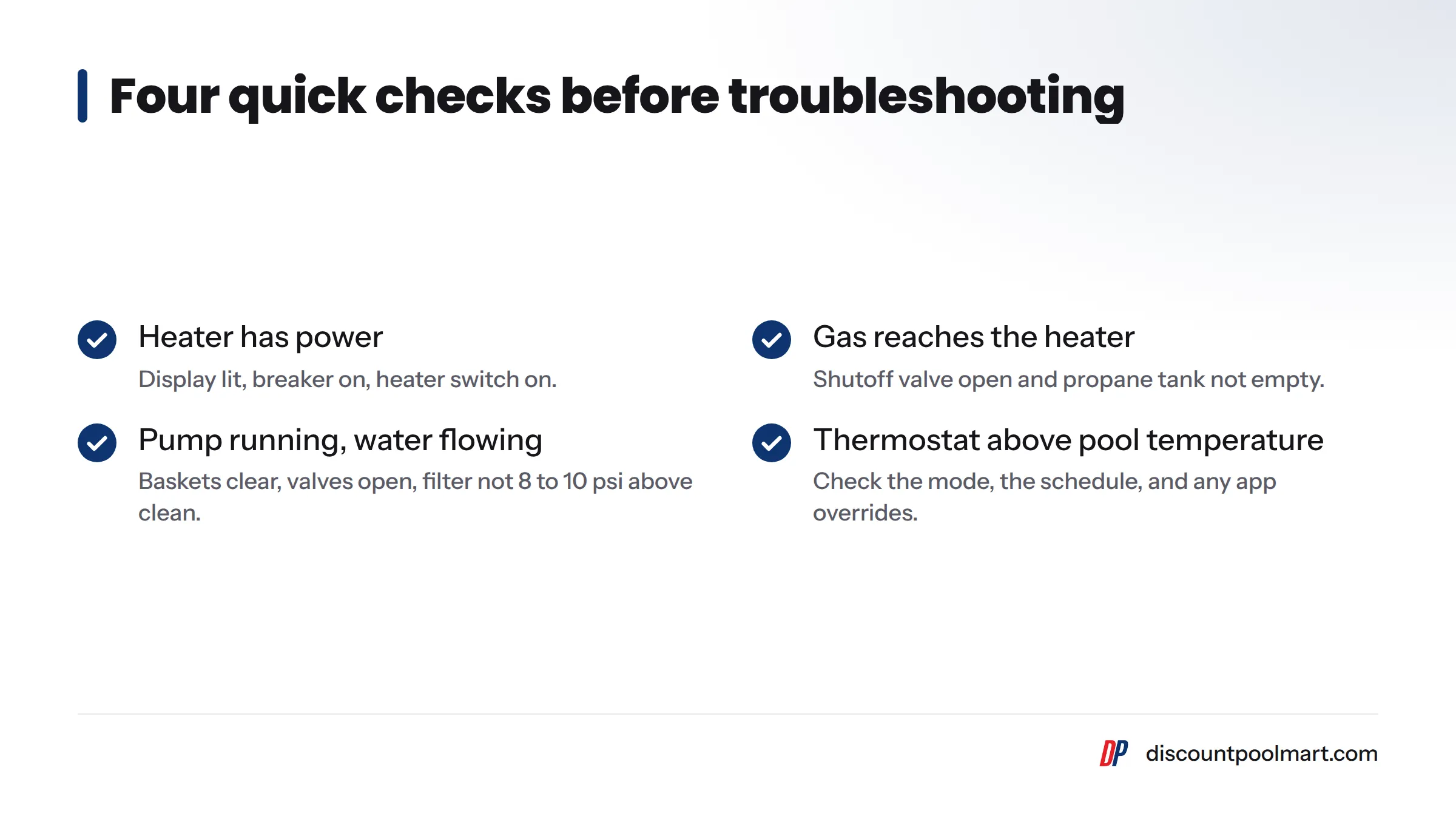
Good pool heater troubleshooting starts with four checks. They take about five minutes and rule out the usual suspects.
Is the Heater Getting Power?
Look at the display. If it's blank, check the breaker at your subpanel and the heater's on/off switch. Reset a tripped breaker once. If it trips again right away, stop resetting it and call an electrician or technician.
Is Gas Reaching the Heater?
On a gas heater, confirm the shutoff valve at the heater is open, with the handle parallel to the pipe. See whether your other gas appliances work. If you run on propane, check the tank level.
If you smell gas, stop. Leave the area, don't touch light switches, and call your gas utility from a safe distance. In Southern California, SoCalGas runs a 24-hour emergency line at 1-800-427-2200.
Is the Pump Running and Water Flowing?
No flow, no fire. The heater won't light without enough water moving through it. Make sure the pump is running, the pump and skimmer baskets are clear, and every valve on the heater's line is open.
Then compare your filter pressure to its clean baseline. A reading 8 to 10 psi above clean usually means the filter needs cleaning. Our guides to diagnosing a pool pump and fixing common pool filter problems cover both steps.
Is the Thermostat Set Above Pool Temperature?
The heater fires only when the set point sits above the current water temperature. Check whether it's in pool or spa mode, review your automation schedule, and look for a remote or app setting that might override the panel.
Pre-diagnosis checklist
- Display lit, breaker on, heater switch on
- Gas valve open, other gas appliances working, propane tank not empty
- Pump running, baskets empty, filter pressure near clean baseline, valves open
- Set point above water temperature, correct pool/spa mode
Symptom: Heater Won't Ignite or Turn On
When a pool heater won't turn on at all, the display usually tells you where to look first. Here's how the common versions break down:
| Symptom detail | Probable cause | Safe homeowner check | Call a tech? |
|---|---|---|---|
| Blank display | Power, breaker, switch | Reset breaker once, check switch | Yes, if breaker trips again |
| Clicks but no flame | Igniter, gas valve, gas supply | Confirm gas valve open | Yes |
| Lights, then goes out | Flame sensor, gas pressure | Note when it happens | Yes |
| "Check flow" or pressure fault | Low flow, pressure switch | Clean filter, empty baskets, open valves | Yes, if it persists |
A Pool Heater That Won't Ignite Often Has a Worn Igniter
The igniter lights the gas. Most heaters use a hot surface igniter that glows like a stove element. When one fails, you see no glow and no flame, even though you may still hear the blower run and the gas valve click. Leave the replacement to a technician.
Gas Valve and Gas Supply Problems
Once every safety check passes, the gas valve opens and sends fuel to the burners. Low supply pressure, a failed valve, or an undersized gas line can each stop ignition cold. This is technician territory only. For startup and routine care, read our guide on how to start and maintain a gas pool heater.
Pressure Switch Not Closing (the Pool Heater Check Flow Error)
The pressure switch senses whether enough water is moving through the heater. If it isn't, the switch blocks the heater from firing. A dirty filter, closed valves, or air in the lines cause most of these trips.
Air in the lines is the reason so many owners see a pool heater check flow error right after a service visit. Here is the checklist we run after our own visits:
- Confirm every valve went back to its normal position.
- Check that the filter lid or clamp is seated and not sucking air.
- Bleed air from the filter's air relief valve.
- Look for an external bypass valve that someone bumped.
- Run the pump for 10 minutes, then try the heater again.
Warning: Never jumper, bypass, or disable the pressure switch or high-limit switch. These switches stop the heater from firing on a dry or overheating heat exchanger, which can crack it, melt plumbing, or start a fire.
Pool Heat Pump Not Heating? No Igniter, Different Causes
A heat pump has no igniter and no gas valve, so the list of suspects changes. When one won't run, check the fan, the compressor, the outdoor air temperature, and the same flow switch logic gas heaters use. Our pool heat pump guide explains how they work.
Symptom: Heater Runs but Heats the Pool Slowly
A pool heater not heating fast enough is a different problem from one that won't start. The burners or compressor are working, but the heat isn't reaching the water, or the pool is losing it faster than the heater adds it.
| Probable cause | What to look for |
|---|---|
| Run time too short | Pump and heater shut off before the pool catches up |
| Low flow or dirty filter | High filter pressure, weak returns |
| External or internal bypass issue | Bypass bumped, stuck, or worn |
| Heat exchanger scale | Slow heating plus popping or knocking |
| Heat loss with no cover | Pool cools fast overnight |
| Heat pump in cool air | Output drops as air temperature falls |
Scale Insulates the Heat Exchanger
The heat exchanger is the bank of tubes where burner heat passes into your pool water. Calcium scale coats the inside of those tubes and acts like insulation, so less heat gets through. Hard water makes this a big deal in Los Angeles, and we cover it in the LA section below.
Flow and Bypass Problems
Flow has to land in the right range. Too little starves the heater. Too much, often from a misadjusted bypass, pushes water through so fast that it leaves before it warms up. Internal bypass valves, like the one in the Pentair ETI 400 water bypass assembly, can also stick as they age.
What to Expect From Gas Heaters vs Heat Pumps
| Behavior | Gas heater | Heat pump |
|---|---|---|
| Heating speed | Fast, works in any weather | Slower, depends on air temperature |
| Ignition parts | Igniter, gas valve, flame sensor | None; fan and compressor |
| Normal "slow" behavior | Rarely normal | Common below about 50°F air |
According to the U.S. Department of Energy's guide to heat pump pool heaters, heat pumps perform well only when outside air stays above roughly 45 to 50°F. The DOE's page on gas swimming pool heaters notes that gas units heat quickly no matter the weather. So a slow heat pump on a chilly evening may be behaving normally. If you're weighing a replacement, compare gas vs heat pump vs solar pool heaters.
Symptom: Heater Displays an Error Code
Most Codes Fall Into Four Families
Every brand words its codes a little differently. Underneath, nearly all of them belong to one of these groups:
| Code family | Usually points to | First safe check |
|---|---|---|
| Flow / pressure | Low water flow, pressure switch | Filter, baskets, valves, air |
| Ignition / flame | Igniter, gas supply, flame sensor | Gas valve open, gas to other appliances |
| Temperature / high-limit | Overheating, low flow, scale | Filter and flow, then call a tech |
| Sensor / system | Failed sensor, board, communication | Power cycle once, then call a tech |
How to Look Up Hayward Pool Heater Error Codes (and Jandy Codes)
- Find the model and serial number on the heater's rating plate.
- Download the manual for that exact model from Hayward or Jandy.
- Match the exact code text in the troubleshooting table.
- Do only the homeowner checks the manual lists.
Model generations use different codes. A forum answer about one Hayward H-Series heater may not match a Universal H-Series, so trust the manual over the thread.
A code that comes back after a reset points to a real fault, not a glitch. Write it down for your technician.
Symptom: Heater Shuts Off Early or Cycles On and Off
If your pool heater keeps shutting off, something in its safety chain is telling it to stop. Here's what usually breaks the chain.
High-Limit Switch Tripping
The high-limit switch cuts the burners when water inside the heater gets too hot. Low flow and scale trigger most trips. Some gas heaters also carry a fusible link (thermal fuse) as a last-resort cutoff, and once it blows, it has to be replaced.
Flame Sensor Losing the Flame Signal
The flame sensor confirms that a flame actually exists. Lose that signal and the gas valve closes. Dirt, oxidation, or weak gas pressure usually cause it.
Flow Interruptions
A pump timer that ends before the heater's schedule does, a mismatched automation setting, or a filter clogging mid-cycle will each cut the heater off. Double-check your pool pump scheduling.
Thermostat Reached or Sensor Reading Wrong
Sometimes nothing is wrong. The water simply hit the set point. A failing temperature sensor can also report the wrong number and shut the heater down early.
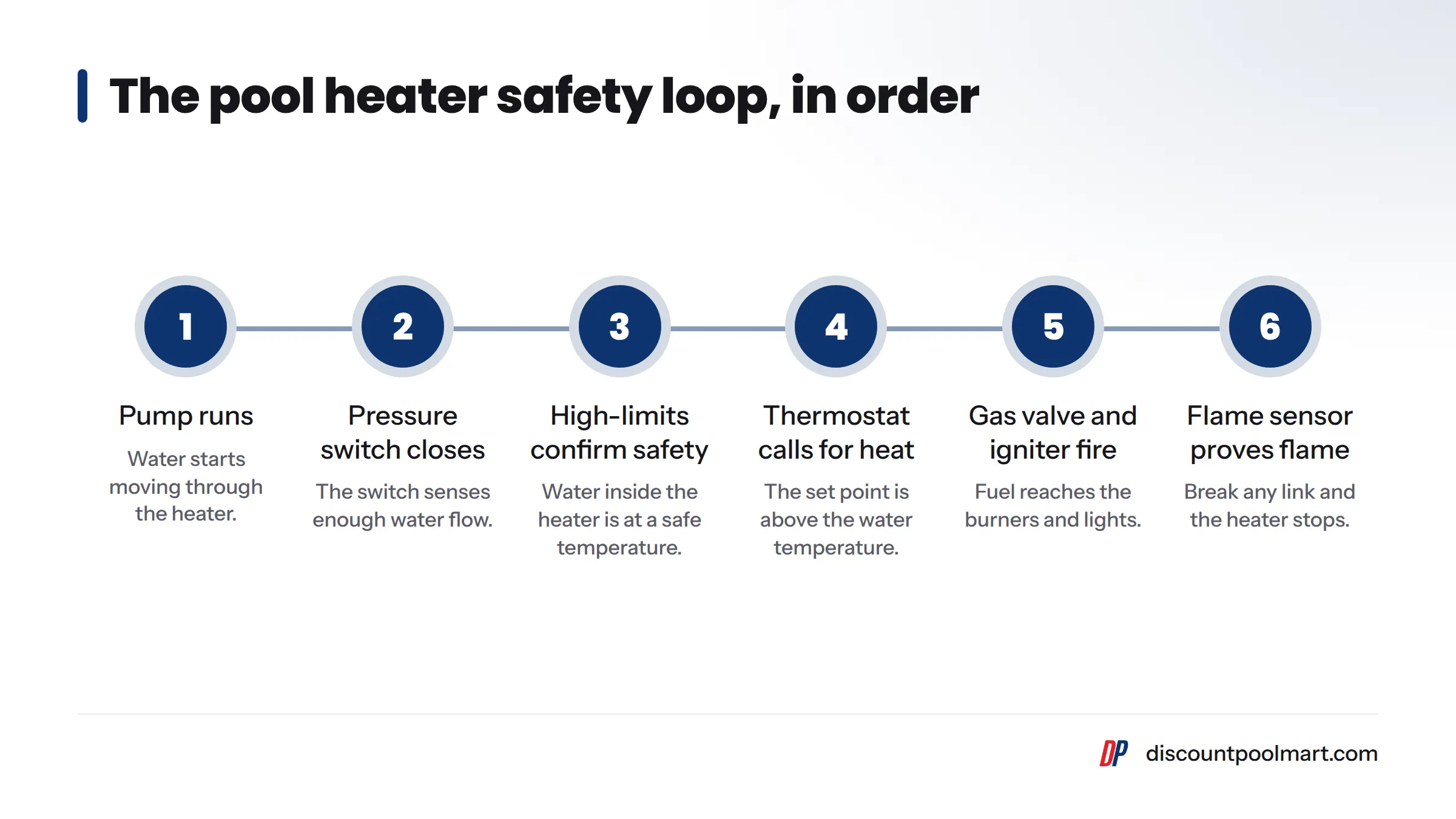
The safety loop, in order: pump runs, pressure switch closes, high-limits confirm a safe temperature, thermostat calls for heat, gas valve and igniter fire, flame sensor proves flame. Break any link and the heater stops.
LA Pattern #1: Hard Water Scales the Heat Exchanger
In our own service records, scaled heat exchangers rank among the most frequent causes of slow heating and high-limit trips. Much of Los Angeles receives imported water from the Colorado River and Northern California, and LADWP publishes hardness levels for your area in its annual Drinking Water Quality Report. Hard water leaves calcium behind as it heats, and the heater tubes are the hottest spot in your whole system.
Watch for these signs of scale:
- The pool takes noticeably longer to heat than it did last season
- High-limit trips keep happening
- You hear knocking, popping, or rumbling while it heats
Prevention starts with balanced water. Learn how to test pool water, then keep calcium hardness and pH in range. Descaling or replacing an exchanger is a technician job.
LA Pattern #2: Worn Igniters in Older Hayward and Jandy Heaters
The second pattern on our service tickets: older Hayward and Jandy gas heaters that click, try to start, and never light. If you're dealing with a Hayward pool heater not turning on after years of service, the igniter is a likely suspect. Igniters heat and cool thousands of times, and they wear out with age. Early warnings include intermittent ignition and ignition-family codes that come and go.
Honestly, I'd rather an owner call us at the first intermittent start than after a full lockout on a cold Saturday. A technician should test and replace the igniter and confirm the control board is healthy. For parts reference, we stock the Hayward H-Series control board.
Where Homeowner Checks End and a Technician Takes Over
| You can do this | Call a technician |
|---|---|
| Reset the breaker once | Any gas smell |
| Clean the filter | Gas valve or burner problems |
| Empty pump and skimmer baskets | Igniter or flame sensor |
| Open valves, bleed air | Control board or wiring |
| Adjust the set point and schedule | Heat exchanger descaling or replacement |
| Read and record codes | Repeated safety trips, soot, or scorch marks |
Spa owners can also review these signs your spa heater needs professional repair.
Next steps: If your checks pass and the heater still won't cooperate, book heater service with Discount Pool Mart or bring your model number to one of our stores. We know what fails on LA equipment pads because we fix it every week. Our Los Angeles pool equipment repair team handles heaters, pumps, and filters. To plan a budget, see pool equipment installation cost in Los Angeles, and for the bigger picture, read our pool heater guide.
Frequently Asked Questions
Can a pool heater be repaired? Yes. Igniters, sensors, switches, and boards are all replaceable. A cracked or heavily scaled heat exchanger can tip the decision toward replacing the heater.
What do the different error codes mean on a Hayward pool heater? Meanings vary by model. Find your model on the rating plate and use the troubleshooting table in that model's manual.
What are common gas pool heater problems? Low flow, igniter failure, gas supply issues, flame sensor faults, high-limit trips, and heat exchanger scale.
Why is my pool heater not working after the pool was serviced? Usually it's a closed valve, air in the filter, a loose lid, or a bumped bypass. Run the post-service checklist above.
Why does my pool heater say "check flow"? The pressure switch isn't sensing enough water. Clean the filter, empty the baskets, open the valves, and bleed air.
Is it safe to bypass the pressure switch to test the heater? No. Bypassing it can let the heater fire dry, which can destroy the heat exchanger or start a fire.
Why does my heater turn on and then shut off? The usual causes are a high-limit trip, a weak flame signal, a flow interruption, or the water reaching its set point.
How do I know if my heat exchanger is scaled? Look for slow heating, high-limit trips, and popping sounds. A technician can confirm it by inspection.
Does a heat pump work in cold weather? It slows down as the air cools, and the DOE says performance drops below about 45 to 50°F.
Is there a reset button on a pool heater? Many control panels let you clear a fault by cycling power or switching modes. Check your manual, and treat a fault that keeps coming back as a service call.