




Pool gas heater operation comes down to four steps. Start the pump so water moves through the heater. Confirm the gas supply is on and nothing is crowding the unit. Light the pilot, or power up an electronic-ignition model. Then set the thermostat for pool or spa. Keeping it running takes three habits: clear away debris, keep your water balanced, and book a professional service once a year.
We're Discount Pool Mart, an authorized Hayward and Jandy dealer with service crews across Los Angeles. Most of the gas heaters our technicians work on don't have a defect. Their owners have habits that cause trouble. This guide covers the habits that keep a heater firing. If you haven't picked a heating system yet, start with our guide to choosing a pool heater.
Written with the Discount Pool Mart service team. Last reviewed October 2026.
Smell gas? Don't light anything. Don't flip switches or try to relight the heater. Get away from the area, then call your gas utility (SoCalGas serves most of LA) or 911 once you're somewhere safe.
Two-Minute Safety Checks Before Every Gas Pool Heater Startup
These checks take about two minutes. In my view, they're the cheapest protection a pool owner can get.
Check for Gas Odor
Utilities add a sulfur or rotten-egg smell to natural gas so people can notice a leak. If you smell it, stop. Never relight after smelling gas, even if the smell fades.
Keep the Vents Clear to Prevent Carbon Monoxide Buildup
Every gas heater produces combustion gases, and carbon monoxide is one of them. The U.S. Consumer Product Safety Commission's Carbon Monoxide Information Center describes CO as an invisible, odorless gas that can kill. Required vent clearances come from your heater's installation manual and the NFPA 54 National Fuel Gas Code. As the owner, you have one job here: keep the vent and the combustion air openings clear.
Clear the Area Around the Unit
Pull back plants, leaves, and anything stored nearby. Look for rodent or bird nests near the burner tray. Look, but don't touch anything inside. Leave sealed panels closed.
Natural Gas or Propane?
The rating plate tells you whether your heater burns natural gas or propane (LP). Either way, you start it the same way. Just confirm the supply valve is open and, with propane, that the tank still has fuel.
Pre-start safety checklist:
- No gas odor near the heater or meter
- Vent cap and top of the unit clear
- At least the manual's required clearance on all sides
- No nests, leaves, or debris near the burner area
- Fuel type confirmed and supply valve open
- Electrical breaker on (electronic models)
- Manual on hand, or downloaded from Hayward or Jandy
Step 1: Get the Pump Moving Water Through the Heater
New owners get stuck on this step more than any other. If the pump isn't moving water, the heater won't fire.
The Pressure Switch Won't Allow Ignition Without Flow
Here is why. A pressure switch reads the water pressure inside the heater. When flow is low or missing, the switch holds the ignition circuit open. That protects the heat exchanger, the bank of tubes that carries heat from the flame into your water. If the burners fired with no water inside, the exchanger would overheat fast.
Clean Filter, Open Valves, and the Bypass
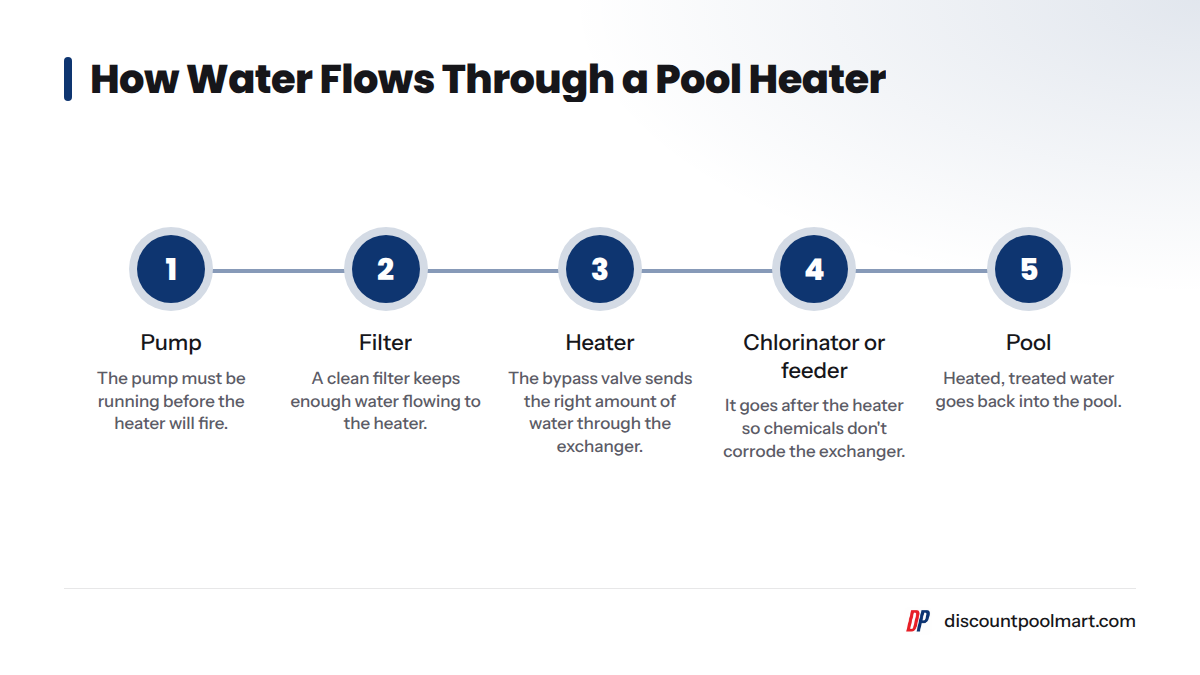
Turn on the pump and check that filter pressure looks normal. A dirty filter starves the heater of flow. Open the valves that feed the heater. Most heaters also contain a bypass valve that routes extra water around the exchanger, so the right amount of water flows through it.
The water path runs like this: pump → filter → heater → chlorinator or chemical feeder → pool. Manufacturer manuals call for chlorinators to sit after the heater, because concentrated chemicals eat through exchanger metal.
If you still can't get good flow, the pump itself may be the problem. Our team handles pool pump repair in Los Angeles.
Step 2: How to Turn On a Gas Pool Heater (Millivolt vs. Electronic Ignition)
Your startup steps depend on the ignition type, and plenty of owners don't know which one they have. Let's break it down.
| Millivolt / Standing Pilot | Electronic Ignition | |
|---|---|---|
| How it starts | You light a small pilot flame by hand. It stays lit and powers the gas valve. | A spark or hot surface igniter lights the burners when the heater calls for heat. |
| What you'll see | Gas control knob, pilot window, often no digital display | Digital control panel with mode and setpoint buttons |
| Power needed | None from the house; a thermopile makes the current | 120V or 240V supply |
| Where instructions live | Lighting label inside the access door | Owner's manual and control panel |
How to Light a Pool Heater Pilot on Millivolt Models
Older Laars and Jandy millivolt units come with a lighting label, usually printed inside the front panel. The usual sequence: turn the gas control to OFF, wait the stated time for any gas to clear, set it to PILOT, hold it down while you light, then turn it to ON. Follow your own label exactly, since timings vary by model. If the pilot assembly fails, have a pro swap in a replacement such as this Jandy pilot burner for Teledyne Laars heaters.
Electronic Ignition: How to Turn On Pool Heater Hayward and Jandy Models
Models like the Hayward Universal H-Series natural gas heater and the Jandy JXi or LXi start with fewer steps. Whether you need how to turn on pool heater Jandy instructions or the Hayward version, the sequence looks almost the same:
- Pump on and running
- Gas supply valve open
- Power on at the breaker
- Select Pool or Spa on the panel
- Raise the setpoint above the current water temperature
- Listen for the igniter, then watch for the burners to light
Technician tip: Your Hayward pool heater manual or Jandy manual lists how many ignition attempts to make. If the heater still won't fire after that, stop. Check flow, gas supply, and setpoint one more time. If all three look right, call a technician instead of retrying over and over.
Step 3: Set the Thermostat and Choose Pool or Spa
Pool Heater Spa Mode vs. Pool Mode
Most heaters store two separate setpoints. Pool mode holds the larger body of water at swimming temperature. Pool heater spa mode heats the smaller spa volume to a higher number. Switching modes only changes which setpoint the heater aims for. Your valves or automation system still decide where the water actually goes.
Changing Modes From Your Phone
Owners running Hayward OmniLogic or Jandy iAquaLink can switch modes from a phone. Our walkthrough shows how to control your pool heater from an app.
Cranking the Thermostat Won't Heat the Water Faster
A gas heater burns at full output until it reaches the setpoint, then cycles off. Setting it 20 degrees higher doesn't warm the water any sooner. The water just overshoots, and you pay for the extra gas. Pick the temperature you want and leave it there.
Step 4: Run Times and Day-to-Day Habits
- Run the pump whenever the heater calls for heat. Line up your heating windows with your pool pump run times.
- Cover the pool. A cover holds heat overnight. Our pool cover guide walks through the options.
- Leave the pilot on or turn it off between uses? Do what your manual says. Some owners keep a standing pilot lit all season and shut it off for long breaks.
- Above-ground pools follow the same principles. Use the manual for your model.
Gas Pool Heater Maintenance: Monthly and Seasonal Tasks
Gas pool heater maintenance isn't complicated. It just needs a routine you actually stick to.
| Monthly | Spring Startup | Fall/Winter Shutdown | Annual |
|---|---|---|---|
| Clear debris and nests | Visual check for nests and damage | Turn heater off at control | Professional service inspection |
| Check vents are open | Reinstall drain plugs | Close gas supply valve | Scale check on exchanger |
| Note filter pressure | Restore flow, then gas, then power | Remove drain plugs per manual (freeze areas) | Gas pressure and venting test |
| Test your pool water | Fire and watch a full cycle | Cover the top if the manual allows | Controls and safety checks |
Pool heater winterization in LA is usually light work. Don't skip it, though. Inland valleys still freeze now and then, and a frozen exchanger can crack.
What a Gas Pool Heater Annual Service Covers
Once a year, a licensed technician should inspect:
- Heat exchanger condition and scale buildup
- Burner tray, burners, and sooting
- Pilot or electronic ignition system
- Pressure switch and high-limit safety switches
- Gas pressure at the valve
- Venting and draft
- Bypass valve operation
- Wiring, control board, and sensors
Owners can handle visual checks and debris. Gas lines, gas valves, electrical work, and sealed combustion parts belong to professionals. Book your heater service with Discount Pool Mart, and an authorized Hayward and Jandy technician will handle the inspection.
Hard Water Scale: The Failure We See Most in LA
When we go through our service records, scaling inside the heat exchanger shows up more than any other failure. I'd put pool heater heat exchanger scale at the top of every LA owner's watch list.
What Scale Does Inside the Exchanger
Hot water pushes calcium out of solution. The calcium hardens into a crust inside the copper tubes and narrows the path for water. Less flow leads to overheating, banging or kettling noises, high-limit trips, and weaker heat output.
Why LA Water Runs Hard
Much of Southern California's water arrives through the Metropolitan Water District, including Colorado River water, which carries a heavy mineral load. The Los Angeles Department of Water and Power publishes hardness levels for its service zones in its annual drinking water quality report, so check the figure for your neighborhood.
Balanced Water Prevents Most Scale
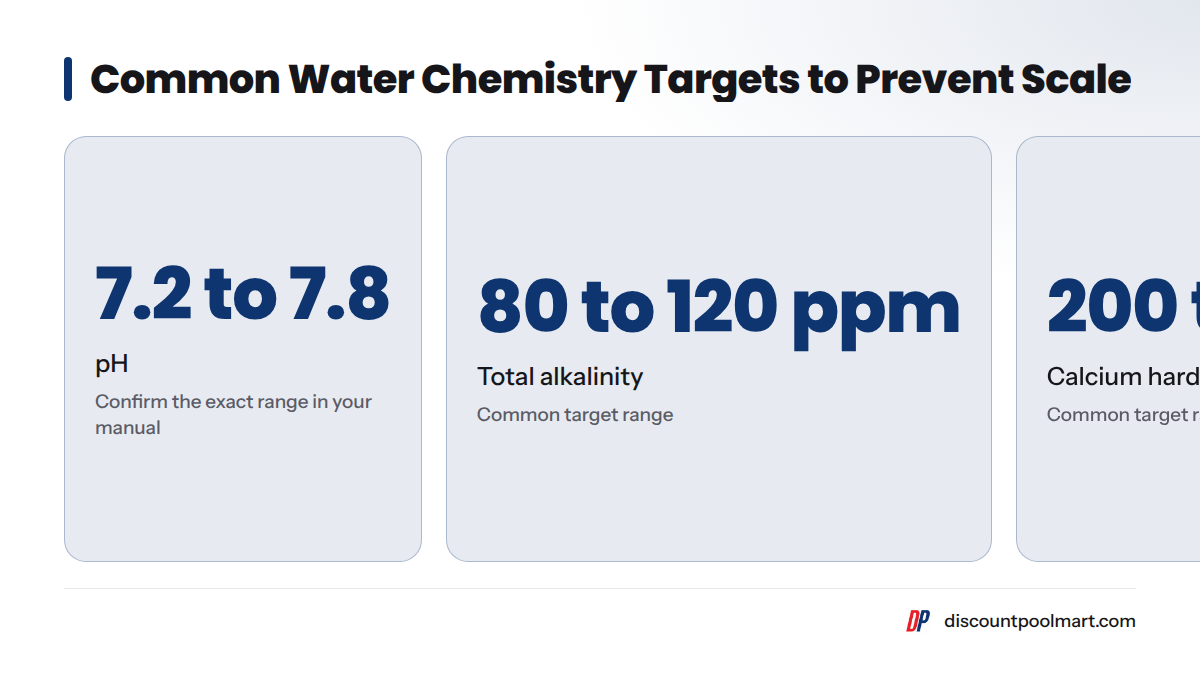
Hayward and Jandy manuals list the water chemistry ranges their warranties depend on. Common targets are pH around 7.2 to 7.8, total alkalinity around 80 to 120 ppm, and calcium hardness around 200 to 400 ppm. Confirm the exact numbers in your own manual. Keeping the Langelier saturation index near zero balances these factors, so the water neither deposits scale nor corrodes metal. Standards from the Pool & Hot Tub Alliance cover the same ground.
Seven Mistakes That Shorten a Heater's Life
- Running the heater with low or no flow
- Bumping the thermostat up again and again
- Ignoring water balance and scale
- Stacking items near the vents
- Trying gas, electrical, or sealed-combustion work yourself
- Relighting after smelling gas
- Skipping winterization in freeze-prone areas
Still weighing your options? See how gas holds up when you compare gas, heat pump, and solar pool heaters.
Pool Gas Heater Operation FAQs
How do gas pool heaters work? The pump pushes water through a heat exchanger while gas burners fire underneath it. The heated water flows back to the pool, and the cycle repeats until the water reaches the setpoint.
Why does my pool pump need to run for the heater to work? The pressure switch blocks ignition when water isn't flowing. That keeps the heat exchanger from overheating.
Can I leave my gas pool heater on all the time? Yes, as long as the setpoint is reasonable and the pump schedule covers your heating windows. The heater cycles off once the water reaches temperature.
Should I turn off the pilot light in winter? For long shutdowns, most manuals say to turn off the pilot and close the gas supply. Follow yours.
What should I do if I smell gas near my pool heater? Leave the area and call your gas utility or 911 from a safe spot. Never relight the heater.
How often does a gas pool heater need professional service? Once a year, ideally before your main heating season starts.
Does hard water damage a pool heater? Yes. Calcium scale restricts flow and overheats the exchanger. Balanced water prevents most of it.
My Hayward heater isn't igniting. What should I check first? Confirm the pump is running, the gas supply is open, and the setpoint sits above the water temperature. If it still won't fire, call a technician.
Sources
- Carbon Monoxide Information Center, U.S. Consumer Product Safety Commission
- NFPA 54, National Fuel Gas Code, National Fire Protection Association
- SoCalGas, Southern California Gas Company
- Los Angeles Department of Water and Power
- Hayward Pool Products, Owner's Manuals and Support
- Jandy, Owner's Manuals and Support
- Pool & Hot Tub Alliance
- Langelier saturation index, Wikipedia
Related: pool heater not working