

How to open your pool in spring in Los Angeles comes down to one idea: you're ramping up, not reopening. Clear winter rain debris from the surface, the skimmer basket, and the deck. Inspect the pool pump and pump basket, restart the filter and write down its clean pressure, then top off the water. Test free chlorine, pH, and total alkalinity. Finish by checking gates, covers, and drain covers.
By the Discount Pool Mart team, pool supply, installation, and repair staff in Los Angeles. Last updated: October 2026.
This guide covers the spring startup sequence and nothing else. Chemical dosing, equipment repair, and anything electrical each have their own page, and we link to them as they come up.
Why LA Pools Still Need a Spring Opening
Most Pools Here Never Close, and That's the Catch
Most Southern California pools stay open all year. Winters are mild, so the water stays in and the equipment keeps running. It usually runs on a shorter schedule, though, and some pumps sit idle for weeks. Your pool didn't hibernate. It idled, and idling leaves its own mess.
That's why a Southern California pool opening looks different from the routine you'll find in guides written for cold climates.
The Three Problems Winter Leaves Behind
Every spring, the same three problems show up at our stores:
- Skimmer baskets packed with leaves, palm fronds, and silt from winter storms.
- Pumps that struggle after months of short run times.
- Filters nobody re-baselined, so the owner can't tell when the pressure starts climbing.
Rain also raises or lowers the water level and dilutes the chemistry.
Did you fully close your pool with a cover and winterizing plugs? Clear the standing water off the cover, then take it off, clean it, and store it. After that, the checklist below applies to you too. Our pool safety cover guide covers cleaning and storing the cover.
| Fully closed pool (cold climates) | LA pool that stayed open |
|---|---|
| Remove and store the cover | Clear rain debris from the water and deck |
| Pull winterizing plugs and reconnect lines | Check equipment that ran less or sat idle |
| Refill from a lowered winter level | Correct a level that rain or evaporation shifted |
| Restart the system from scratch | Reset short winter run times to spring times |
Your Printable Pool Opening Checklist
Print this pool opening checklist and work down it in order. The sequence matters, because each step protects the one after it. For most owners, a spring pool startup in Los Angeles takes an afternoon. Equipment problems can stretch that.
| Step | What to Check | Done ☐ |
|---|---|---|
| 1. Clear debris | Skim the surface, empty the skimmer basket, sweep the deck, brush and vacuum silt | ☐ |
| 2. Inspect equipment | Empty the pump basket, check the lid O-ring, listen to the pump, look for leaks, reset run times | ☐ |
| 3. Restart the filter | Check the media for your filter type, then write down the clean pressure: ____ PSI | ☐ |
| 4. Water level | Bring it to mid-skimmer and check the auto-fill | ☐ |
| 5. Test water | Free chlorine ____, pH ____, alkalinity ____, date ____ | ☐ |
| 6. Safety walk | Gate latch, fence, cover, drain covers, rescue gear | ☐ |
Let's break it down step by step.
1. Clear Winter Rain Debris From the Surface, Skimmer, and Deck
Skim First, Then Empty the Skimmer Basket
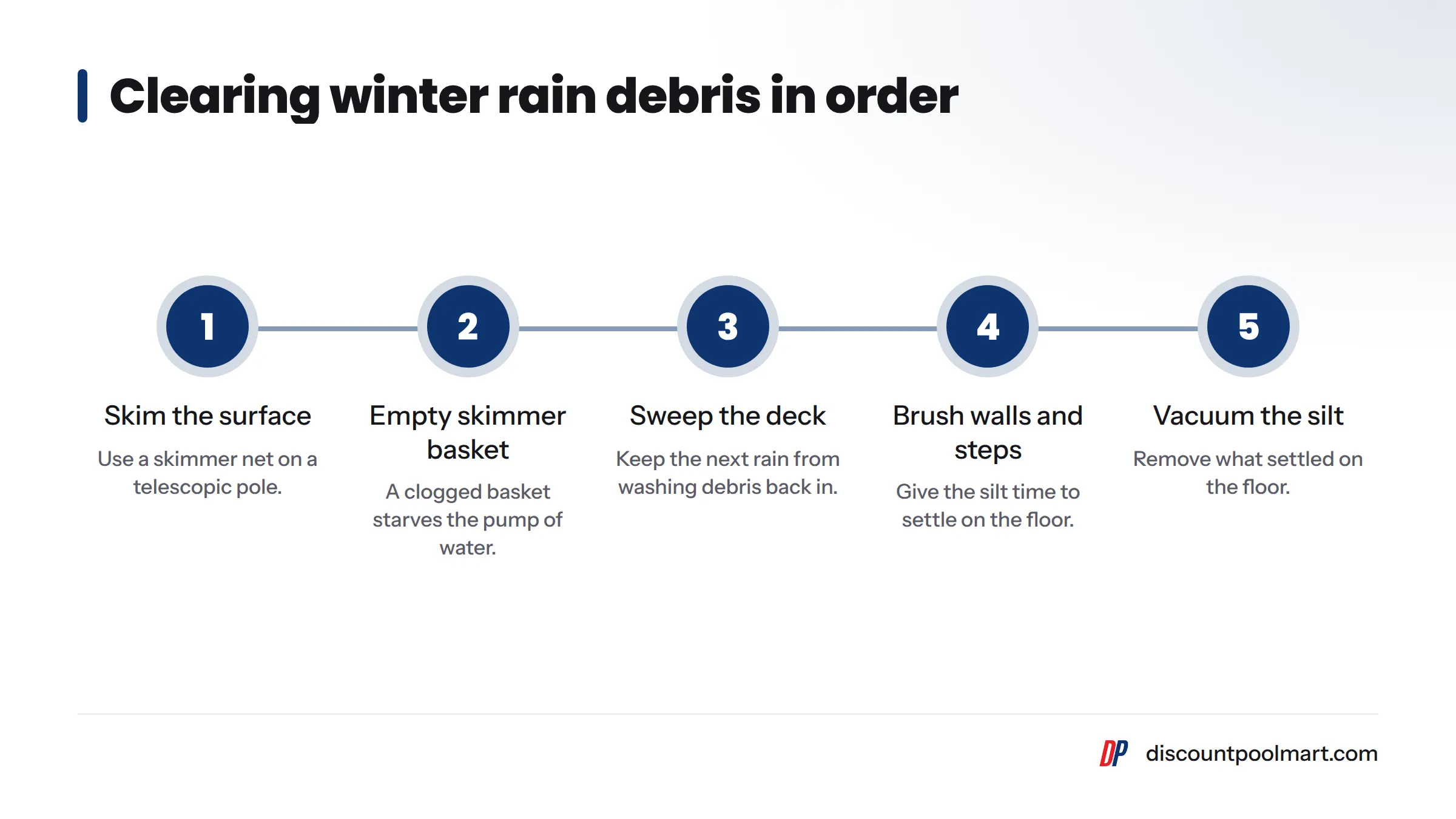
Start with a skimmer net on a telescopic pole, then empty the skimmer basket. Here is why the basket comes first: a clogged basket starves the pump of water, and a starved pump runs hot and loses prime.
Sweep the Deck So the Next Storm Can't Undo Your Work
Sweep leaves and dirt away from the pool edge. Skip it and the next rain washes the whole pile straight back into the water.
Brush, Wait, Then Vacuum the Silt
Brush the walls and steps, give the silt time to settle on the floor, then vacuum it out. Our guide to manual pool vacuuming walks through setting up the vacuum head and hose.
2. Inspect Pool Equipment That Sat Idle Over Winter
Pump Basket and Lid O-Ring
Turn the system off and empty the pump basket. Check the lid O-ring for cracks or flat spots. A worn O-ring lets air into the system, and air in the lines means weak flow.
The Pump Itself
Turn the pump on and listen. A steady hum is normal. Then look under the pump and around the fittings for drips.
Plumbing, Valves, and Heater
Trace the plumbing from the pump to the filter, the multiport valve, the heater, and the return jets. Look for cracks or wet spots. Gas heater owners should follow our guide to starting your gas pool heater along with the owner's manual.
Reset Run Times for Warmer Water
A pool that ran four hours a day all winter needs more circulation as the water warms. Variable-speed pumps from Pentair, Hayward, and Jandy store their schedules in a timer or an app, so the change takes a few minutes. Our pool pump scheduling guide helps you pick spring run times.
Stop and call a pro if you notice: leaks, cracked housings, grinding or screeching, a pump that won't prime, or a motor that hums without spinning or trips the breaker. Don't open electrical components yourself. Read the 5 signs your pump needs repair, or book pool pump repair in Los Angeles with our team.
3. Restart and Check the Pool Filter
What to Look At for Your Filter Type
| Filter type | What to look at before startup | Where to go next |
|---|---|---|
| Cartridge filter | Torn, flattened, or caked pleats and a cracked end cap | Filter problems guide and manufacturer manual |
| DE filter | Torn grids and an even DE coating after any backwash | Filter problems guide and manufacturer manual |
| Sand filter | Multiport position and backwash steps per the manual | Filter problems guide and manufacturer manual |
If you came here looking for how to open pool with sand filter equipment, the table's last row is your starting point. Set the multiport valve to the position your manual specifies and follow its backwash steps before you move on.
Write Down the Clean Pressure
Once the system runs clear and steady, record the reading on the filter pressure gauge. That number is your spring baseline. When the reading climbs well above it over the following weeks, the filter needs cleaning. Replace the gauge if the needle won't move or won't return to zero with the pump off.
Keep the Manufacturer's Manual Close
Every filter model has its own startup order, so we always tell customers to keep the manual within reach. If something looks off, our rundown of common pool filter problems covers the usual causes.
4. Top Off the Water Level
Aim for roughly the middle of the skimmer opening. Too low, and the skimmer pulls in air. Too high, and it can't catch floating debris. Winter rain can push the level up, and dry stretches can pull it down. Check the auto-fill if you have one. In our view, water loss you can't explain calls for a professional, not a bucket.
5. Test Pool Water and Bring Readings Into Range
Test Strips or a Liquid Kit
Test strips are fast and simple. A liquid test kit takes longer but reads more precisely. Our guide on how to test pool water explains the full method.
Start With Three Readings
- Free chlorine: the active sanitizer that kills germs and holds off algae.
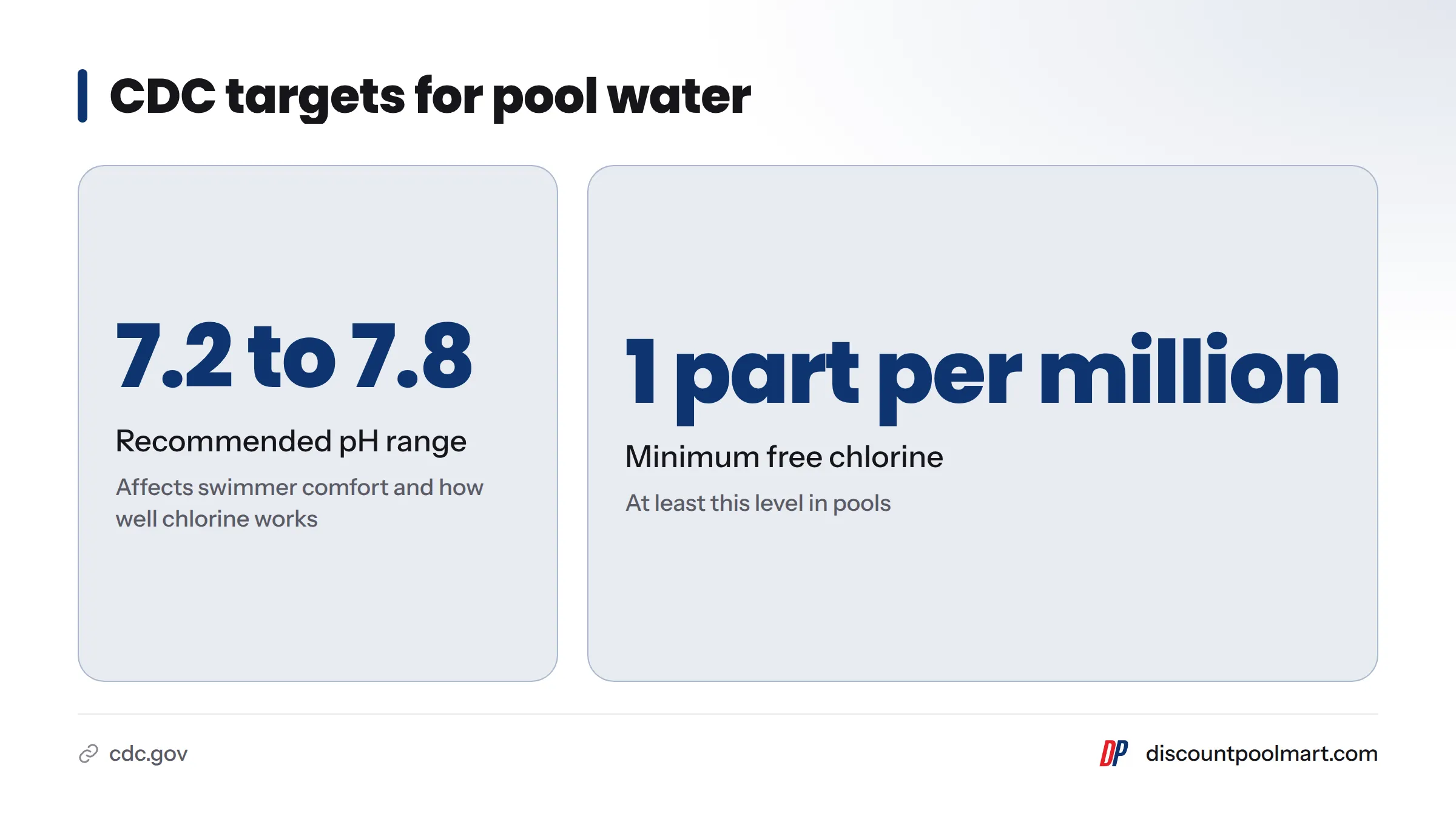
- pH: how acidic or basic the water is. It affects swimmer comfort and how well chlorine works.
- Total alkalinity: the water's buffer, which keeps pH from swinging.
Outdoor pools also benefit from a cyanuric acid check, since CYA shields chlorine from sunlight.
The Numbers to Aim For
The CDC's Healthy Swimming guidance recommends a pH of 7.2 to 7.8 and free chlorine of at least 1 part per million in pools. Always follow the label directions on any chemical you add.
Ready to balance? Step-by-step dosing lives in our pool chemical guide for LA homeowners.
Retest after every storm. Rain dilutes the water and carries debris in with it.
6. Run Pool Safety Checks on Fencing, Gates, Covers, and Drains
We consider this the most important step, and most opening guides skip it.
Self-Closing Gate Latch
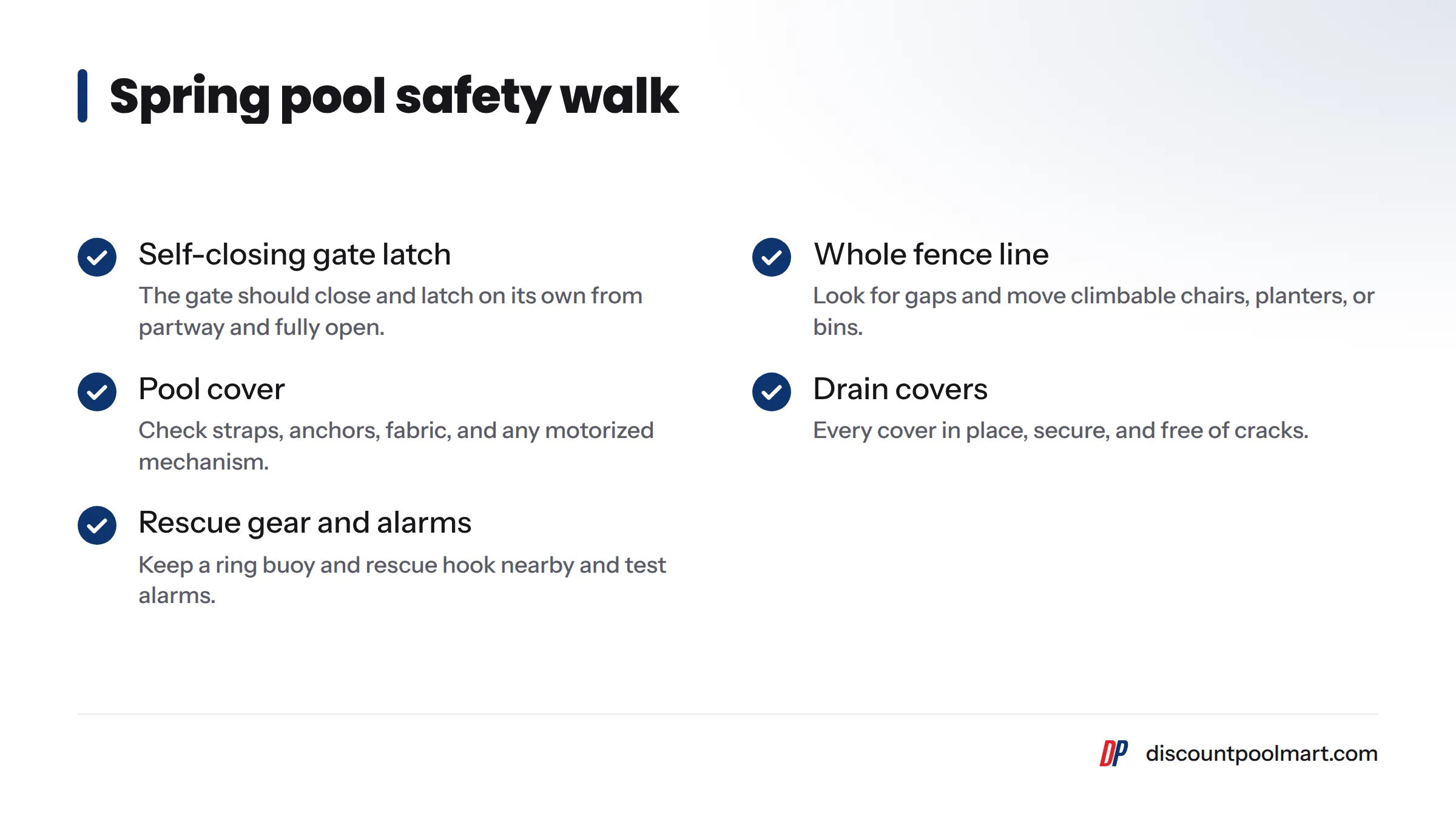
Open the gate partway and let go. Then do it again from fully open. The gate should close and latch on its own every time.
Walk the Whole Fence Line
Look for gaps and damage. Move any chairs, planters, or bins that ended up against the fence over winter, because kids can climb them. California sets its barrier rules in the Swimming Pool Safety Act, Health and Safety Code §115920 and the sections that follow, which you can read on California Legislative Information. Our page on California pool fence requirements puts those rules in plain English.
Pool Cover
Check the straps, anchors, fabric, and any motorized mechanism. The safety cover guide shows what a cover in good shape looks like.
Drain Covers
Confirm every drain cover is in place, secure, and free of cracks. The federal Virginia Graeme Baker Pool and Spa Safety Act requires anti-entrapment drain covers, and the CPSC's Pool Safely campaign explains why they matter. If you find a damaged cover, keep everyone out of the water and call a professional.
Rescue Gear and Alarms
Make sure a ring buoy and a rescue hook sit near the pool, and test your alarms. Our pool rescue equipment guide lists what to keep within reach of the water.
The five-minute safety walk:
- Test the gate latch from three positions.
- Walk the full fence line.
- Inspect the cover.
- Look at every drain cover.
- Test alarms and check rescue gear.
Next Steps: Your First Week After Opening
For the first few days, let the filter run on its new schedule, skim daily, and retest the water. Then compare the filter gauge to the baseline you wrote down. Once the readings hold steady, switch to our weekly LA pool maintenance checklist. Above-ground pool owners should follow our above ground pool maintenance routine instead.
Need test strips, a replacement cartridge, a new O-ring, or a pressure gauge? Did the checklist turn up a problem? Stop by a Discount Pool Mart store, or ask us about installation and repair. We'd rather see you in March than in a July emergency.
FAQ
Do I need to open my pool in spring if I live in Los Angeles?
Yes, even if it never closed. Winter rain leaves debris and shifts the water level, and short run times leave the equipment underworked. A spring ramp-up catches clogged baskets, worn O-rings, and safety problems before swim season starts.
When should I open my pool in Southern California?
When to open your pool depends on your schedule, but we suggest early spring, before the water warms. Algae grows slowly in cool water, and repair calendars still have openings. That's why we'd rather see you in March than in July.
How do I open my pool for summer?
How to open your pool for summer uses the same six steps. Spring is still the better time to do them, for the reasons above: cooler water, slower algae, and easier repair scheduling.
How do I open a pool for the first time?
If you're new to pool ownership and wondering how to open a pool for the first time, follow the printable checklist above in order and keep your equipment manuals nearby. The same advice covers how to open your pool in spring for the first time after buying a home with a pool. Stop at any step that turns up a leak, a crack, or an electrical fault, and call a professional.
Is the process different for an inground pool?
The steps in this guide reflect how to open an inground pool that stayed filled through an LA winter. Above-ground pools follow a separate routine, which our above-ground maintenance guide covers.
What chemicals do I put in my pool when I first open it?
Test the water before adding anything. Most pools need sanitizer and pH adjustments, but your readings decide which ones and how much. Follow the label directions and our chemical guide for dosing.
How long can my pool go without chlorine?
Not long. Chlorine protects swimmers and keeps algae from taking hold, and as LA water warms, algae can bloom quickly. Our guide on how to prevent pool algae in Southern California explains what to do.
Can I handle pool startup after winter myself, or should I call a pro?
Most homeowners can work through a spring pool opening checklist like this one on their own. Call a professional if you find leaks, electrical faults, a pump that won't prime, cracked equipment, or damaged drain covers.