

Extreme heat hits a pool three ways at once. It burns through chlorine, gives algae a head start, and pulls water out faster than at any other time of year. Pool care during a heatwave comes down to a short daily routine that deals with all three: test free chlorine every day, add chlorine in the evening, check stabilizer, run the pump longer, brush, top off, and call a pro when chlorine won't hold.
At Discount Pool Mart, we've spent about 40 years helping Los Angeles and San Fernando Valley pool owners through summer and fall heat. This is the same plan we give people at the counter.
The 7-step heatwave plan:
- Test free chlorine every day.
- Add chlorine or shock in the evening, not at midday.
- Check your stabilizer (CYA) level.
- Run the pump longer and keep the filter clean.
- Brush, skim, and watch for early algae.
- Top off evaporated water and slow further loss.
- Know when to call a pool professional.
Heatwave in the forecast? Do these 3 things today: test free chlorine, clean the filter or check its pressure, and top off the water.
Why a Southern California Heatwave Puts Your Pool on a Short Clock
A heatwave doesn't usually create new pool problems. It speeds up the ones you already handle every week. Let's break it down.
Heat and UV Burn Through Free Chlorine
Chlorine demand is the total amount of chlorine your water uses up fighting sunlight, sweat, sunscreen, leaves, and microorganisms. In hot weather, that demand rises from two sides. Ultraviolet light breaks down any chlorine that stabilizer isn't protecting, and longer, stronger sun means more chlorine lost to the sun. Hot days also bring more swimmers, and each one adds to the load.
Warm Water Gives Algae a Head Start
Almost every pool has algae spores in it. Warm water helps them multiply faster, so a short dip in chlorine can turn into a full bloom within a day or two. The heat isn't really the problem. The problem is the low-chlorine gap the heat opens up.
Dry Valley Heat Speeds Up Evaporation
The National Weather Service Los Angeles/Oxnard office regularly issues heat advisories for inland valleys. That hot, low-humidity air is why pool evaporation in a heatwave becomes something to check every day. Dry air pulls water off the surface quickly.
From our service calls: During long stretches of San Fernando Valley heat, the call we get most often is about a pool that held chlorine fine last week and now reads zero by morning. Close behind that is water that drops noticeably in just a few days.
Three pressures, one result: UV strips chlorine, warm water feeds algae, and dry heat speeds up evaporation. All three lead to a low-chlorine window, and that window is how pools turn green.
Step 1: Test Free Chlorine Every Day Until the Heat Breaks
Free chlorine is the chlorine still available to sanitize your water. This number tells you whether your pool is protected right now.
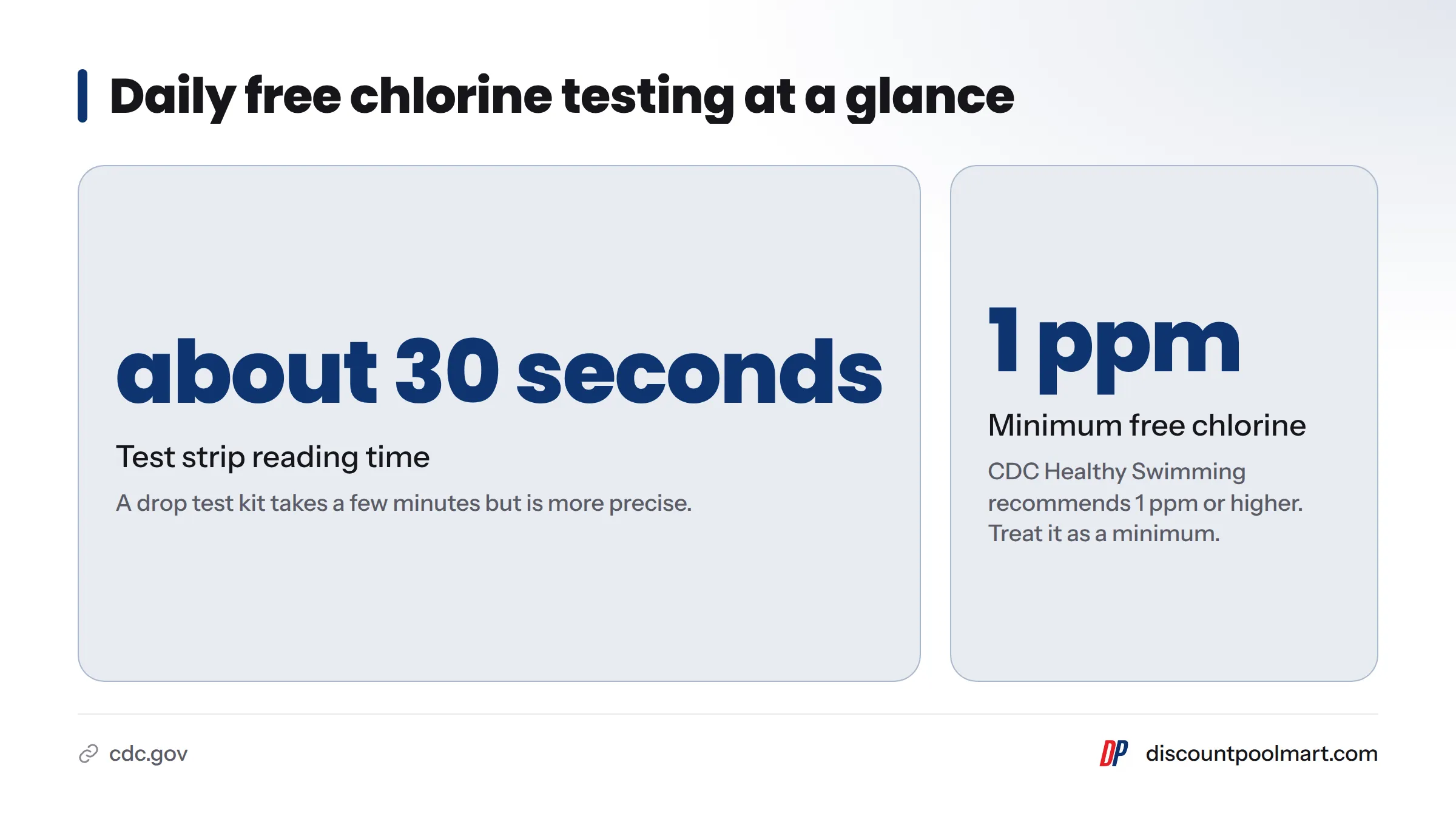
Test strips give you a reading in about 30 seconds. A drop test kit takes a few minutes but gives a more precise number. Either one works for daily checks, and our guide on testing pool water compares them side by side.
The Healthy Swimming program from the CDC recommends keeping free chlorine in pools at 1 ppm or higher. The right working level goes up as your stabilizer level goes up, so treat that number as a minimum.
Try the dusk-and-dawn check. Test at sunset, then test again at sunrise. If chlorine drops sharply overnight with no sun on the water, UV isn't the cause. Something in the water is using it up, usually organic debris or early algae.
Step 2: Add Chlorine or Shock in the Evening, Not at Midday
If you're wondering when to add chlorine to pool in summer, the answer is evening, after the sun is off the water. With no UV overnight, the chlorine spends those hours attacking contaminants instead of breaking down in sunlight.
I'll be blunt: dosing at 1 p.m. in August is how people waste half a jug.
Liquid chlorine (sodium hypochlorite) is our go-to for heatwave top-ups because it doesn't add stabilizer. Our liquid chlorine dosing guide lists the amounts.
Shock treatment is a larger dose that raises chlorine quickly. It makes sense when you see:
- Cloudy water after heavy use
- Slippery walls or a faint green tint
- A big overnight drop on your dusk-and-dawn check
Stay out of the water until chlorine is back in range.
Heat-safe chemical storage: Store chemicals in a shaded, cool, ventilated spot with the lids closed tight. Never mix products, and always follow the label directions.
Step 3: Check Your Stabilizer (CYA) So the Sun Doesn't Strip Your Chlorine
Cyanuric acid (CYA, or stabilizer) shields chlorine from UV breakdown. Too little, and sunlight strips chlorine within hours. Too much, and chlorine works more slowly.
For reference, the CDC Model Aquatic Health Code caps stabilizer at 90 ppm for public pools. Residential targets come from the ANSI/APSP/ICC-11 standard, published through the Pool & Hot Tub Alliance.
Here is why long seasons matter. Stabilized tablets add CYA every time they dissolve, so months of tablet use can push levels high. Read up on what cyanuric acid does. For pH, alkalinity, and calcium, use our guide on how to balance pool chemicals safely.
Step 4: How Long to Run Your Pool Pump in Hot Weather
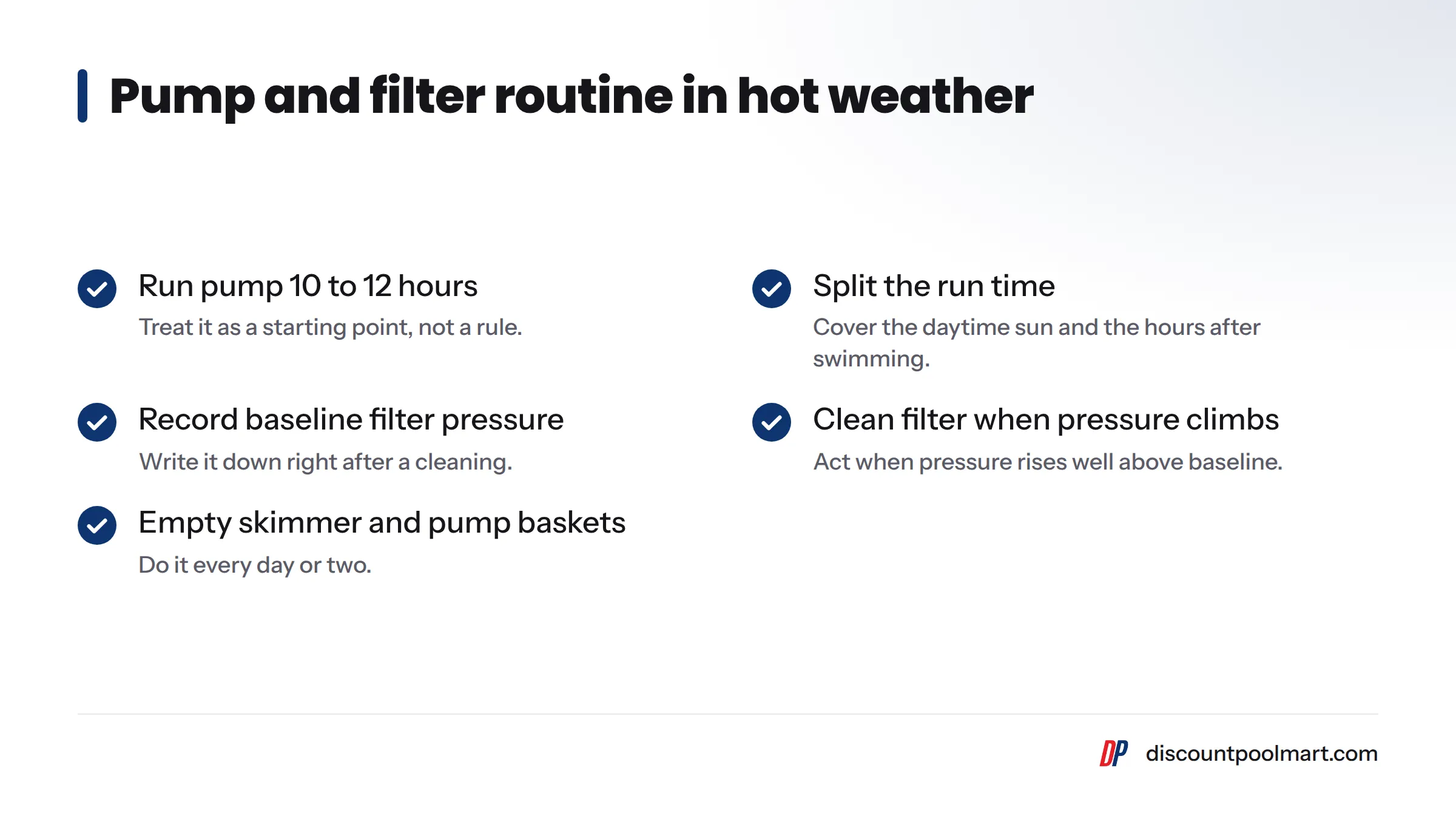
Circulation moves chlorine into every corner and pushes debris to the filter. Most industry advice on how long to run pool pump in hot weather lands at 10 to 12 hours a day or more. Treat that as a starting point, though, not a rule. Split the run time into blocks that cover the daytime sun and the hours after swimming. Our guide to pool pump scheduling shows how to set it up.
Salt pool owners should note one thing: your saltwater pool chlorinator only makes chlorine while the pump runs.
For the filter, write down the pressure reading right after a cleaning. That's your baseline. When the pressure climbs well above it, it's time for a round of pool filter cleaning. Empty the skimmer and pump baskets every day or two as well. In our experience, a clogged basket quietly causes more trouble during extreme heat than most owners expect.
Step 5: Brush, Skim, and Catch Algae Early
Skim every day. Brush the walls, steps, and shaded corners where the water moves least. Vacuum when debris settles, using our manual vacuuming guide.
Early algae shows up as slippery patches, a faint green or yellow tint, or water that looks dull instead of sparkling. Our tips to prevent pool algae in hot weather across Southern California lower the risk. If algae has already moved in, start with our algae treatment guide.
| Symptom | Likely cause | First action |
|---|---|---|
| Chlorine at 0 by morning | High demand from organics or early algae | Evening shock, brush, retest at dawn |
| Cloudy after a pool party | Heavy bather load | Dose chlorine at dusk, run pump, see fixing cloudy water |
| Green tint in corners | Algae starting in dead spots | Brush hard, shock that evening |
| Filter pressure rising | Clogged filter | Clean the filter |
| Water below the skimmer | Evaporation | Top off, then retest |
Step 6: Replace Evaporated Water and Slow the Loss
Keep the water level around the middle of the skimmer opening. Below that point, the skimmer can pull in air and the pump can lose prime.
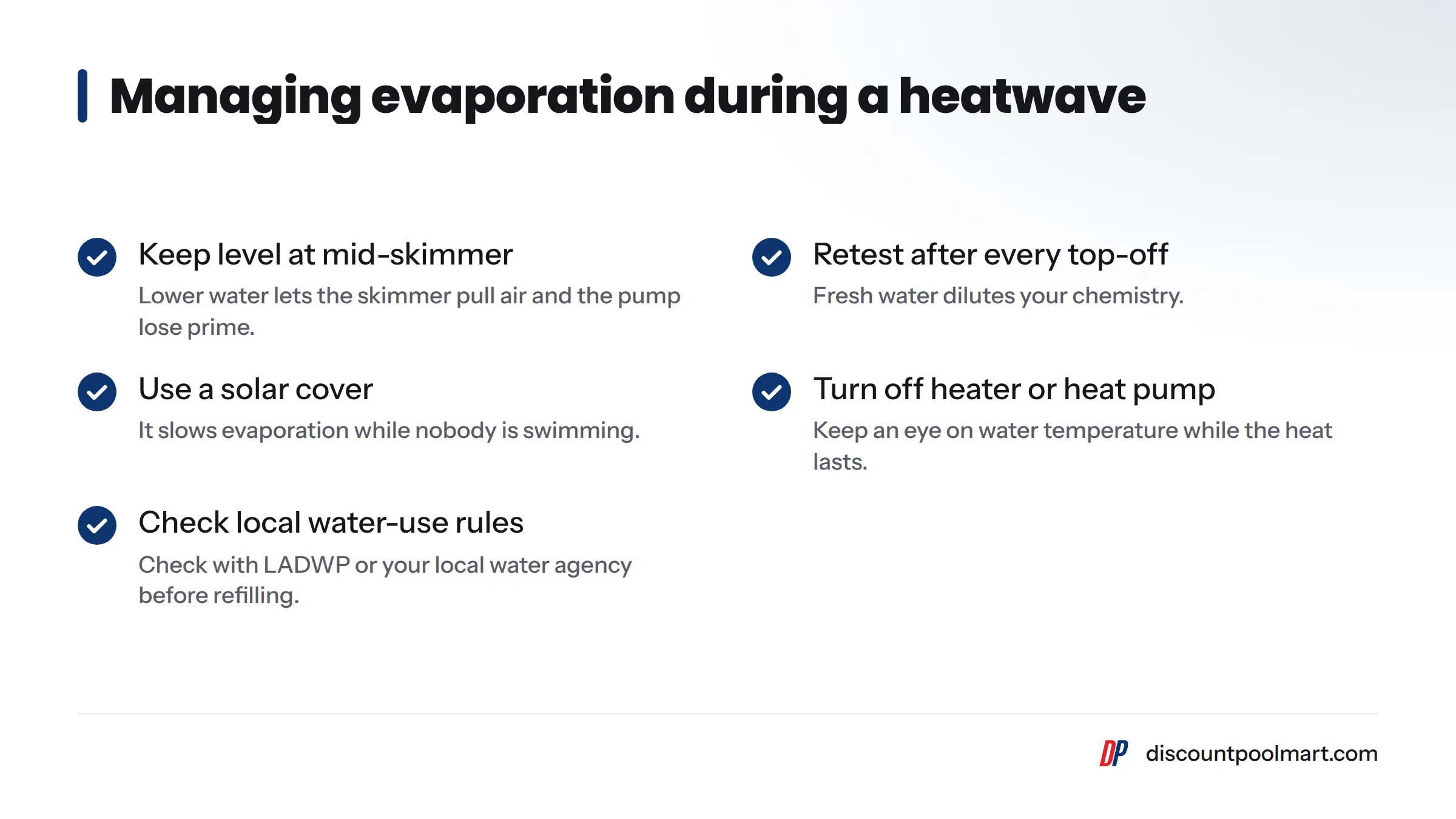
Fresh water dilutes your chemistry, so retest after every top-off.
A solar cover slows evaporation while nobody is using the pool. The tradeoff is that it also holds in heat. Keep an eye on water temperature, and switch off your heater or heat pump while the heatwave lasts. Our solar pool cover guide and heat pump guide cover both.
Before you refill, check the current watering and water-use rules with LADWP or your local water agency.
Leak warning: If your pool loses far more water than it did in past summers, or more than your neighbors' pools, you may have a leak. Skip ahead to Step 7.
Step 7: Know When to Call a Pool Professional
A test kit can't fix everything. Call a pro when:
- Chlorine won't hold for 24 hours, even with evening dosing
- Green water stays green after a shock
- The pump runs loud or hot, loses prime, or trips the breaker
- You suspect a leak
- Filter pressure stays high after a cleaning
Don't open up electrical equipment yourself. Our team handles pool pump repair in Los Angeles. For liquid chlorine, test supplies, and straight answers on Los Angeles heatwave pool care, stop by a Discount Pool Mart store. We'd much rather spend five minutes with you now than see your pool turn green next week.
Heatwave Pool Maintenance Checklist: Before, During, and After
Before the heat arrives:
- Stock liquid chlorine and test supplies, stored safely
- Clean the filter and note baseline pressure
- Check CYA
- Top off to mid-skimmer
- Set a longer, split pump schedule
- Get the solar cover ready
During the heatwave:
- Test free chlorine daily
- Dose chlorine in the evening
- Skim and brush
- Empty baskets
- Check water level and filter pressure
After it breaks:
- Retest the full panel
- Clean the filter and brush the pool
- Return the pump to its normal schedule
- Check for CYA buildup
Next steps: print this list and tape it up near your equipment pad. Pool maintenance during a heatwave is mostly about timing, and the list keeps you on schedule.
Heatwave Pool Care FAQs
What water temperature is too hot for a pool? There's no single cutoff. Warmer water does raise chlorine demand and algae risk, though, so the hotter the water gets, the more closely you should watch your chlorine.
How do I keep my pool clear all summer? Good hot weather pool care rests on four habits: steady free chlorine, daily skimming, a clean filter, and enough circulation. Our algae prevention guide walks through the routine.
Can I swim in the pool in 100-degree weather? As far as the pool goes, yes, as long as chlorine is in range. For your own heat precautions, check the heat safety page from the National Weather Service.
Should I leave my heater or heat pump on during a heatwave? No. Your pool picks up plenty of heat on its own, so turn it off.
Should I shock my pool at night? Yes. Evening dosing keeps UV from breaking the chlorine down before it can work.
Do I need to test every day during a heatwave? Yes. We've seen chlorine go from fine to zero in a single hot day, and that's a big reason San Fernando Valley pool care in August looks so different from the rest of the year.
Sources
- Healthy Swimming, Centers for Disease Control and Prevention
- Model Aquatic Health Code, Centers for Disease Control and Prevention
- National Weather Service Los Angeles/Oxnard, NOAA
- Heat Safety, National Weather Service
- Pool & Hot Tub Alliance (ANSI/APSP/ICC-11 standards publisher)
- Los Angeles Department of Water and Power
- Cyanuric acid, Wikipedia