

Pool drain cover safety comes down to one device and a handful of checks. An anti-entrapment drain cover stops your pump's suction from pinning hair, a limb, or a whole body against the main drain. The right cover meets four conditions: it's certified to ANSI/APSP/ICC-16, it fits your drain's size, sump, and mounting, its flow rating is at or above your pump's flow, and it's still inside its marked service life. Below, I'll show you how to check the cover you have, read its label, and pick a replacement.
Your Pool Main Drain Cover Is a Safety Device, Not Just a Grate
The main drain is the suction outlet at the deepest point of the pool, and your pump pulls water through it. The pool main drain cover sits over that opening. The industry calls it a suction outlet fitting assembly (SOFA), or just a grate.
Here is why that matters. The opening pulls hard. A modern anti-entrapment cover is domed or raised, so a hand or body can't press flat against it and block all the flow. Older flat covers can be sealed completely, and a fully sealed outlet is how entrapment happens.
| Feature | Flat legacy cover | Certified anti-entrapment cover |
|---|---|---|
| Shape | Flat, low profile | Domed or raised |
| Can a body seal it? | Yes | Designed to resist full blockage |
| Certification marking | Often none | Standard, flow rating, service life |
| Our verdict | Replace it | Keep it inspected |
I'll be blunt: if you pull a flat pool drain cover off an older pool at season opening, don't wait for it to fail. Swap it.
Not the same as a pool safety cover. A drain cover is a small grate on the pool floor. A pool safety cover stretches across the whole pool surface to stop people from falling into the water.
How Pool Drain Entrapment Happens
Five ways suction can trap a swimmer
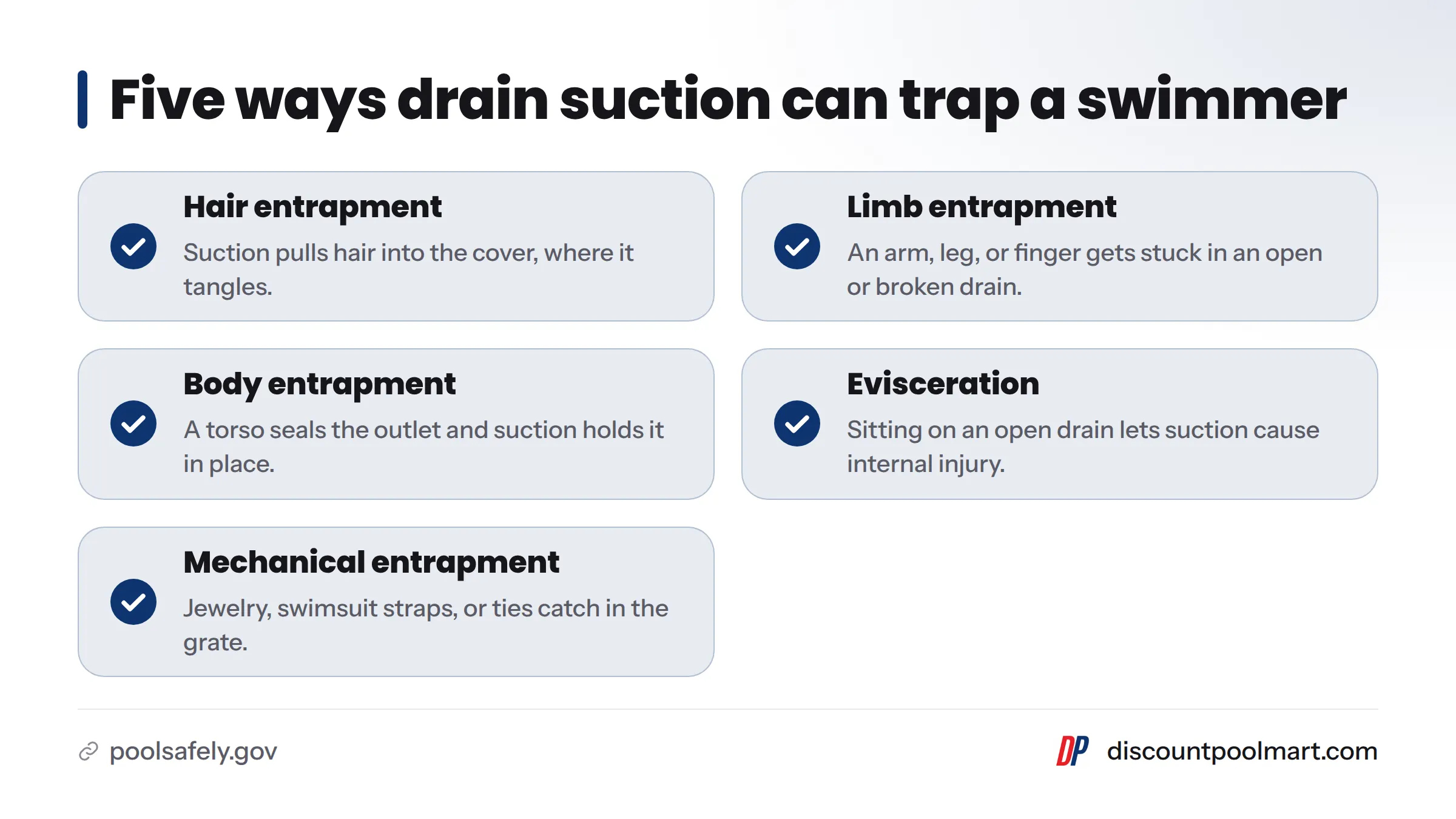
The U.S. Consumer Product Safety Commission runs the Pool Safely campaign, which lists the hazards that drain covers and related devices are meant to stop:
- Hair entrapment: suction pulls hair into the cover, where it tangles.
- Limb entrapment: an arm, leg, or finger gets stuck in an open or broken drain.
- Body entrapment: a torso seals the outlet and suction holds it in place.
- Evisceration: someone sits on an open drain and the suction causes internal injury.
- Mechanical entrapment: jewelry, swimsuit straps, or ties catch in the grate.
Children face the highest risk
Kids sit on drains, play near the pool floor, and often aren't strong enough to pull free. Long hair raises the risk of hair entrapment for anyone, adult or child. CPSC tracks entrapment incidents in its pool and spa reports, and most of the victims are children.
Stop rule: If a cover is missing or broken, turn off the pump and keep everyone out of the water until it's replaced.
What the Virginia Graeme Baker Act Requires
A federal law named for a seven-year-old
The Virginia Graeme Baker Pool and Spa Safety Act is a federal law, and CPSC enforces it. It carries the name of a seven-year-old girl who died from suction entrapment in a spa. Under the statute text at 15 U.S.C. 8001 and following, every drain cover sold in the U.S. has to meet the federal performance standard. Public pools and spas must use compliant covers too. A public pool with a single main drain that isn't unblockable needs an extra layer of protection, such as a safety vacuum release system.
From ASME A112.19.8 to ANSI/APSP/ICC-16
The law first adopted ASME A112.19.8 as the cover standard. CPSC's Pool Safely guidance on the Act says ANSI/APSP/ICC-16 has since replaced it. The Pool & Hot Tub Alliance (formerly APSP) and the International Code Council developed the newer standard. You may also see ANSI/APSP/ICC-7 mentioned. That one covers suction entrapment avoidance across the whole system and doesn't certify covers.
What the law means for a backyard pool
Every cover sold today has to meet the federal standard, so most homeowners treat a VGB compliant drain cover as the starting point, not an upgrade. Some states go further. In California, Health and Safety Code section 115928 says residential pools built or remodeled under a building permit need at least two suction outlets per pump plus anti-entrapment covers. Fences and barriers fall under different rules, which our pool fence guide covers.
This is general information, not legal advice. A licensed pool professional can check your specific pool.
Reading the Label: Flow Rating, Mounting, and Drain Cover Expiration Date
Turn a certified cover over or look along the rim. The markings are molded into the plastic.
| Marking | What it means | What to check |
|---|---|---|
| Standard (ANSI/APSP/ICC-16 or ASME A112.19.8) | The cover was tested to the federal standard | It's present and readable |
| Flow rating (GPM) | The maximum flow the cover is rated for | At or above your pump's flow |
| Floor or wall | The mounting position it was tested in | Matches where your drain sits |
| Service life or expiration | How long the rating holds | The date hasn't passed |
| Manufacturer and model | Who made it and which part it is | Matches the replacement you buy |
Drain cover flow rating (GPM)
This number tells you how many gallons per minute can safely pass through the cover. If your pump moves more water than that, the cover is undersized. Dual-drain systems are harder to work out, so ask a pro how the flow splits between the two outlets.
Service life and expiration date
Sunlight and pool chemicals weaken plastic over time, which is why certified covers list a service life. Look up the exact figure on the manufacturer's spec sheet and replace the cover once that period ends. If the drain cover expiration date has already passed, the cover no longer carries its rating.
Floor vs. wall mounting
A cover tested on the floor may not hold the same rating on a wall. Install it only in the position the label names.
Replace your cover now if it is:
- Past its expiration or service life date
- Missing its label, or the label can't be read
- Cracked, chipped, or broken
- Warped, faded, chalky, or brittle
- Loose, or missing any screws
- Flat or an old-style design
- Gone entirely
Choosing a Pool Drain Cover Replacement That Fits Your Drain
Let's break it down. A good pool drain cover replacement starts with your drain, not the store shelf.
- Identify the drain. Measure it, note whether it's round or square, and check the frame or ring type.
- Confirm sump depth and mounting. The label lists the sump the cover was tested with.
- Match the flow rating to your system's actual flow.
- Check whether you have one main drain or two, and whether an SVRS is installed.
- Confirm the certification marking and service life on the new cover.
- Bring the old cover or a photo to the store, or have a licensed pro confirm the fit.
One main drain vs. two
With a single drain, all the suction runs through one point. If something blocks it, that spot takes the full pull. Dual main drains are spaced apart and plumbed together, so they share the suction. If one gets blocked, a swimmer doesn't get trapped.
An SVRS is a backup, not a substitute
A safety vacuum release system such as the Vacless SVRS10ADJ detects a sudden spike in vacuum and breaks the suction. In my view, treat it as a backup behind a certified cover and never as a replacement for one. Our guide to layers of pool safety shows how it fits with the other protections.
Drain Covers We Stock for Common LA-Area Pool Drains
At Discount Pool Mart, we carry certified covers from manufacturers we trust. Before you install one, check both the listing and the label on the cover for its flow rating and service life.
| Drain configuration | Cover | Notes |
|---|---|---|
| 8" drain with frame | Waterway 8" Anti Vortex Cover and Frame, white | Also in gray, black, dark gray, and tan |
| 10" round, mixed frames | AquaStar 10" Round Cover with Adapter | The universal adapter kit helps with older frames |
| Fill-up style main drain | AquaStar Fill Up Cover in clear or gray | Confirm the fit with our staff |
| CMP main drain | CMP Main Drain Cover, white | Listed at 175 GPM; check it against the label |
| 7 3/8" anti-vortex | Afras Anti Vortex Cover in dark gray or white | The size has to match exactly |
Bring your old cover or a photo of its label. Our staff can help you find a match. While you're here, browse our other pool safety equipment.
When to Replace Your Cover and Who Should Install It
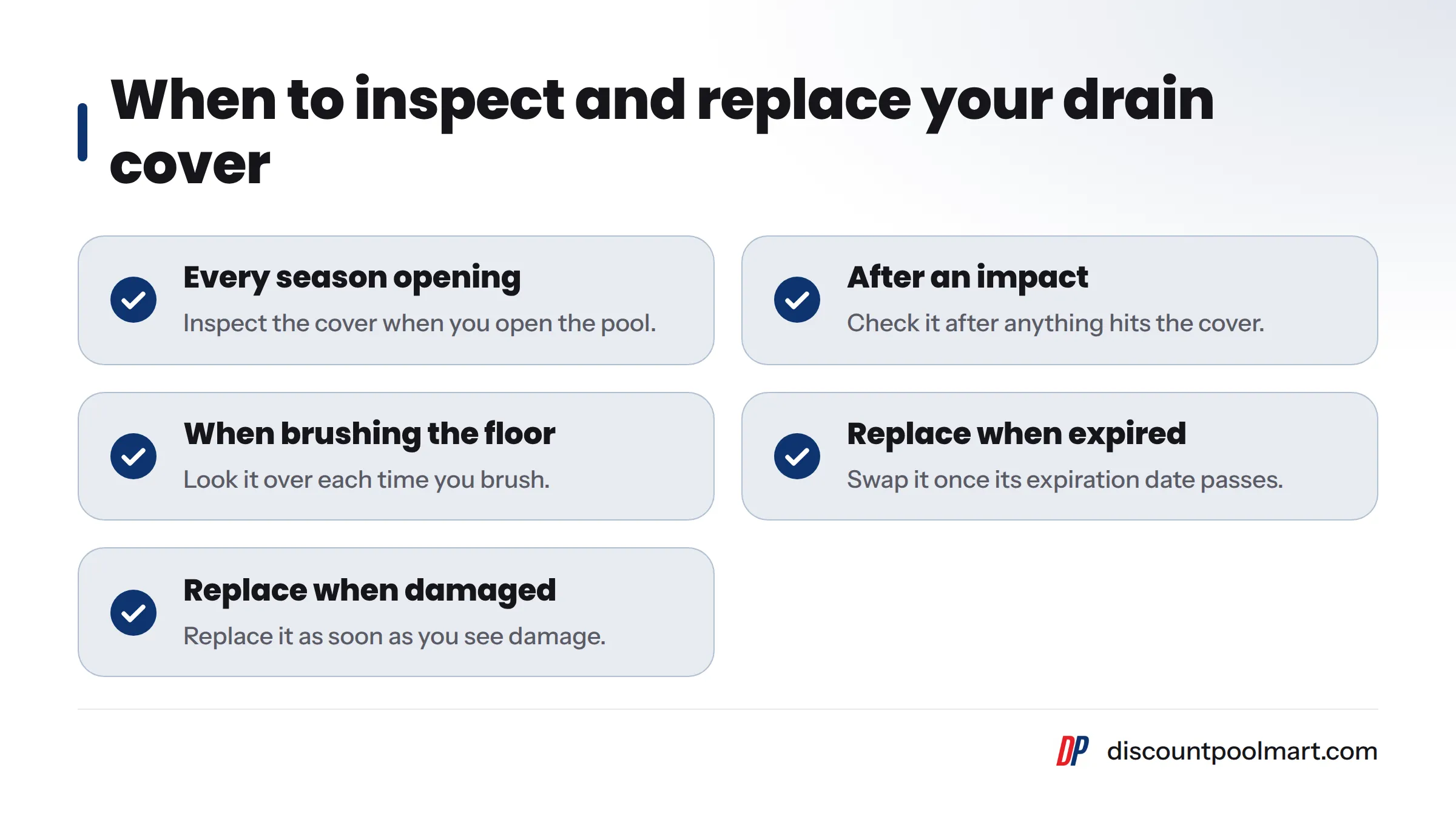
Next steps: inspect the cover at every season opening, after anything hits it, and whenever you brush the floor. Our seasonal pool maintenance calendar makes that easy to remember. Replace the cover when it expires or as soon as you see damage.
For main drain work, I always recommend a licensed pool professional. A pro checks sump depth, fit, and fasteners, so nobody has to guess whether the new cover is seated correctly. Discount Pool Mart offers installation and repair services if you'd like help. For the bigger picture, including electrical hazards, start with our pool safety hub.
Pool Drain Cover Safety FAQ
Pool drain cover no screws: is it safe to swim? No. A loose cover can shift and expose the opening. Shut off the pump and keep swimmers out until the cover is secured or replaced.
Are flat pool drain covers dangerous? Yes. A body can seal a flat cover completely. Replace it with a domed, certified cover.
Do pool drain covers expire? Yes. Certified covers show a service life or expiration date on the label. Replace them once that date passes.
What does "VGB compliant" mean on a drain cover? It means the cover was certified to the federal drain cover standard, which is now ANSI/APSP/ICC-16.
Do above-ground pools like Intex need anti-entrapment drain covers? Many have small suction fittings. For above ground pool drain cover safety, follow the pool manufacturer's guidance and use only parts they approve.
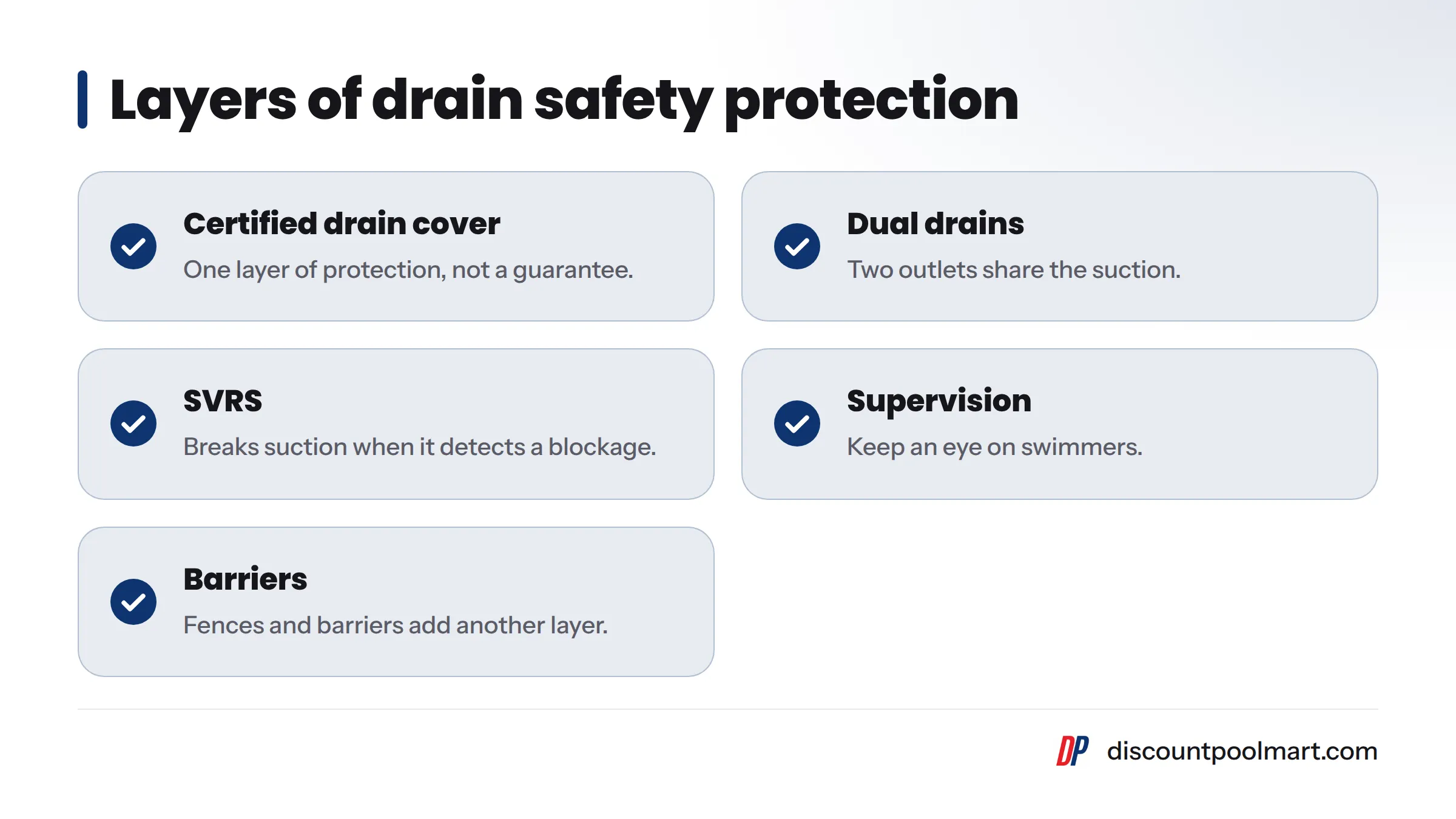
Does a certified drain cover make my pool fully safe? No. It's one layer of protection. Dual drains, an SVRS, supervision, and barriers add more. A cover on its own guarantees nothing legally.
Can I replace a main drain cover myself? Some homeowners do, but a licensed pro should still check the fit and the sump.
What is an SVRS, and do I need one? It's a device that breaks suction when it detects a blockage. Pools with a single drain benefit most. Ask a pro about yours.
Sources
- Pool & Spa Safety Act, Pool Safely (U.S. Consumer Product Safety Commission)
- 15 U.S.C. 8001, Legal Information Institute, Cornell Law School
- California Health and Safety Code Section 115928, California Legislative Information
- Virginia Graeme Baker Pool and Spa Safety Act, Wikipedia
- CMP Main Drain Cover listing, Discount Pool Mart