

Pool alarms come in five types: gate and door alarms, surface wave alarms, subsurface alarms, wearable immersion alarms, and perimeter or motion sensors. For most backyard pools, Discount Pool Mart recommends starting with a pool gate alarm or pool door alarm, then adding a subsurface or surface wave water alarm. Each alarm is one layer of protection, and none of them replaces an adult watching the pool.
I wrote this guide because parents ask us the same thing at the counter every week: "Which one actually works?" They have good reason to worry. The CDC's drowning facts page reports that drowning kills more children ages 1 to 4 than any other cause of death. Drowning happens fast and usually in silence, so a loud warning that comes early gives you time to act.
What is a pool alarm? A pool alarm is a sensor that sets off a siren when someone opens a door or gate to the pool area, moves into the pool zone, or enters the water. Most models also send the alert to a remote receiver or indoor siren, so adults inside the house hear it.
Quick Answer: The Best Pool Alarm Type for Most Backyard Pools
| Alarm type | What it detects | When it alerts | False alarm tendency | Works with a pool cover? | Best for |
|---|---|---|---|---|---|
| 1. Gate and door alarm | A door, gate, or window opening | Before anyone reaches the water | Low | Yes, the cover doesn't affect it | Homes with a door that opens toward the pool |
| 2. Surface wave alarm | Waves on the water surface | After water entry | Higher (wind, rain, cleaners) | No, take it out before covering | Sheltered pools and first-time buyers |
| 3. Subsurface alarm | A pressure wave below the waterline | After water entry | Low to moderate | Depends on the model, so check with the maker | Windy or tree-lined yards |
| 4. Wearable immersion alarm | A wristband or collar going under water | When the wearer goes in | Low | Yes, the cover doesn't affect it | One specific toddler or pet |
| 5. Perimeter or motion sensor | Movement in the pool zone | Before anyone reaches the water | Moderate (pets, wildlife, foliage) | Yes, the cover doesn't affect it | Large or open yards |
Our verdict: Put a gate or door alarm in first, since it's the only water-side option here that warns you before anyone reaches the pool. Windy yard? Add a subsurface alarm. Sheltered yard? A surface wave alarm will do the job. After that, put wearables on any child or pet who needs an extra set of eyes.
How We Ranked Pool Alarms: Reliability, False Alarms, Coverage, and Upkeep
Let's break it down. We judged every swimming pool alarm on four things.
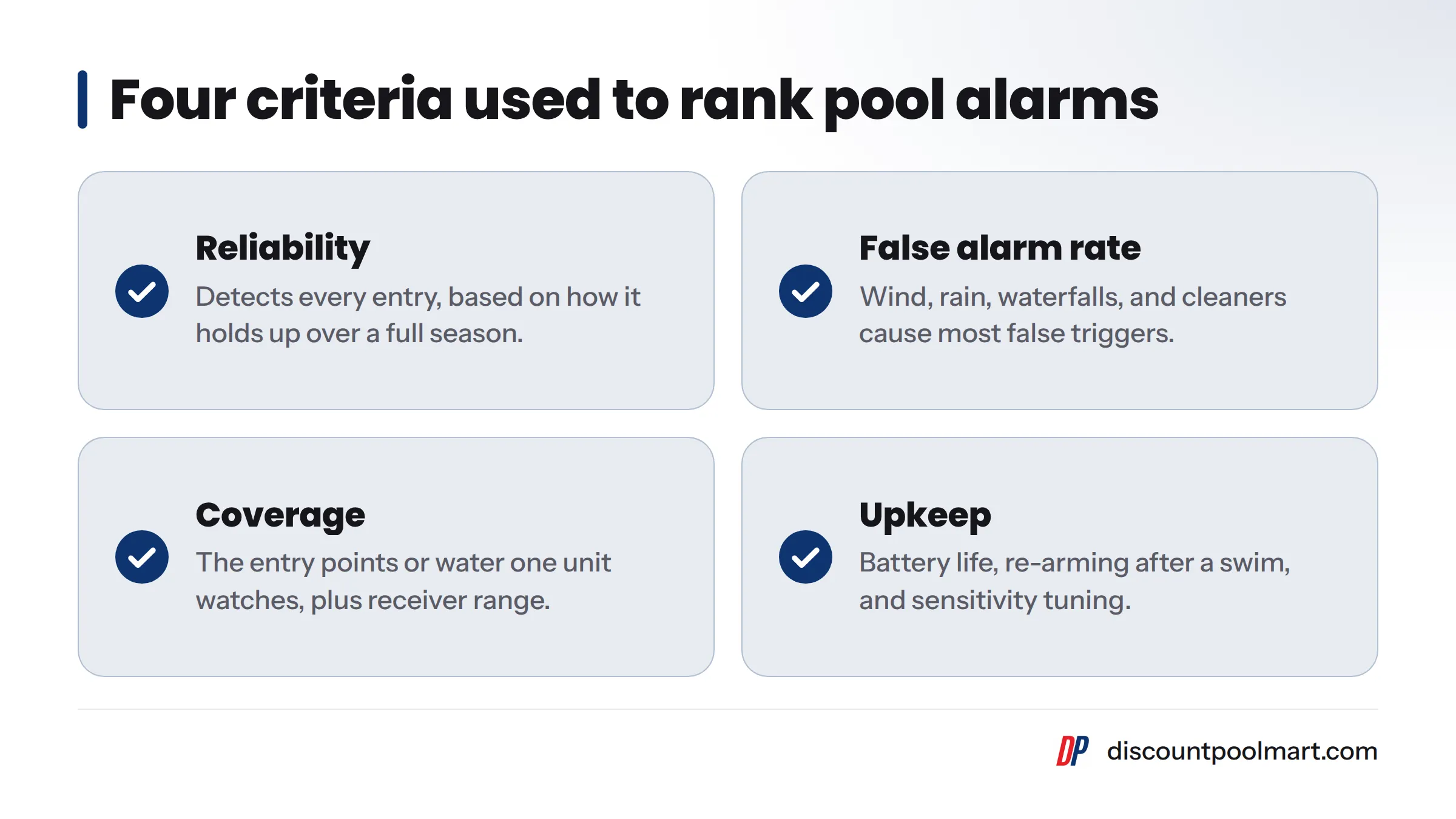
Reliability
Does it detect an entry every single time? We trusted what customers tell us after a full season more than how a unit performs on day one.
False Alarm Rate
An alarm that cries wolf gets switched off. Wind, rain, waterfalls, and automatic cleaners cause most false triggers. If you're unsure how your cleaner stirs the water, our guide to robotic, suction, and pressure cleaners explains how each type moves it.
Coverage
This means how many entry points or how much water one unit can watch, plus how far its remote receiver reaches. Range changes from model to model, so read the manufacturer's spec sheet before you buy.
Upkeep
We looked at battery life, re-arming after swim time, and sensitivity tuning. In our experience, people keep low-fuss alarms switched on, and the fussy ones end up in a drawer.
Our data: These rankings come from Discount Pool Mart in-store sales data and customer feedback collected over more than 40 years of serving Los Angeles pool owners. We report patterns, not percentages.
1. Gate and Door Alarms: Our Top Pick for First-Line Detection
A magnetic contact mounts on the frame of a door, gate, or window. Open it, break the contact, and the siren goes off. Adults press a bypass button to walk through without tripping it.
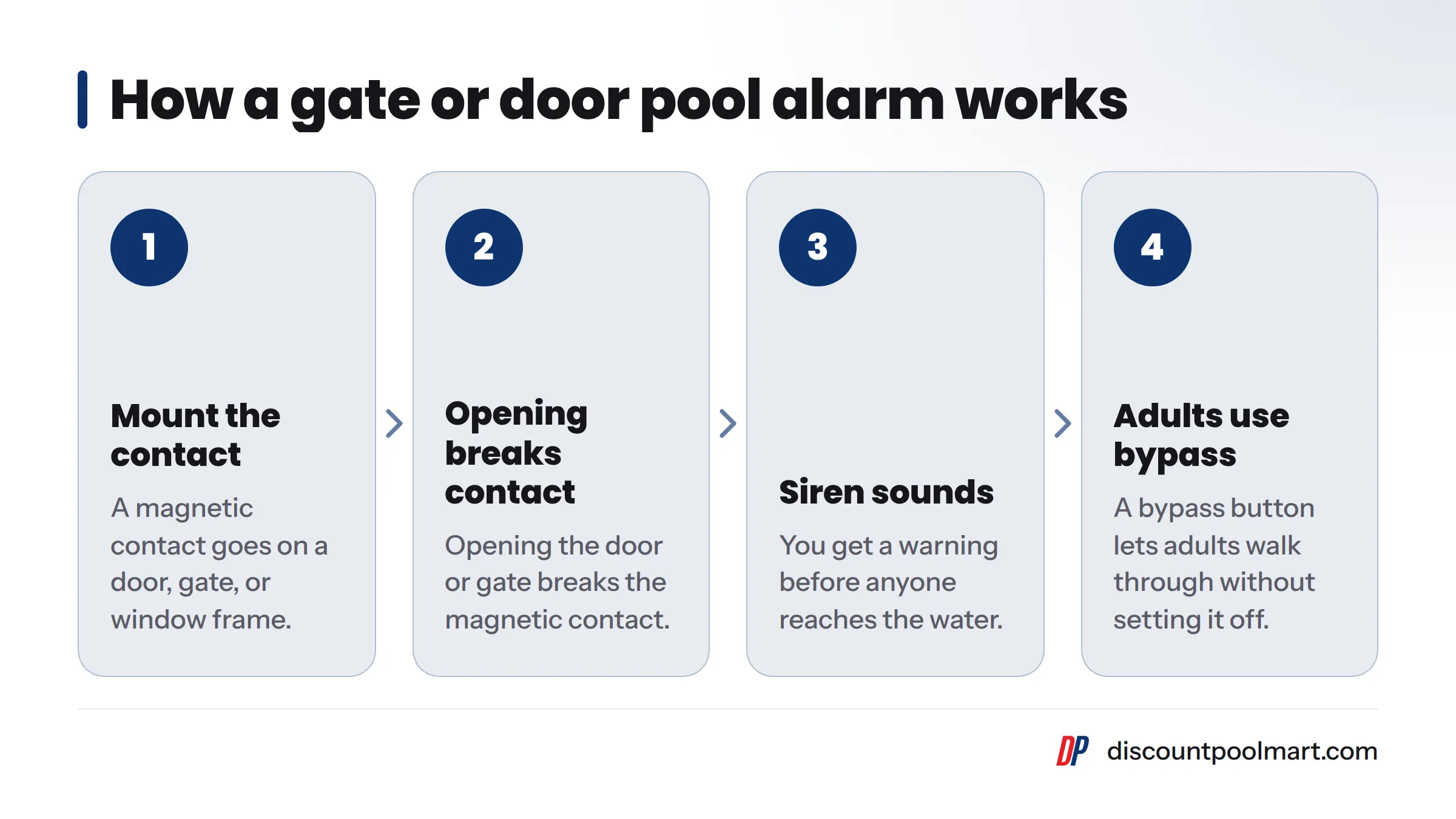
Here is why it ranks first. A pool door alarm warns you before a child gets anywhere near the water, and surface wind can't fool it. Customers rarely bring these back. The catch: it only watches the openings you fit it to. A pet door, an unlatched window, or a gap in the fence stays unwatched. Many units carry a UL 2017 listing, the UL Solutions standard for general-purpose signaling devices and systems.
Store favorite: For patio doors that open onto the pool, families most often pick the Poolguard DAPT-2 pool door alarm. Check the product page for current specs and pricing.
2. Surface Wave Pool Alarms: Best for Detecting Entry Into the Water
A floating pool alarm, or a deck-mounted version, reads the waves on the water surface. When the disturbance gets big enough, the siren sounds. Setup is easy, and you can find one almost anywhere. The downsides add up, though. Wind, rain, and pool cleaners can trigger it, you have to pull it out before closing a cover, and you have to re-arm it after every swim.
How to cut down false alarms:
- Start at medium sensitivity and lower it one step at a time.
- Shut off waterfalls, jets, and cleaners whenever the alarm is armed. A pool automation system can run that equipment during swim hours instead.
- Re-arm the alarm as soon as the last swimmer climbs out.
3. Subsurface Pool Alarms: Fewest False Alarms in Windy Yards
A subsurface pool alarm uses a sensor below the waterline to pick up the pressure wave a body makes when it enters the water. Most units mount on the deck and send the alert to a remote receiver. Surface ripples barely register, which explains why customers with trees or breezy yards tend to prefer them.
The trade-offs are a harder install and the need to confirm that the unit works with your automatic or safety cover. Our pool safety cover guide handles the cover side of that question.
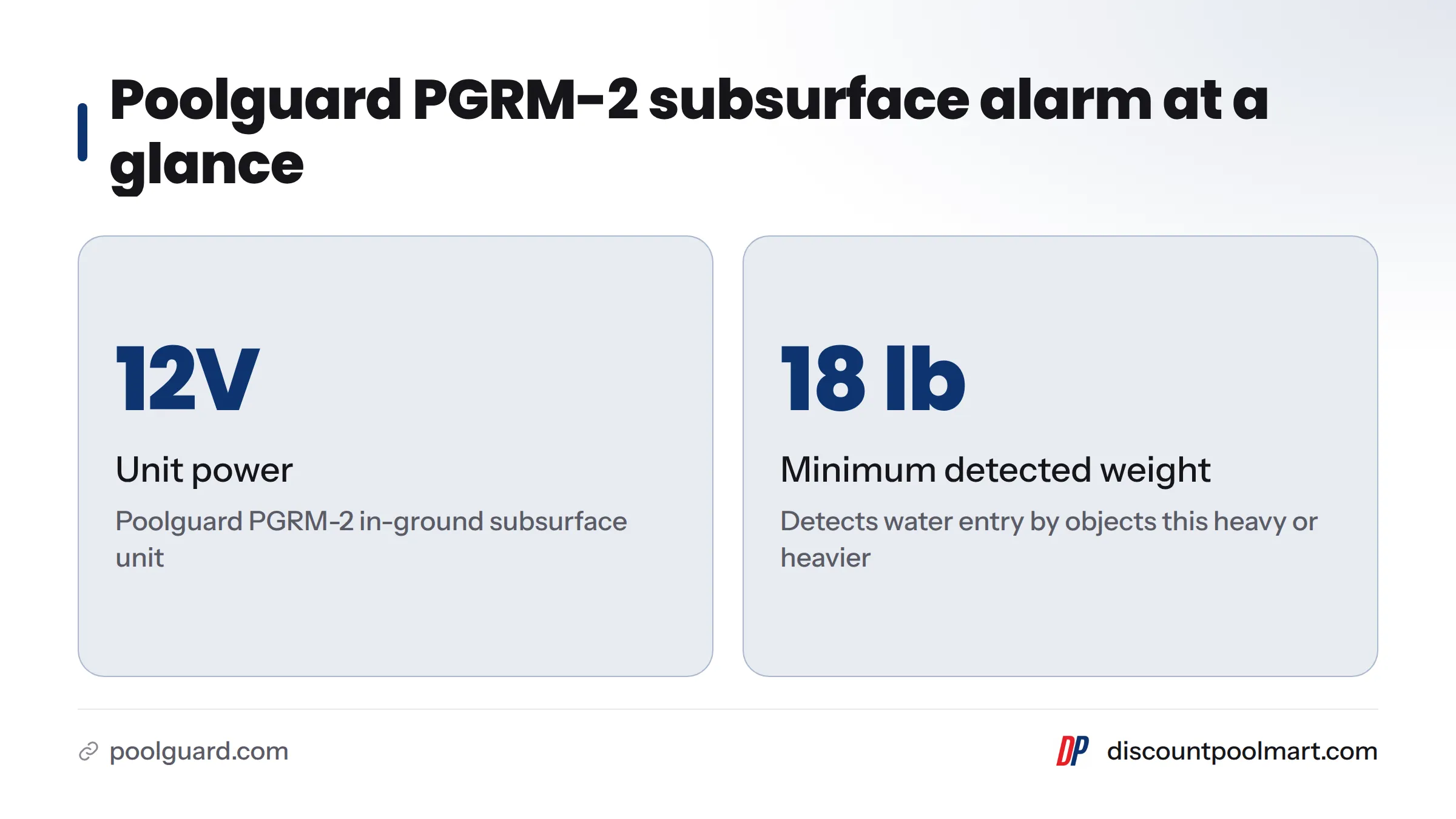
Product callout: The Poolguard PGRM-2 in-ground pool alarm is a 12V subsurface unit. Poolguard says its in-ground alarm detects water entry by objects weighing 18 lb or more. Ask in-store about professional installation.
Check the packaging for certification to ASTM F2208, the Standard Specification for Pool Alarms from ASTM International. The standard sets performance requirements for pool alarms, so that label tells you the unit passed testing against a shared benchmark.
4. Wearable Child and Pet Immersion Alarms: Best Personal Backup
A wearable pool alarm puts a transmitter in a wristband or collar. If it goes under water, a base station sounds. It follows your child or dog anywhere on the property, and weather doesn't bother it.
The weakness is obvious: it only works when worn. Toddlers pull them off, and loose collars slip. I'd treat any pool alarm for kids that sits on a wrist as backup, never the main line. Check the fit and the batteries every week.
5. Perimeter and Motion Sensor Alarms: Best for Large or Open Yards
Infrared beams or a passive infrared sensor pick up movement in the pool zone. Camera units with AI person detection belong in this group too. They cover a wide area and warn you early.
They also need careful placement, since pets, raccoons, and swaying plants can set them off. App alerts depend on your Wi-Fi staying up. Our advice is to pair one with a water alarm rather than rely on it alone.
What Our Customers Report About Reliability and Maintenance
The same handful of problems comes up again and again at our counters:
- Surface alarms going off on windy afternoons. This is the top complaint by far.
- Forgetting to re-arm after a swim.
- Finding a dead battery at the worst possible moment.
- Putting the receiver in the garage, where nobody hears it.
Gate and door alarms rarely come back for any of these reasons. Wherever your receiver goes, put it in the kitchen or living room, inside its rated range, and away from big metal appliances.
Monthly Pool Alarm Check
- Test the siren with the manufacturer's test procedure.
- Check or replace the batteries.
- Walk the house to confirm you can hear the receiver from every room you use.
- Retune sensitivity after storms or seasonal wind changes.
- Re-arm after every swim. Make this a daily habit.
How to Choose: Matching Alarm Types to Your Pool and Household
Next steps. Find your situation below.
- A toddler in the house and a sliding door to the pool? Get a door alarm, a subsurface alarm, and a wearable.
- Only pets? Get a wearable pet collar and a water alarm.
- A windy or tree-lined yard? Choose a subsurface alarm over a surface wave model.
- You use a pool cover? Confirm cover compatibility before you buy.
- A large yard with no single entry point? Get a perimeter or motion sensor plus a water alarm.
Layers of protection: Alarms work alongside barriers, covers, rescue gear, and adult supervision. The CPSC's Pool Safely campaign teaches the same layered approach. Read about the layers every pool needs, see our pool fence guide for barrier questions, and stock up on pool rescue equipment.
Ready to pick yours? Browse safety gear at Discount Pool Mart, or stop by and ask our staff about installation.
Pool Alarm FAQs
Are pool alarms worth it?
Yes, as one layer of protection. A door or gate alarm warns you before a child reaches the water, and a water alarm warns you the moment someone goes in. Neither one replaces an adult watching the pool.
What is the best pool alarm?
For most homes, start with a gate or door alarm, then add a subsurface or surface wave water alarm. Add wearables for specific children or pets.
How much does a pool alarm cost?
Pool alarm cost depends on the type. Wearables and door alarms usually cost less than subsurface systems that need installing. Check our product pages for current pricing.
What are the best pool alarms in 2026?
In 2026, our store favorites remain the Poolguard DAPT-2 door alarm and the PGRM-2 subsurface alarm, used together.
Can I use a pool alarm with a pool cover?
Door, wearable, and motion alarms work fine with a cover. Floating alarms have to come out before you cover the pool. Subsurface compatibility depends on the model.
Why does my pool alarm keep going off?
Wind, rain, cleaners, waterfalls, or sensitivity set too high cause most false alarms. Lower the sensitivity and turn off equipment while the alarm is armed.
Sources
- Drowning Data and Facts, Centers for Disease Control and Prevention
- Pool Safely, U.S. Consumer Product Safety Commission
- ASTM F2208 Standard Specification for Pool Alarms, ASTM International
- Poolguard Pool Alarms, Poolguard
Related: pool safety, pool safety equipment