
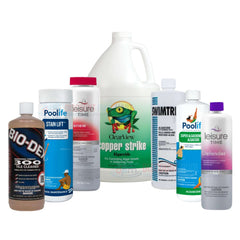
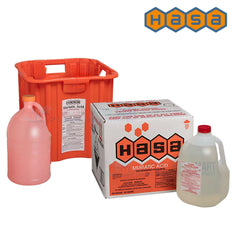
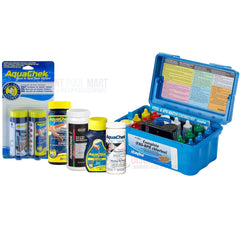
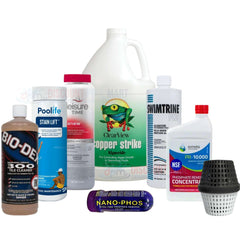

Why is my pool water cloudy? Nearly every case comes down to one of six cloudy pool water causes: low free chlorine or chloramine buildup, high pH and total alkalinity, high calcium hardness, too little filtration, fine particles from debris and swimmers, or high cyanuric acid and dissolved solids. The fix follows a set order. Test first, correct sanitizer and balance, run the filter longer, then add clarifier or floc.
That's the short version. The longer one comes from people who deal with this every week. For more than 40 years, customers have carried jars of milky pool water up to the Discount Pool Mart counters across Los Angeles, and we hear the same story over and over. A heatwave hits. The owner tops off the pool with the garden hose every few days. Then one morning the water looks like skim milk. Most of them picked up a clarifier on the way in, and most of the time clarifier wasn't the answer.
That's why we handle every cloudy pool the same way. We test, then match the numbers to a cause. Let's break it down.
Quick Answer: What Makes Pool Water Cloudy and How to Clear It Fast
| Cause | How to tell | Fix |
|---|---|---|
| Low free chlorine or chloramines | Free chlorine low, or total chlorine well above free | Shock per label |
| High pH and alkalinity | pH above 7.8, alkalinity above about 120 ppm | Lower with acid in measured doses |
| High calcium hardness | White haze, scale at the waterline | Balance pH, use scale control, dilute |
| Not enough filtration | Chemistry fine, water still dull | Run the pump longer, clean or backwash |
| Fine particles and swimmer load | Haze after parties, rain, dust or ash | Clarifier or flocculant |
| High CYA or TDS | Chemistry "right" but chlorine stops working | Partial drain and refill |
The target ranges below reflect commonly published residential guidance from the Pool & Hot Tub Alliance, the group that publishes the ANSI/APSP/ICC-11 water quality standard. Check the current standard and your product labels against your own pool:
| Parameter | Typical residential target |
|---|---|
| Free chlorine | 1 to 4 ppm |
| pH | 7.2 to 7.8 |
| Total alkalinity | 80 to 120 ppm |
| Calcium hardness | 200 to 400 ppm |
| Cyanuric acid | 30 to 50 ppm |
Seeing green, not milky white? That's most likely algae, which is a separate problem. Our guide to treating green, yellow and black algae walks you through it.
Cause 1: Low Free Chlorine or Chloramine Buildup (Fix: Test, Then Shock)
Free Chlorine vs Combined Chlorine
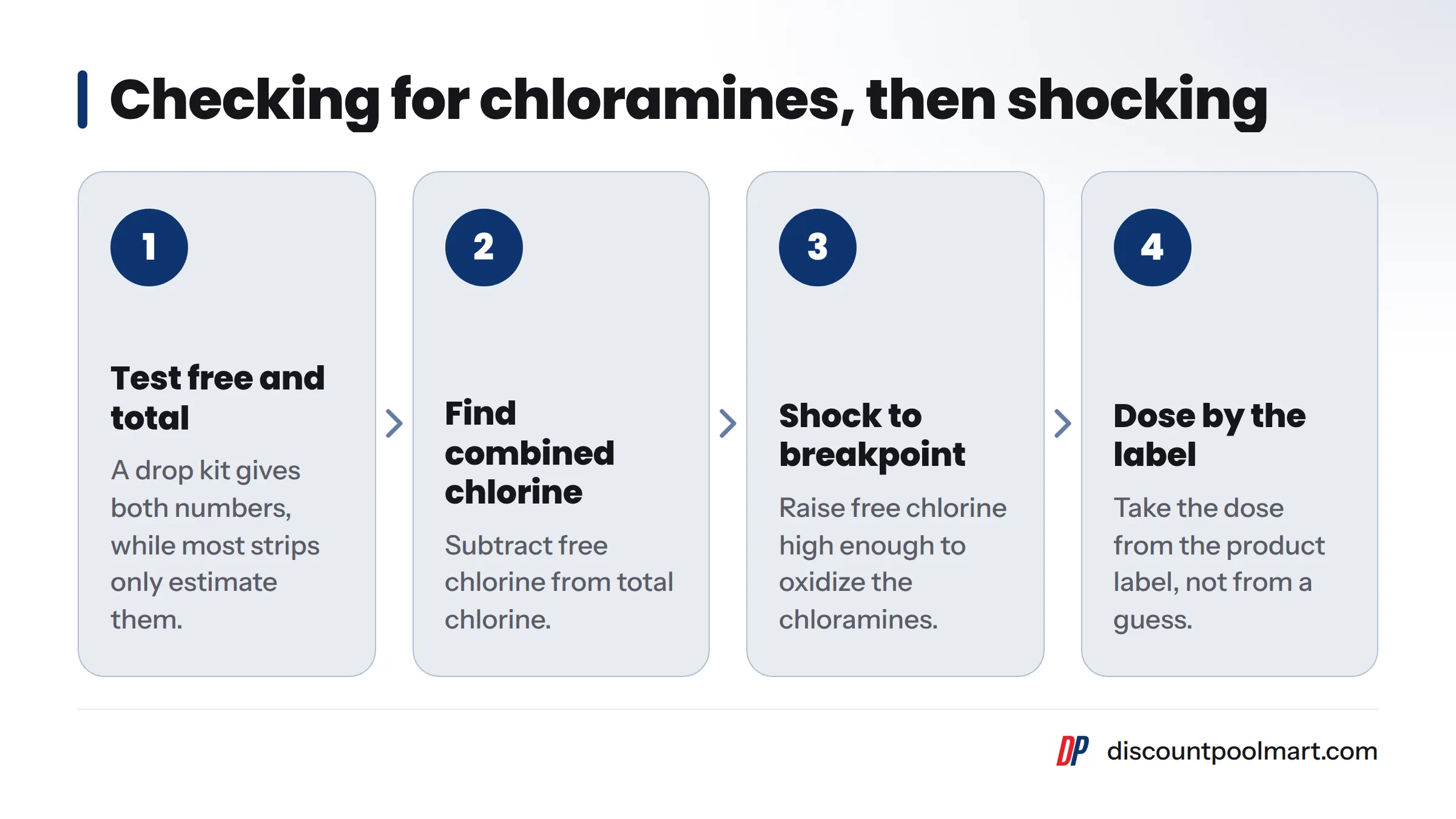
Free chlorine is the active sanitizer still available to attack contaminants. Combined chlorine has already reacted with sweat, urine and other nitrogen compounds and formed chloramines. Chloramines sanitize poorly and give off that harsh "chlorine" smell people blame on too much chlorine. They also leave organic waste hanging in the water as a dull haze.
How to Tell
Test both free and total chlorine. Subtract free from total and you have combined chlorine. A Taylor-style drop kit gives you both numbers, while most strips only estimate them. This is the classic "my chlorine reads fine" trap. Total chlorine looks healthy, but most of it is already spent.
The Fix: Shock to Break Down Chloramines
Raise free chlorine high enough to oxidize the chloramines. Pool pros call this breakpoint chlorination. Our step-by-step on how to shock a pool covers timing and technique. Take the dose from the product label, not from a guess.
Does Too Much Chlorine Make a Pool Cloudy?
Chlorine on its own rarely clouds water, but the product that carries it can. Calcium hypochlorite (cal-hypo) shock adds calcium and raises pH. That's why a short haze after shocking is common, especially in hard-water pools that already run high on pH. Sodium hypochlorite, sold as liquid chlorine, adds no calcium. In our view it's the better pick for most LA pools, and we often steer customers toward it.
Cause 2: High pH and Total Alkalinity (Fix: Lower With Acid in Measured Doses)
pH tells you how acidic or basic the water is. Total alkalinity is the water's buffer, the thing that holds pH in place. When both run high, calcium carbonate falls out of solution and floats around as fine white specks. Chlorine also loses strength as pH climbs.
A quick myth check: high pH doesn't "grow bacteria" by itself. It weakens your chlorine and pushes calcium out of the water. The cloud comes from that.
| Feature | Muriatic acid | Sodium bisulfate (dry acid) |
|---|---|---|
| Form | Liquid | Granular |
| Handling | Strong fumes; wear goggles and gloves | Fewer fumes; still an acid |
| Effect | Lowers pH and alkalinity | Lowers pH and alkalinity |
| Read first | Label and Safety Data Sheet | Label and Safety Data Sheet |
Lowering pH in measured doses:
- Test pH and alkalinity.
- Add a partial dose per the label, with the pump running.
- Let it circulate for as long as the label says.
- Retest, and repeat if needed.
- Never mix acid with chlorine or any other chemical.
Want the full sequence? Here's how to balance your pool water in the right order.
Cause 3: High Calcium Hardness and Scaling From SoCal Hard Water (Fix: Balance and Dilute)
What Calcium Hardness and Calcium Scaling Are
Calcium hardness measures how much calcium is dissolved in the water. Scaling happens when that calcium leaves solution. You see it as crusty white lines on the tile, or as milky pool water before the particles settle. A calcium scaling cloudy pool rarely has just one bad day. It builds up over weeks.
Why Southern California Hard Water Makes It Worse
The Metropolitan Water District of Southern California imports water from the Colorado River and the State Water Project, and Colorado River supplies tend to run hard. Your utility, such as LADWP, publishes an annual water quality report with hardness figures for your area. Look yours up.
Then add evaporation to the picture. The water leaves, but the calcium stays, and every top-off brings in more. From our side of the counter, this is the pattern national guides tend to miss: an LA pool gets cloudier every summer without anything actually "going wrong."
The Fix
- Keep pH and alkalinity in range so the calcium stays dissolved.
- Add a scale and metal control product like Orenda SC-1000, dosed per label.
- If hardness climbs too high, partially drain and refill.
One more correction while we're here. Flocculant does not lower hardness. Only dilution does.
Cause 4: Not Enough Filtration Run Time or Dirty Filter Media (Fix: Run Longer and Clean)
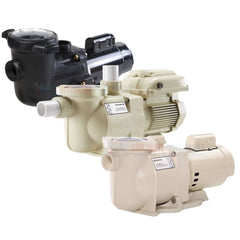
Turnover means pushing the pool's full volume through the filter. Short pump schedules leave fine particles behind, and we see them a lot after owners switch to a variable-speed pump to save energy. Revisit your pool pump run times and run the pump around the clock until the water clears.
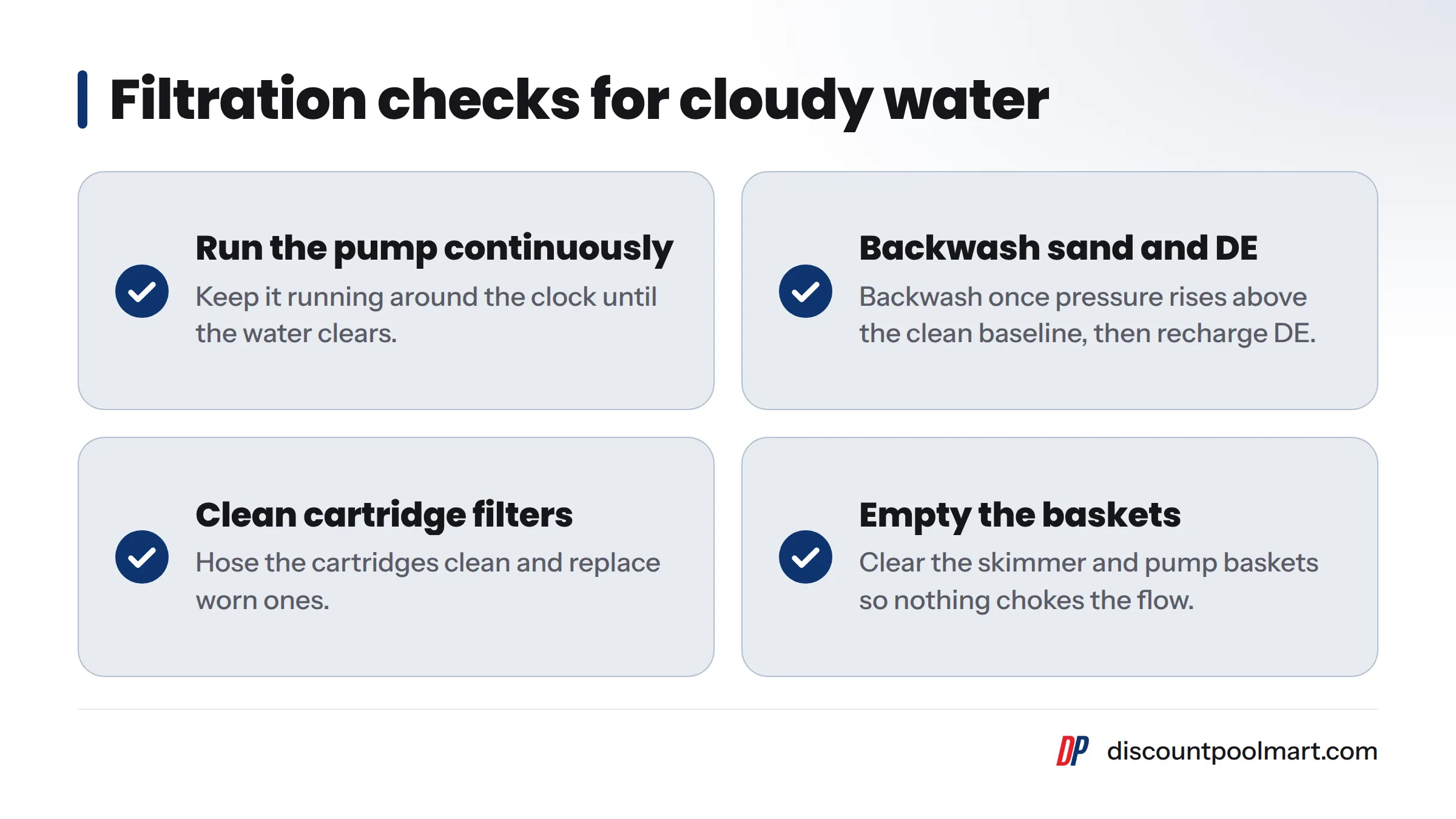
Next, check the filter itself:
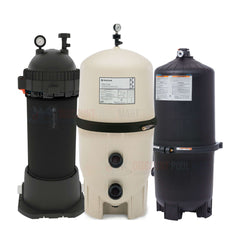
- Sand and DE filters: backwash once pressure rises above the clean baseline your manufacturer lists. Recharge DE afterward.
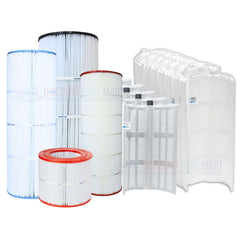
- Cartridge filters: pull the cartridges and hose them clean. Replace worn ones.
- Baskets: empty the skimmer and pump baskets so nothing chokes the flow.
Equipment acting up? Leaks, noisy motors and broken valves need a pro. See our page on pool pump repair in Los Angeles.
We like how this Swim University video covers the "still cloudy" filtration checks.
Cause 5: Fine Particles, Debris, and Swimmer Load (Fix: Clarifier or Flocculant)
Body oils, sunscreen, dust, pollen, runoff from heavy rain and wildfire ash all leave behind particles too small for a filter to catch. After fire season, follow our steps for pool care after wildfire ash.
You have two ways to deal with them. A pool clarifier clumps tiny particles into bigger ones your filter can trap. A pool flocculant binds them into heavy clumps that sink to the floor so you can vacuum them out.
| Feature | Pool clarifier | Pool flocculant |
|---|---|---|
| How it works | Gathers particles for the filter | Drops particles to the floor |
| Speed | Gradual | Faster settling |
| Effort | Low; let the filter work | High; vacuum to waste |
| Best for | Mild to moderate haze | Very cloudy water |
| Filter notes | Works with all filter types | Needs a waste or drain setting; cartridge-only systems struggle |
For everyday haze, we reach for a pool clarifier like Poolife TurboBlu. If you go with floc, set aside time to vacuum the pool to waste. And when sunscreen and oils are the culprit, an enzyme water cleaner like Orenda CV-600 breaks down the organic film.
Cause 6: High Cyanuric Acid or Total Dissolved Solids (Fix: Partial Drain and Refill)
Cyanuric acid (CYA) is a stabilizer that shields chlorine from sunlight. It builds up from trichlor tablets and dichlor shock because neither one breaks down in the water. With too much CYA, chlorine works slowly and contaminants hang around. Learn more about what cyanuric acid does in your pool.
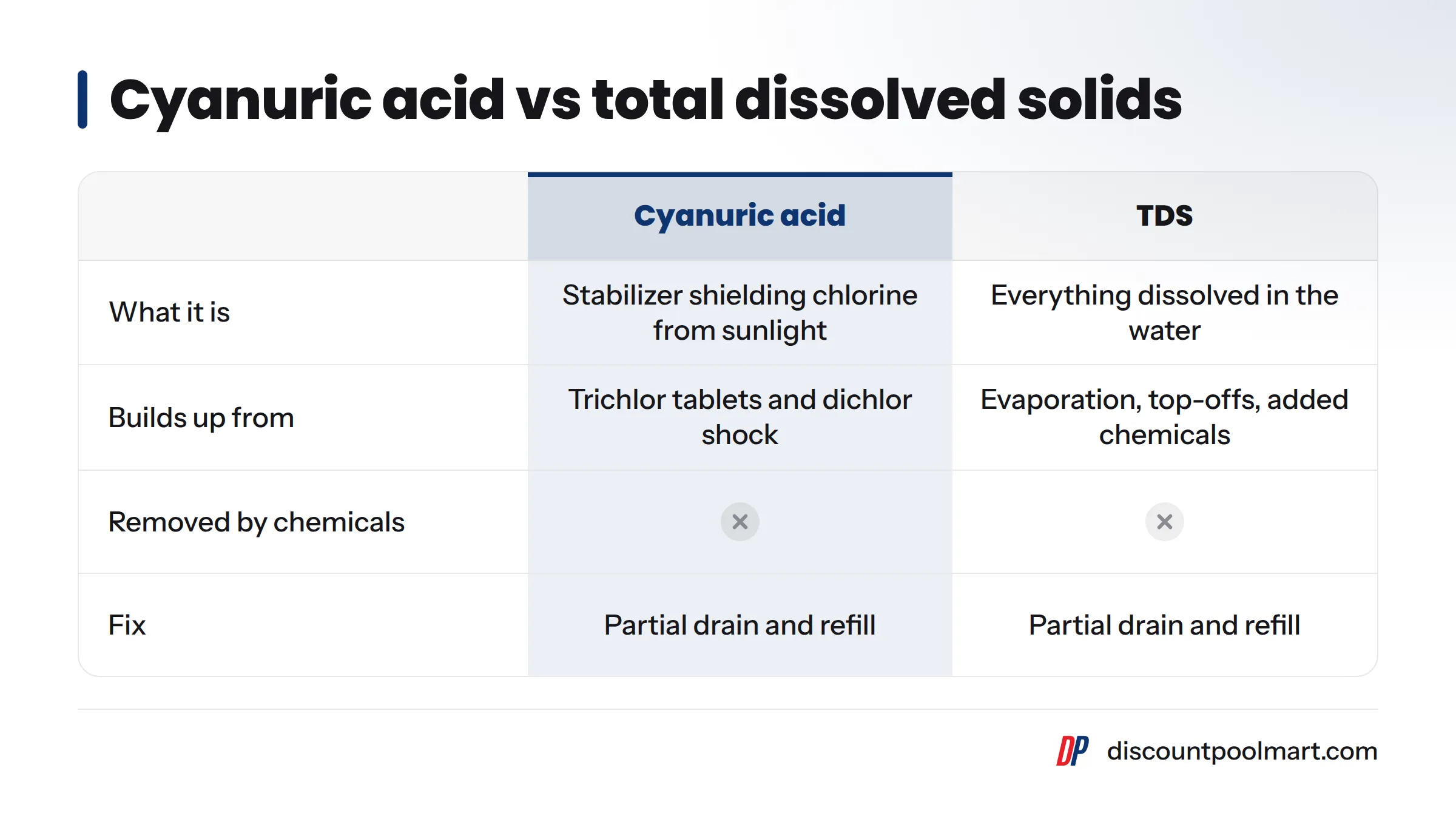
Total dissolved solids (TDS) covers everything dissolved in the water: salts, calcium and chemical leftovers. TDS rises with evaporation, with top-offs and with every chemical you add.
No chemical removes either one. Dilution is the only fix, so drain part of the pool and refill it. Keep the hard-water catch in mind, though. LA fill water brings its own calcium, so test the refill too.
How to Clear Cloudy Pool Water Fast: The Order to Work In
We can't promise a timeframe, because every pool clears at its own pace. What we can say is that cloudy pool water treatment wastes far fewer chemicals when you follow this order:
- Test. Use a drop kit like the Taylor complete test kit from Taylor Technologies, or strips for a quick check. Our pool water testing guide compares the methods.
- Shock if free chlorine is low or combined chlorine is high.
- Lower pH and alkalinity into range in measured doses.
- Check calcium, CYA and TDS. Dilute if they're high.
- Run the filter continuously and clean or backwash it.
- Add clarifier, or use floc and vacuum to waste.
- Retest and adjust.
Follow every product label. Never mix chemicals. Add each one separately with the pump running.
Intex and above-ground pools: people search "cloudy pool water Intex" all summer, and the answer usually starts with the filter. Small cartridge filters clog fast, so rinse the cartridge daily while you clear the water. Low water volume means small doses, so measure carefully. Skip floc unless you can vacuum to waste.
How to Keep Your Pool Water Clear Week to Week
Your weekly checklist:
- Test chlorine, pH and alkalinity.
- Keep sanitizer and balance in range.
- Stick to a steady pump schedule.
- Empty the skimmer baskets, and clean or backwash the filter as pressure rises.
- Check calcium and CYA monthly in hard-water areas.
Weather throws curveballs. Read up on pool care after heavy rain and pool care during a heatwave, and stock up on pool water chemistry supplies before the next one.
Still stuck? Bring a sample in. Find a Discount Pool Mart store near you and we'll go through it with you.
Cloudy Pool Questions We Hear at the Counter
How can I fix cloudy pool water? Test first. Then correct chlorine, pH and alkalinity, run the filter longer, and finish with clarifier or floc. That's how to fix cloudy pool water without guessing.
How do I clear a cloudy pool fast? Work in order: test, shock, balance, filter continuously, clarify, retest. Skipping steps usually slows things down.
Does too much chlorine make a pool cloudy? Rarely on its own. Cal-hypo shock can cause haze because it adds calcium and raises pH.
Why do I have cloudy pool water after shocking? The filter needs time to remove what the shock oxidized. Check pH and calcium, and keep the pump running.
Should I use a pool clarifier or a pool flocculant? Use clarifier for mild haze and any filter type. Use floc for heavy cloudiness when you can vacuum to waste.
Why is my pool cloudy when the chlorine level is fine? Check combined chlorine first, then pH and calcium, then filter run time, then CYA and TDS.
Can hard tap water make my pool cloudy? Yes. Hard fill water and repeated top-offs raise calcium, which clouds the water once pH climbs.
How do I fix cloudy water in an Intex or above-ground pool? Clean the cartridge often, run the pump longer, dose small and exact, and choose clarifier over floc.