

My first hot tub taught me chemistry the hard way. Three weeks after the delivery truck pulled away, the water had gone dull and gray, the jets were whipping up foam like the head on a pint of stout, and my wife came in from a soak with an itchy red rash across her back. I'd been eyeballing everything, a capful here and a scoop there. Once I saw what I was doing wrong, the fix was simple: test first, adjust in the right order, and respect how fast a small, hot body of water changes.
This guide walks through that system so you can skip my three bad weeks. It includes a spa water chemistry chart, the correct balancing order, chlorine vs bromine sanitizer levels, dosing math, a weekly hot tub maintenance cheat sheet, and fixes for cloudy, foamy, or smelly water. Everything is current for 2026. It draws on public health standards and on years of answering questions at the Discount Pool Mart counter.
Spa Water Chemistry Chart: Ideal Hot Tub Levels at a Glance
Spa water balance means four readings sit inside their target ranges at the same time: sanitizer, pH, total alkalinity, and calcium hardness. For most residential hot tubs, that works out to free chlorine at 3 to 5 ppm (or bromine at 4 to 6 ppm), pH at 7.4 to 7.6, total alkalinity at 80 to 120 ppm, and calcium hardness at 150 to 250 ppm.
| Parameter | Ideal Range | Why It Matters |
|---|---|---|
| Free chlorine | 3 to 5 ppm | Kills bacteria fast in warm water |
| Bromine | 4 to 6 ppm | Stays stable at high temperatures |
| pH | 7.4 to 7.6 (acceptable 7.2 to 7.8) | Controls comfort and sanitizer strength |
| Total alkalinity | 80 to 120 ppm | Buffers pH so it stops bouncing |
| Calcium hardness | 150 to 250 ppm | Prevents scale and protects surfaces |
| Cyanuric acid (chlorine spas) | Under 30 to 40 ppm | Too much slows chlorine down |
| Total dissolved solids | Under 1,500 ppm above fill water | High TDS keeps chemicals from working properly |
| Water temperature | 104°F maximum | Safety limit for soaking |
Keep this hot tub chemistry chart somewhere you'll actually see it. The numbers line up with public health guidance: the CDC's Model Aquatic Health Code sets minimums of 3.0 ppm free chlorine or 4.0 ppm bromine for spas, with pH between 7.0 and 7.8. That code applies to public facilities, not backyard tubs. I still treat its minimums as the floor, never the goal.
Pool owners can check these figures against our pool water chemistry guide. The parameters match. The targets and the speed of change don't.
Swim University's short primer goes through the same levels on camera:
Why Hot Tub Water Chemistry Swings Faster Than a Pool
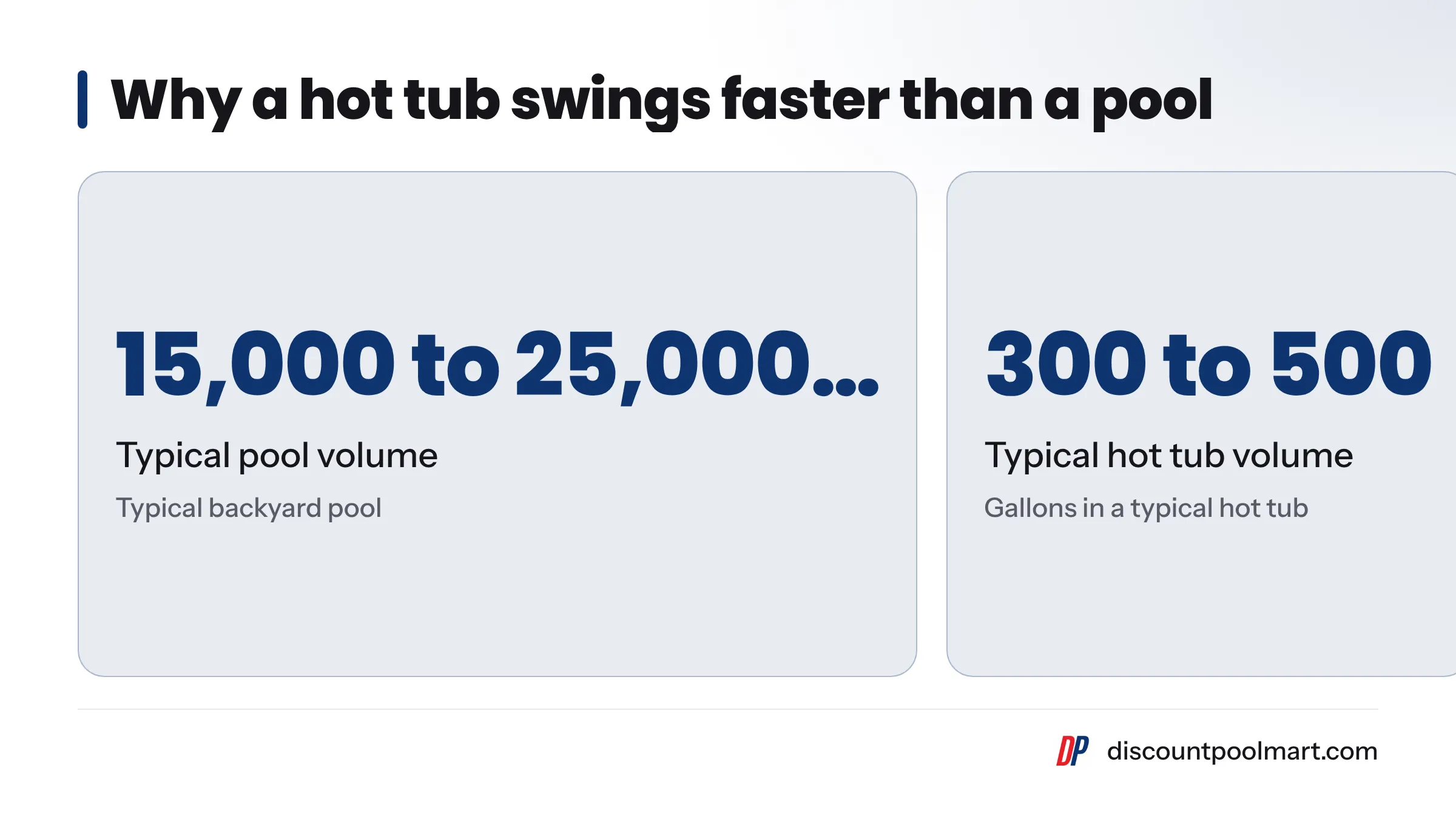
Here is why a spa feels so touchy. A typical backyard pool holds 15,000 to 25,000 gallons, and a typical hot tub holds 300 to 500. Put two adults in a 400-gallon spa and the bather load per gallon is dozens of times higher than it would be with the same two people in a pool.
Four forces work against you at once:
- Heat. Water at 100 to 104°F speeds up bacterial growth and burns through sanitizer faster.
- Aeration. Jets and air blowers push carbon dioxide out of the water, so pH climbs almost every time someone soaks.
- Body waste. Sweat, skin oils, lotions, and deodorant pile up quickly in such a small volume.
- Evaporation. Water leaves, minerals stay, and dissolved solids rise week after week.
Combine all four and a tub that tested perfectly on Sunday can drift out of range by Thursday. After years of soaking, I don't think the people who struggle with spa water balance are doing anything wrong. They just aren't testing often enough for a body of water this small.
Warm, poorly sanitized water is also where Pseudomonas aeruginosa grows best, and that bacterium causes "hot tub rash." The rash on my wife's back was a textbook case of low sanitizer. Keeping chlorine or bromine in range is your best defense.
How to Balance Hot Tub Water: The Correct Order
Getting the order right matters more than anything else in this guide. Each adjustment changes the next one, so working out of sequence burns through chemicals and money. Let's break it down.
- Test the water with fresh strips or a drop kit.
- Adjust total alkalinity first, because it anchors pH.
- Adjust pH once alkalinity is in range.
- Adjust calcium hardness to protect the shell and heater.
- Bring sanitizer up to its target level.
- Shock or oxidize to burn off contaminants.
- Retest after 2 to 4 hours of circulation and fine-tune.
While you work, keep the pumps running and the cover off. Add one product at a time and wait at least 20 to 30 minutes before the next one.
Step 1: Test Your Spa Water Accurately
Test strips give a reading in 15 seconds and handle daily checks just fine. For weekly balancing, a liquid drop kit is more accurate (DPD for chlorine, FAS-DPD for precise readings). Humidity ruins strips quickly, so keep them somewhere cool and dry and throw them out once they expire.
Our step-by-step water testing guide explains how to read strips and drop kits without guessing. The technique is the same for a spa.
Step 2: Set Total Alkalinity First
Total alkalinity (TA) measures the carbonates and bicarbonates that resist pH change. Think of it as a shock absorber. Below 80 ppm, pH jumps around with every soak. Above 120 ppm, pH drifts high and won't come back down.
- To raise TA: add sodium bicarbonate. Oreq Clear Spa Alkalinity Increaser is pure bicarb packaged for spa-sized doses. It lifts TA and nudges pH only slightly.
- To lower TA: add dry acid (sodium bisulfate) in small doses with the jets running, then aerate.
Step 3: Bring pH Into the 7.4 to 7.6 Window
The pH scale runs from 0 to 14, with 7 as neutral. Spa water does best slightly alkaline, at 7.4 to 7.6. That's close to the pH of human tears, which is why balanced water doesn't sting your eyes.
High pH costs chlorine much of its killing power and leaves scale on jets and heater elements. Low pH makes the water corrosive, and it starts eating at metal parts and seals.
- To raise pH: Leisure Time Spa Up pH Increaser uses sodium carbonate and moves pH quickly.
- To lower pH: Leisure Time Spa Down uses sodium bisulfate and pulls alkalinity down a little too.
Hot tub pH and alkalinity move together, and that's the reason TA comes first. Once TA holds steady, pH usually needs only small touch-ups.
This four-minute Swim University clip covers exactly this step:
Step 4: Check Spa Calcium Hardness
Calcium hardness measures how much calcium is dissolved in the water. Acrylic spas do well at 150 to 250 ppm. Soft water (under 100 ppm) foams easily and can attack metal. Hard water leaves white crust on the jets, the waterline, and the heater element.
To raise calcium, use a calcium chloride product made for spas. Lowering it means a partial drain and a refill with softer water, which the hard water section below explains.
Hot Tub Sanitizer Levels: Chlorine vs Bromine
Both sanitizers work. Which one suits you depends on how you use the tub.
| Factor | Chlorine | Bromine |
|---|---|---|
| Target level | 3 to 5 ppm free chlorine | 4 to 6 ppm |
| Speed | Kills faster | Slightly slower, steady |
| Heat stability | Breaks down faster above 100°F | Holds up well in hot water |
| pH sensitivity | Loses strength above pH 7.8 | Stays effective across wider pH range |
| Odor | Stronger smell when combined chlorine builds | Milder smell |
| Typical form | Granules (dichlor) | Tablets in floater or granules |
| Best for | Owners who test often and soak in short sessions | Frequent soakers and "set it and forget it" owners |
My take: if you're in the tub every night and hate the pool smell, go with bromine. If you soak a few times a week and want quick, predictable results, chlorine is easier to dial in.
For chlorine spas, Leisure Time Spa 56 Chlorinating Granules dissolve fast and are pH-neutral, so they're the easiest daily sanitizer we sell. Spa 56 is sodium dichlor, which means every dose adds a little cyanuric acid. Test CYA monthly and change the water once it climbs past 40 ppm.
For bromine spas, Leisure Time Brominating granules build up a bromine reserve quickly after a refill. A floater keeps the level topped up between tests.
Never mix chlorine and bromine products in the same container, and drain the tub before switching sanitizers. Any bromide left in the water will turn your chlorine into bromine anyway.
Shocking a Hot Tub: When and How
Shock (oxidizer) destroys the organic waste and chloramines that build up faster than regular sanitizer can handle. Shock once a week, plus after any heavy-use session like a party.
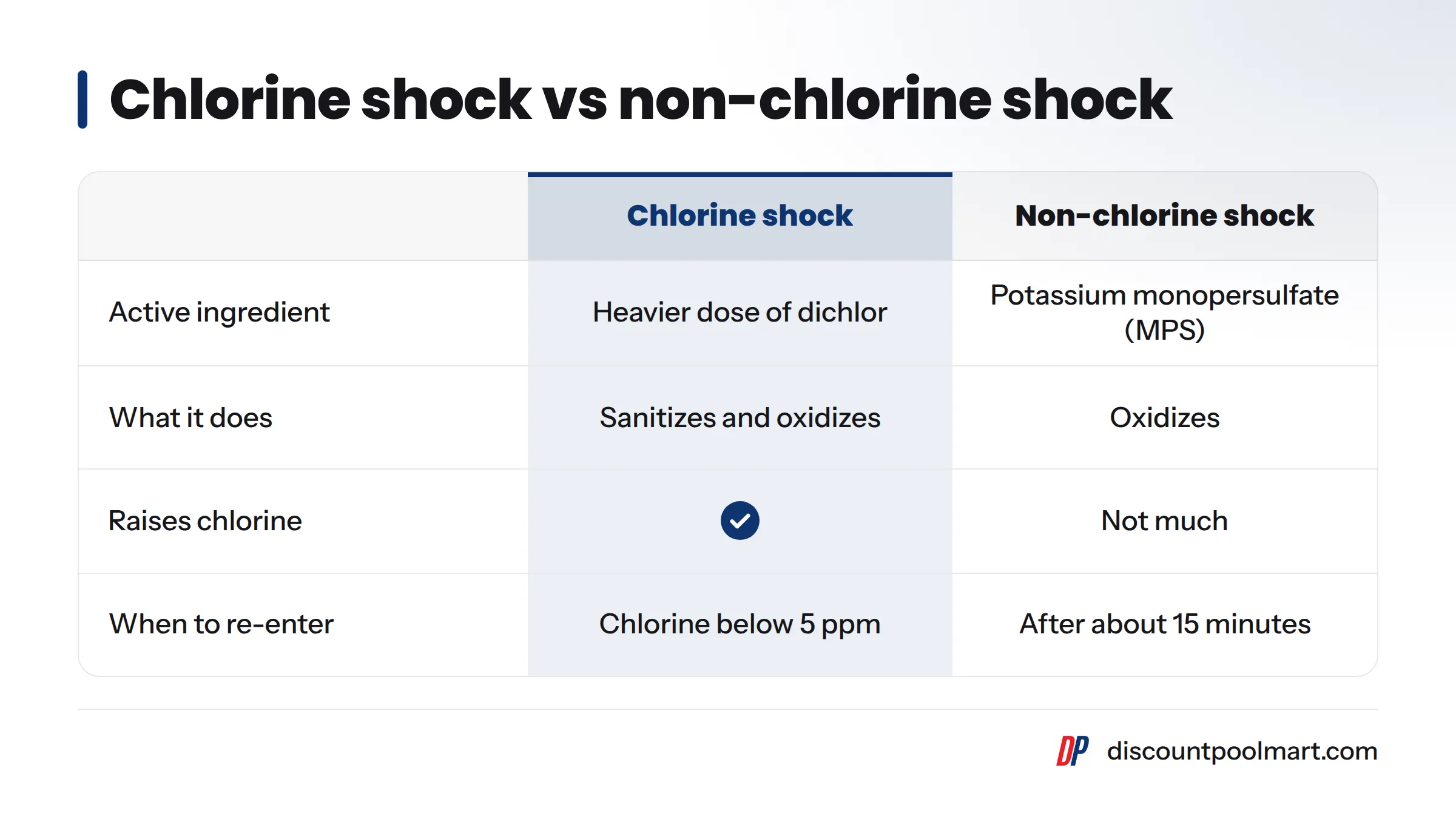
There are two options:
- Chlorine shock: a heavier dose of dichlor that sanitizes and oxidizes in one step. Stay out of the tub until chlorine falls back below 5 ppm.
- Non-chlorine shock (MPS): potassium monopersulfate oxidizes without raising chlorine much, so you can usually get back in after about 15 minutes. Leisure Time Renew Non-Chlorine Shock is my weekly go-to and works with both chlorine and bromine systems.
Shock with the cover open and the jets running for at least 20 minutes so the gases can escape. Our guide to shocking a pool covers the pool version, and the same reasoning applies to a spa.
Hard Water Hot Tub Fixes: Calcium, Scale, and Metals
Fill water from a well or a hard-water city supply can start above 300 ppm calcium before you add any chemicals. That sets you up for scale on the heater, which shortens element life and raises your power bill.
Next steps for a hard water hot tub:
- Test the fill water before you fill, not after.
- Put a pre-filter on the garden hose to catch metals and sediment.
- Blend water sources if you can. Some owners mix softened water with tap water to land near 150 to 200 ppm. Don't fill entirely with softened water, because calcium can end up too low.
- Hold pH at 7.4 to 7.6. High pH speeds up scaling, so tight pH control gives you a lot of breathing room.
- Add a scale and stain inhibitor if your water tests above 250 ppm.
To judge whether water will scale or corrode, water chemists use the Langelier Saturation Index, which weighs pH, alkalinity, calcium, temperature, and dissolved solids together. Hot water tips that balance toward scaling, so spas tolerate less calcium than pools.
The Spa Water Chemistry Formula: Volume and Dosing Math
Every chemical label lists a dose per amount of water, so you need your tub's real gallon count to get it right.
Rectangular or square spa: Length (ft) × Width (ft) × Average depth (ft) × 7.5 = gallons
Round spa: Diameter (ft) × Diameter (ft) × Average depth (ft) × 5.9 = gallons
Take a 7 × 7 ft tub filled to an average depth of 3 ft: 7 × 7 × 3 × 7.5 comes to about 1,100 gallons of raw volume. Seats, the footwell, and molded lounges take up a big share of that space, so the spec sheet for the same tub probably lists 350 to 450 gallons. Go with the manufacturer's number over the raw formula every time.
Next, scale the label dose. If a product calls for "1 tablespoon per 250 gallons" and your spa holds 400 gallons, use 1.6 tablespoons. My own rule is to add 75% of the calculated dose, circulate for 30 minutes, retest, and add the rest only if needed. Adding more is easy. Taking chemicals out means draining.
Hot Tub Maintenance Cheat Sheet
I follow this routine, and I keep a printed copy taped inside my equipment cabinet.
| Frequency | Task |
|---|---|
| Before each soak | Test sanitizer and pH with a strip; adjust if out of range |
| After each soak | Add sanitizer dose; replace cover |
| 2 to 3 times per week | Full test: sanitizer, pH, alkalinity |
| Weekly | Shock with MPS or chlorine; rinse filter cartridge with a hose |
| Monthly | Test calcium hardness and CYA; deep-clean filter with cleaner soak |
| Every 3 to 4 months | Drain, purge lines, clean shell, refill, and rebalance |
| Yearly | Replace filter cartridge; inspect cover for waterlogging |
A clogged filter makes every chemical work harder. Our filter cleaning walkthrough demonstrates the rinse-and-soak method for cartridges.
The cover affects your chemistry too. A cracked or waterlogged cover lets in debris, leaks heat, and leaves sanitizer exposed to sunlight, which burns it off. If yours is sagging, a made-to-order spa cover can pay for itself over time through lower chemical and energy use.
Troubleshooting Cloudy, Foamy, or Smelly Spa Water
Most problems come down to the same four causes: low sanitizer, high pH, a dirty filter, or old water. Check this table before you buy a specialty product.
| Problem | Likely Cause | Fix |
|---|---|---|
| Cloudy water | Low sanitizer, high pH or TA, dirty filter | Balance TA and pH, shock, clean filter, then add clarifier |
| Foam | Lotions, soaps, detergents in swimsuits, high TDS | Use defoamer short term; drain if TDS is high |
| Strong chlorine smell | Chloramines (combined chlorine) | Shock to break them down |
| Green or brown tint | Metals or algae | Test for metals; shock; add metal sequestrant |
| Itchy skin or rash | Low sanitizer, bacteria | Raise sanitizer, shock, check filter |
| Burning eyes | pH out of range | Bring pH back to 7.4 to 7.6 |
| White crust on jets | High calcium and pH | Lower pH, add scale inhibitor, partial drain |
If haze sticks around after balancing, Leisure Time Bright & Clear clumps tiny particles together so the filter can trap them. For oily scum lines, the Orenda CE-Spa enzyme clarifier breaks down body oils and lotions before they foam or coat the shell. When surface foam ruins a soak, Leisure Time Foam Down knocks it flat within minutes.
A fair warning, though: defoamer treats the symptom, not the cause. If you're reaching for it every week, the water is telling you it's time to drain.
When to Drain and Refill Your Hot Tub
Perfect chemistry can't rescue water that's loaded with dissolved solids. The industry rule of thumb:
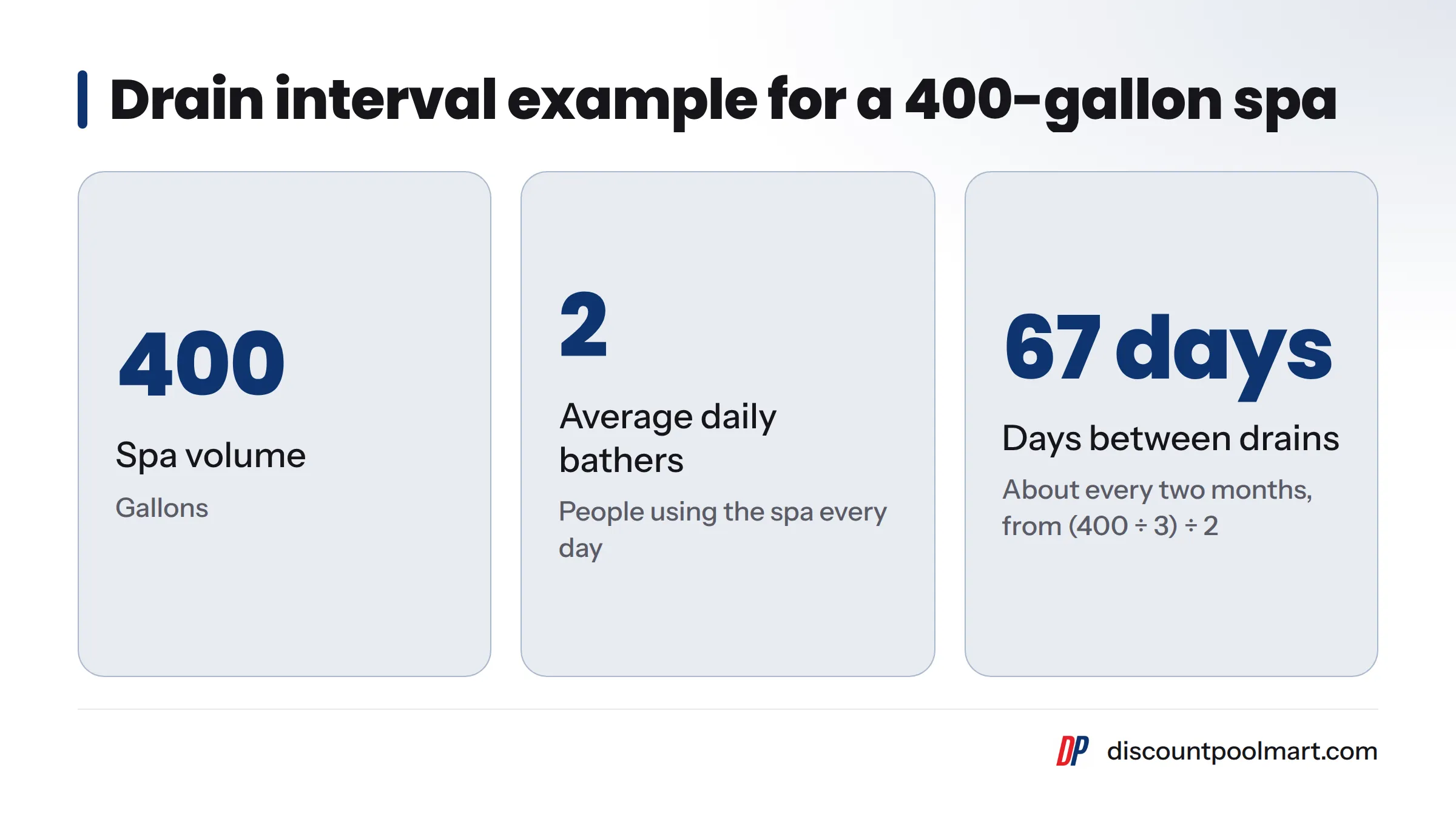
Days between drains = (Spa gallons ÷ 3) ÷ Average daily bathers
For a 400-gallon spa that two people use every day, (400 ÷ 3) ÷ 2 comes to about 67 days, or roughly every two months. With lighter use, you can stretch that to three or four months.
Before you drain, add a line flush product and run the jets for 20 to 30 minutes to clear biofilm out of the plumbing. Then drain, wipe down the shell, rinse the filter, refill through a hose pre-filter, and rebalance in order: alkalinity, pH, calcium, sanitizer, shock.
Build a Small Kit of Hot Tub Chemicals That Covers Almost Everything
You don't need 20 bottles. This short list handles nearly every situation:
- Test strips plus a drop kit
- Sanitizer (chlorine granules or bromine)
- Non-chlorine shock
- pH increaser and pH decreaser
- Alkalinity increaser
- Calcium increaser (soft-water areas only)
- Clarifier and defoamer for problem days
Discount Pool Mart carries all of these from brands like Leisure Time, Orenda, and Oreq, at prices that often beat big-box stores. We ship fast, and our staff own spas themselves. Browse the full water chemistry supplies section to put your kit together in one order. If you're near one of our Los Angeles-area stores, we also handle equipment installation and repair.
Frequently Asked Questions About Spa Water Chemistry
What should I add first when balancing a hot tub?
Start with total alkalinity. It buffers pH, so if you adjust pH first, you'll end up chasing it back and forth. Once TA sits at 80 to 120 ppm, adjust pH, then calcium, then sanitizer.
How often should I test hot tub water?
Check sanitizer and pH before each soak, run a full test two or three times a week, and test calcium and CYA monthly. With so little water, levels change fast.
Can I use pool chemicals in a hot tub?
Some of the active ingredients are the same, but pool products are dosed for thousands of gallons. Some, like trichlor pucks, also drop pH sharply in a small tub. Stick with spa-labeled chemicals so your doses come out right.
Why does my hot tub pH keep rising?
Jets and air blowers drive carbon dioxide out of the water, and pH goes up as it leaves. High alkalinity makes the problem worse. Bring TA down toward 80 to 100 ppm and pH usually settles.
Is it safe to get in right after adding chemicals?
Most balancers need at least 20 to 30 minutes. After chlorine shock, wait until free chlorine drops below 5 ppm. Non-chlorine shock usually needs about 15 minutes, but follow the label.
What causes hot tub folliculitis?
Bacteria such as Pseudomonas aeruginosa multiply in warm water when sanitizer runs low. To prevent it, hold chlorine at 3 to 5 ppm or bromine at 4 to 6 ppm, shock weekly, and keep the filter clean.
My wife hasn't had a rash since that first month. Our water stays clear and soft, and upkeep takes me about five minutes a week. Test first, follow the order, and the tub will be ready whenever you are.